Reliable Safety Marking for Industrial Zones: No Paint, No Rollers, No Hassle — Adopting Modern Technologies
In this article, I would like to address a relevant topic concerning the organization of HSE processes in production, specifically the implementation of measures for visualizing pedestrian routes and hazardous areas where lifting mechanisms operate.
Visualization is one of the most effective means for orienting employees in a production environment and helps eliminate risks such as workers entering danger zones, ensuring they move only along verified and established routes.
In modern production, hazardous areas are visualized using signs indicating dangerous production factors, mandatory signs, prohibitive signs, and directional indicators. Floor and machinery painting, along with other marking methods introduced at the dawn of the industrial age and passed down through generations of evolving manufacturing, are also used.
The primary principle of using all the aforementioned visualization tools involves physically placing signs (moving them as needed) and applying paint with brushes and rollers to surfaces where we want to highlight something requiring special attention from employees.
After studying the main challenges of maintaining painted markings, we identified several drawbacks, specifically:
- paint wears off and loses its signaling properties;
- regular marking updates require time and labor;
- there is a constant need to replenish paint stocks, which incurs additional costs;
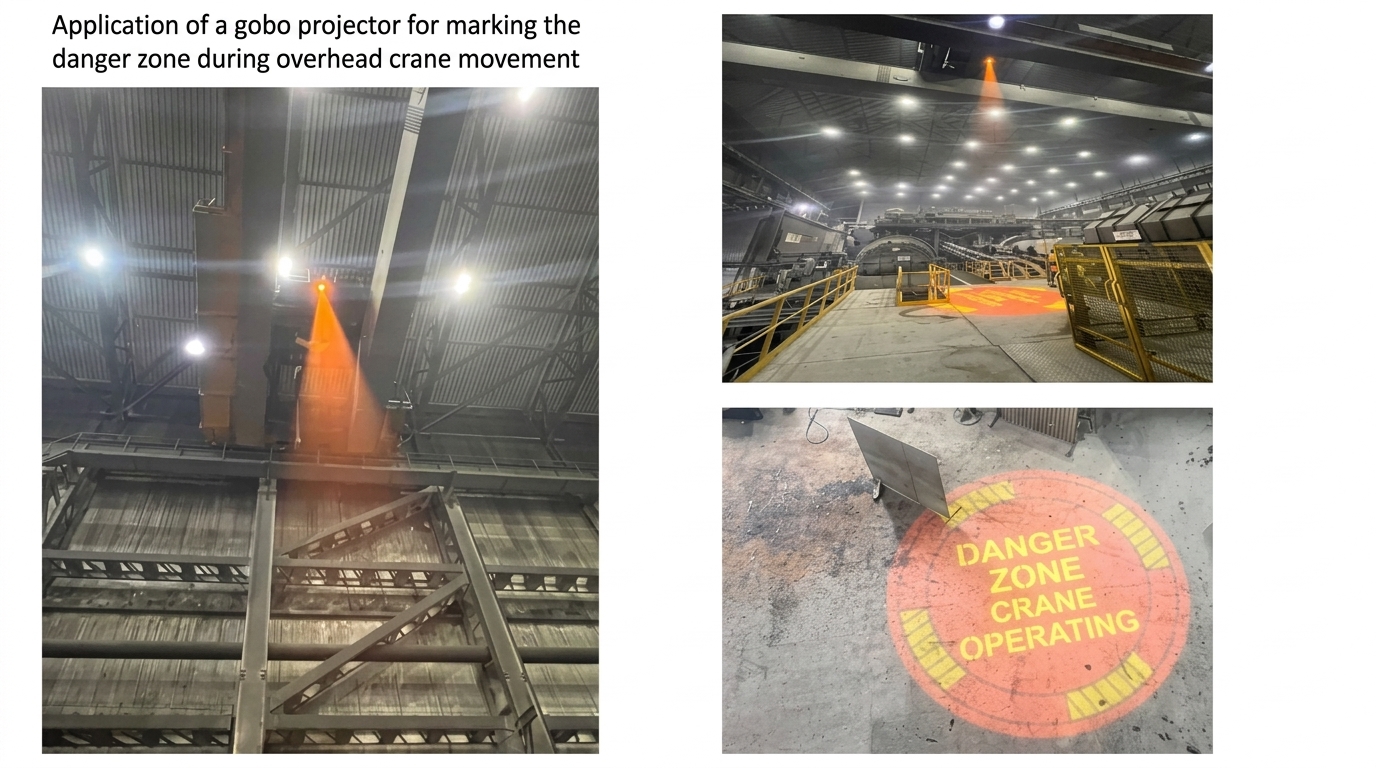
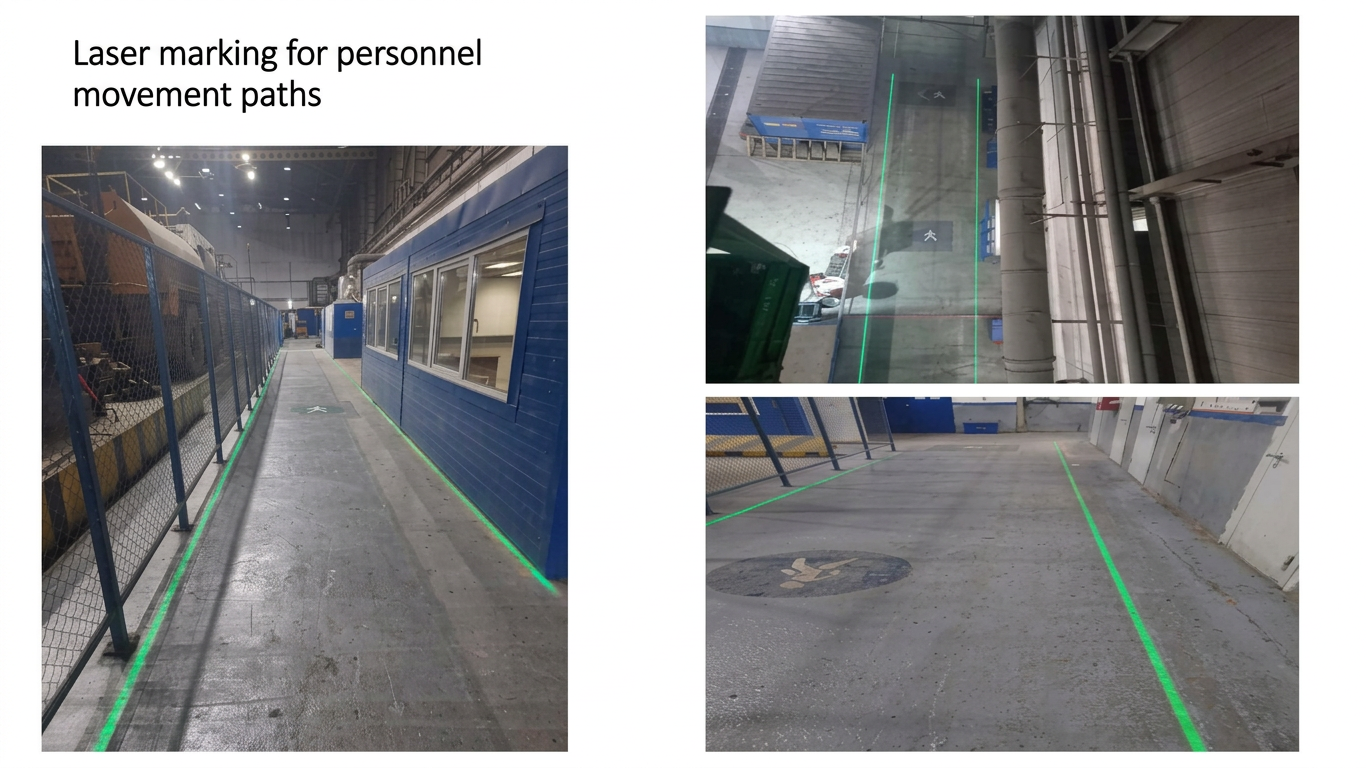
The solution to this problem was the use of markings in the form of light beams and projected images on surfaces using gobo projectors and laser emitters.
Having developed the necessary concept, we reached out to lighting equipment manufacturers and advertising agencies — thus adopting modern approaches by adapting lighting equipment for safety marking.
This approach eliminated all the aforementioned disadvantages associated with painted markings and allowed us to further provide the necessary collective protection measures for personnel.
Structurally, we implemented:
- Light projection of the danger zone during overhead crane operation.
- Laser light marking for pedestrian routes in workshops.
The approach itself offers limitless development opportunities, driven by the need to mark:
- danger zones in red;
- marking barriers with LED strips, and more;
The results of the pilot project implementation are shown in the photos.