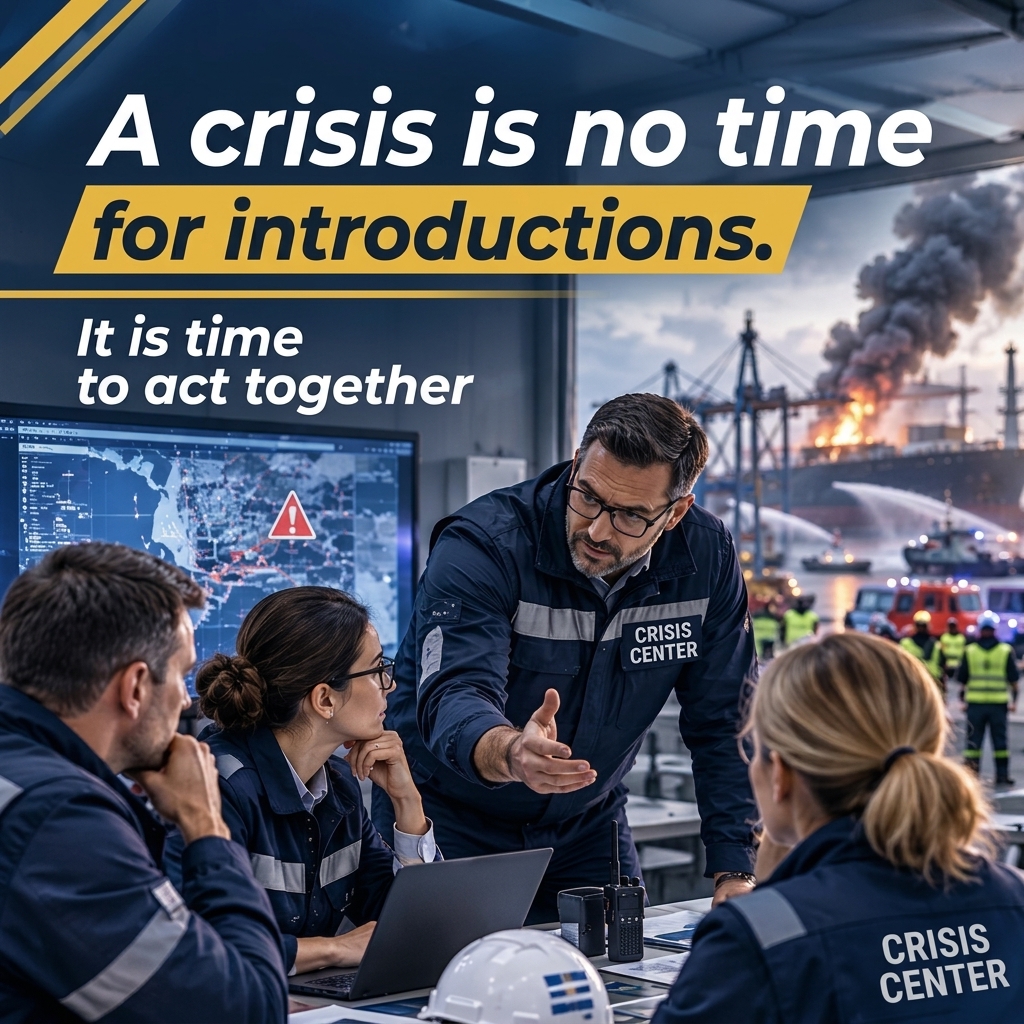
A Crisis Is No Time for Introductions. It Is Time to Act Together
Why Does Crisis Management Begin Long Before an Incident?
In HSE and industrial safety, we are used to talking about incident prevention, risk management, incident investigation, and emergency preparedness. Yet there is another vital element of a mature safety management system: a company's readiness to manage a crisis.
This raises a natural question: what happens if tomorrow the company faces a major industrial accident, employee fatalities, a large-scale fire, a hazardous material release, or another event capable of impacting not only human safety, but also business continuity, corporate reputation, and relations with government authorities? Who will make the decisions? Who will lead the crisis response? Who will liaise with emergency services, regulators, and the media? Who will assess the impact on the business? And most importantly, how do you ensure coordinated action across all stakeholders when there is virtually no time for discussion? The answers to these questions must exist before a crisis strikes.
A Crisis Management Team Is Not an Executive Meeting
A crisis management team is a pre-established governance structure designed to coordinate company-wide actions during a crisis, make strategic decisions, and manage the aftermath of an incident. Its purpose is not to replace emergency responders or on-site incident commanders working directly at the scene. Rather, the team's role is to provide systematic crisis management at the corporate level. During a major incident, multiple critical tasks must be addressed simultaneously:
- ensuring people's safety and minimizing the consequences of the incident;
- coordinating with emergency services and government authorities;
- assessing the impact of the event on operations and business continuity;
- making decisions on suspending or resuming operations;
- managing information flows and internal and external communications;
- providing support to injured personnel, employees, and their families;
- evaluating financial, legal, and reputational consequences.
Without a predefined structure, all of this risks devolving into a chaotic process in which everyone acts based on their own interpretation of the situation.
Core and Situational Members: Why the Distinction Matters
In our company, the crisis management team is built around core and situational members. Core members are senior executives and heads of key business functions whose involvement is essential to managing any crisis, regardless of its nature. Situational members are brought in depending on the specific crisis scenario. These may include specialists in process safety, HSE, environmental protection, maintenance, IT, legal affairs, communications, HR, and other subject-matter experts. It is important not merely to compile a list of members, but to define in advance:
- who is called into the team and under what circumstances;
- what specific role each member plays;
- what decisions they are authorized to make;
- which functional area they are accountable for;
- to whom and in what sequence they escalate and share information;
- who serves as their designated alternate if they are unavailable.
In practice, defining the situational roster often proves to be one of the most challenging tasks. Crises vary widely in nature, scale, and impact, meaning the required set of competencies will differ every time.
The Scenario Lead: Accountability Must Be Assigned in Advance
For each high-probability crisis scenario, it is essential to designate a scenario lead in advance. This person does not necessarily lead the crisis management team itself. Rather, it is someone who possesses the relevant domain expertise, understands the nuances of that specific scenario, and can organize the company's preparedness to handle it.
For example, one leader may be designated for a major industrial accident scenario, another for a large-scale environmental spill, and a third for a cybersecurity crisis. This approach establishes a clear scenario owner responsible for developing, updating, and maintaining corporate readiness for that specific event. At the same time, it is crucial to draw clear boundaries between accountability for scenario planning, leading the crisis management team, and commanding tactical on-site emergency response.
A Crisis Management Team Needs a Clear Lifecycle
Another fundamental element is a well-defined activation process for the crisis management team. It must cover the entire lifecycle from initial incident detection to crisis closure. Specifically, companies need to establish:
- Incident detection and initial assessment. Who receives the initial report, what criteria trigger a potential crisis classification, and who decides to escalate the response level?
- Activation of the crisis management team. Who has the authority to convene the team, how are members notified, and within what timeframe must they join?
- Initial briefing and situation assessment. How do you establish a common operating picture, set immediate priorities, and make initial strategic decisions?
- Ongoing crisis management. How are regular briefings, information sharing, action tracking, and cross-functional coordination structured?
- Team stand-down. Who makes the decision to conclude active crisis management and transition to business recovery?
- Post-crisis review and lessons learned. How are decisions documented, response effectiveness evaluated, and crisis plans updated?
Crisis management does not end once the immediate incident is contained. Recovering operations, managing long-term impacts, and returning the company to stable performance also demand structured coordination.
Why Crisis Simulations Are Mandatory for Preparedness
You can design an impressive crisis management structure, assign roles, approve policies, and draft detailed playbooks. Yet none of this guarantees an effective response on its own. True readiness is tested not by documents, but by how people act under uncertainty and severe time pressure. That is why our company validates the structure and internal dynamics of our crisis management team through regular crisis simulations. Simulations make it possible to test:
- how quickly the crisis management team activates;
- whether the right team composition has been selected;
- whether members clearly understand their roles and decision-making authority;
- how effectively information flows across the team;
- whether the team can make sound decisions with incomplete or conflicting data;
- how smoothly different functional workstreams collaborate;
- how promptly and consistently decisions are executed;
- what gaps exist in current procedures and governance systems.
The unique value of simulations lies in the ability to safely model complex, high-stakes situations that could carry severe consequences in real life. During exercises, participants confront unexpected twists, shifting conditions, escalating threats, and the need to make decisions under pressure. This not only stress-tests written procedures, but also builds teamwork, mutual trust, and a shared understanding of crisis management principles.
A Crisis Management Team Is an Investment in Business Resilience
In HSE and industrial safety, we often measure performance by how effectively we prevent incidents. However, a mature management system must also address another dimension: how prepared the organization is to respond if an incident happens anyway. Building a crisis management team is not an admission that a crisis is inevitable. It is an acknowledgment that leadership responsibility extends beyond risk prevention to managing the consequences of events that cannot be entirely ruled out.
Establishing a crisis management team, defining its membership, clarifying roles, developing scenarios, and running regular crisis simulations enable a company to move from paper compliance to genuine crisis capability. Ultimately, the takeaway is simple: when a crisis hits, there should be zero doubt about who is in charge, whom to call in, and how to coordinate action. Every one of those questions must be answered beforehand. Because a crisis is not the time to build a team—it is the time for the team to perform. How ready is your organization for that moment?