From Words to Safety: How Artificial Intelligence Helps Prevent Workplace Risks
The quality of HSE briefings directly affects how well employees are prepared to perform operational tasks safely. This is especially true for drilling sites and production support bases, where personnel encounter a wide range of workplace hazards every day.
An initial HSE briefing must give each employee a clear understanding of potential risks, safe work practices, equipment operating rules, and how to respond to abnormal situations. However, simply conducting a briefing is not enough. It is essential to monitor how thoroughly and accurately the supervisor delivers the information required by the program.
In practice, even with approved programs in place, individual topics can be overlooked. A drilling supervisor or mechanic may skip certain requirements, provide insufficient detail on job-specific hazards, or fail to address the specifics of particular tasks.
To address this challenge, the company decided to implement a briefing quality control system powered by artificial intelligence.
From Video Recording to Briefing Quality Assessment
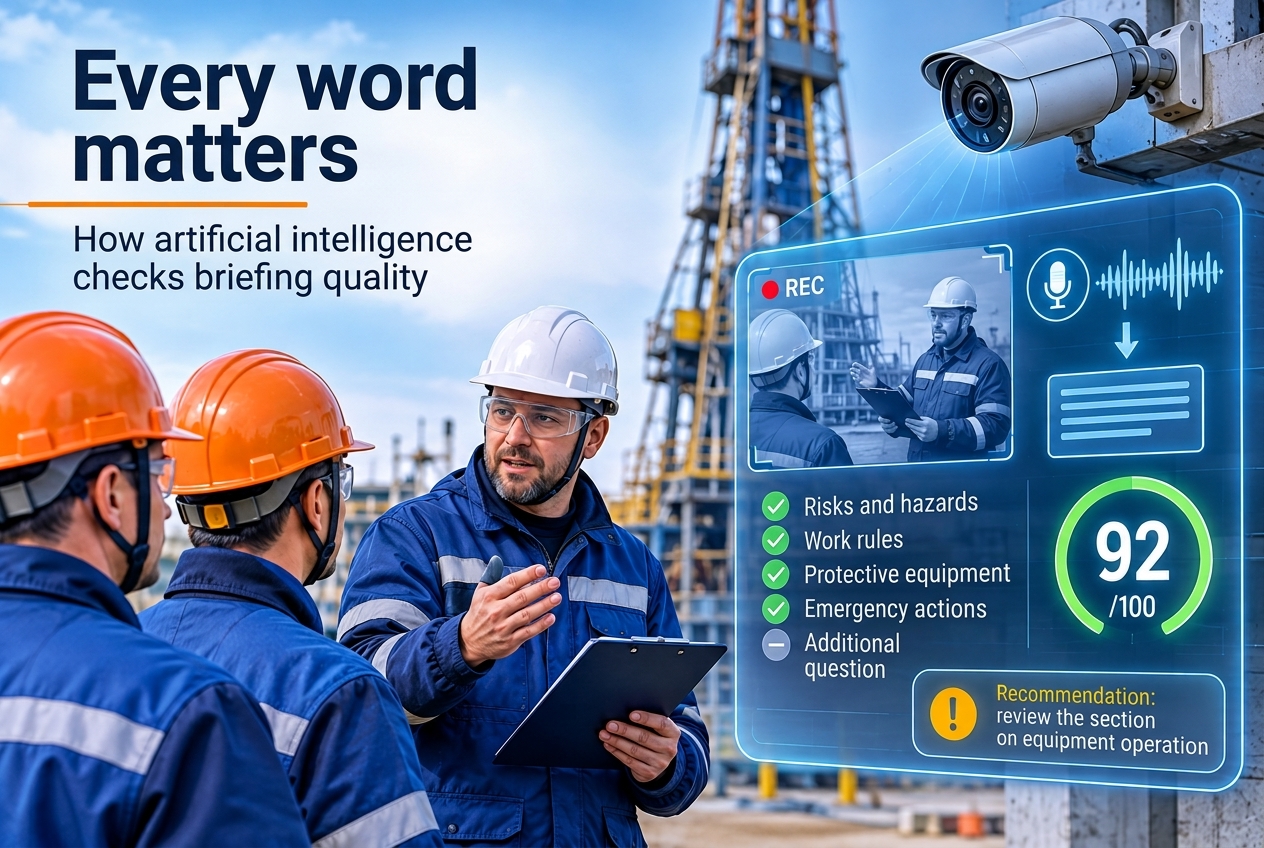
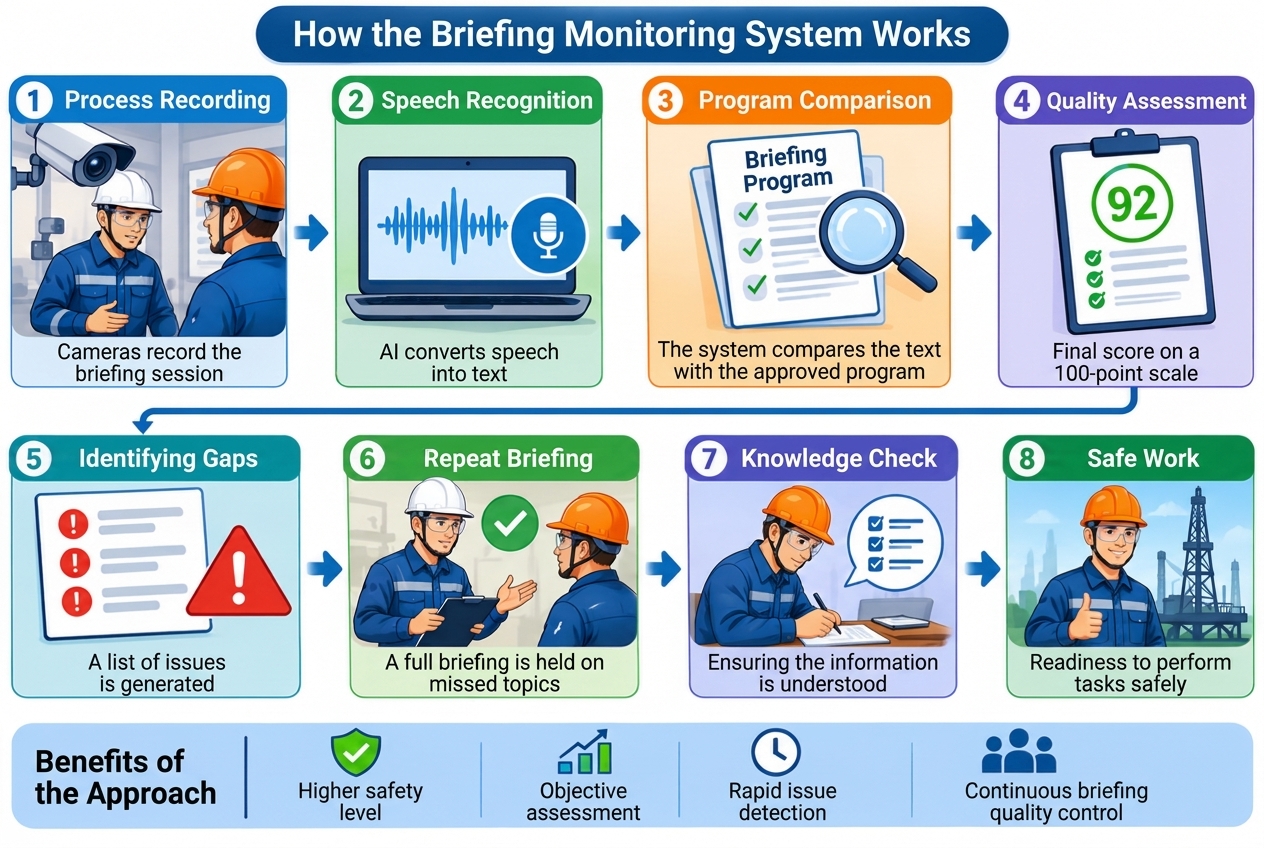
Video cameras are installed at locations where initial HSE briefings take place. They record the interaction between the drilling supervisor or production support base mechanic and the employee.
Next, the video recording is fed into the artificial intelligence system. At the first stage, the AI recognizes speech and transcribes it into text. The resulting transcript forms the basis for further analysis.
The content of approved briefing programs is preloaded into the system's database. Artificial intelligence then compares what was actually said against the established list of topics and requirements.
The analysis looks beyond whether individual topics were merely mentioned. The system evaluates how thoroughly safety issues were covered, whether the information delivered matches the specific job role, and whether it accounts for the nature of the work being performed.
Special attention is given to occupational risks. For example, when briefing a drilling crew member, the system checks whether hazards related to drilling equipment operation, pipe handling, lifting operations, and presence in hazard zones were addressed.
For production support base mechanics, a different set of topics is evaluated: repair work safety, equipment operation, tool use, electrical safety, and requirements for servicing industrial machinery.
Thus, the scope of the assessment is determined by the specifics of the job role and the nature of the upcoming work.
Measurable Evaluation and Identifying Omissions
Based on the analysis, artificial intelligence assigns a quality score to the briefing on a 100-point scale.
In addition to the final score, the system generates a list of findings. It highlights topics that were covered in insufficient detail or not discussed at all during the session.
This format reveals not only the instructor's overall rating, but also specific shortcomings. For example, a supervisor might thoroughly explain equipment operating procedures while omitting safety requirements for maintenance or repair.
In that case, the system records the missing information and flags the need for additional clarification.
The resulting report enables a substantive assessment of each instructor's performance and helps identify which topics require special attention during subsequent employee training.
Identified Shortcomings Trigger Retraining
A key feature of this approach is that omissions identified by AI do not remain mere findings in a report.
If the analysis shows that certain program topics were not covered, the employee undergoes a full briefing followed by a knowledge assessment.
In this way, the system closes the control loop—from recording the session and identifying shortcomings to resolving them and verifying comprehension.
This makes it possible to close employee knowledge gaps in a timely manner, preventing situations where someone begins a task without having received essential information about the associated hazards.
An Additional Tool for Managers and HSE Specialists
Deploying artificial intelligence opens up additional capabilities for overseeing the work of drilling supervisors and production support base mechanics.
Managers receive objective feedback on the completeness of conducted briefings. They can spot recurring findings, evaluate how effectively safety requirements are communicated, and adjust the content of discussions with employees.
For HSE specialists, the analysis results help identify common shortcomings in how briefings are organized, determine topics for additional supervisor training, and refine personnel training programs.
At the same time, artificial intelligence does not replace accountable personnel. It serves an analytical function, helping detect omissions that are difficult to catch through routine spot checks.
The system's final score should be viewed as a management oversight tool rather than standalone confirmation that an employee is ready to perform work safely.
Technology Focused on Incident Prevention
The system is currently undergoing pilot operation. During this phase, the quality of speech recognition, the accuracy of matching the resulting text against briefing programs, and the reliability of the assigned scores are being evaluated.
Particular attention is paid to how accurately artificial intelligence identifies skipped topics and detects insufficient coverage of occupational risks. After all, simply mentioning a hazard does not mean the employee has received adequate information about protective measures.
Further development of the project will improve briefing quality control and establish a unified practice for evaluating how briefings are conducted across operational sites.
Using artificial intelligence makes it possible to move beyond checking signatures and logbook entries to analyzing the actual content of each briefing. This helps detect gaps in personnel training early and close them before operational tasks begin.
Ultimately, the goal of such a system is simple: every employee must know what hazards they may face in their workplace, what requirements they must follow, and how to act to prevent an injury or emergency.