Coal Stockyard as an Underestimated Hazard: What Happens to Coal After Mining
Coal mining and coal storage are two distinct tasks. Thousands of studies, guidelines, and dissertations are dedicated to the former. The latter remains on the periphery of attention, even though it is at the stockyard that coal is exposed to open air, wind, sun, and precipitation, and in volumes comparable to the annual throughput of a medium-sized port. During periods of slow sales, the stockpile at a major terminal can reach three million tonnes.
All this coal is chemically active. It oxidizes, heats up, and under certain conditions ignites without an external ignition source or human error. This article examines what global practice offers for stockyards, what Russian standards require, what the verified procedure for hot spot suppression is, and what experimental solution deserves testing at an operating terminal.
The Industry Looks Underground
A review of scientific databases reveals a telling picture. Since 2020, over fifteen hundred papers on spontaneous coal combustion have been published worldwide. More than half of them focus on mines, coal seams, and goafs. Only thirty-two papers—or two percent—are dedicated to stockyards and stockpiles.
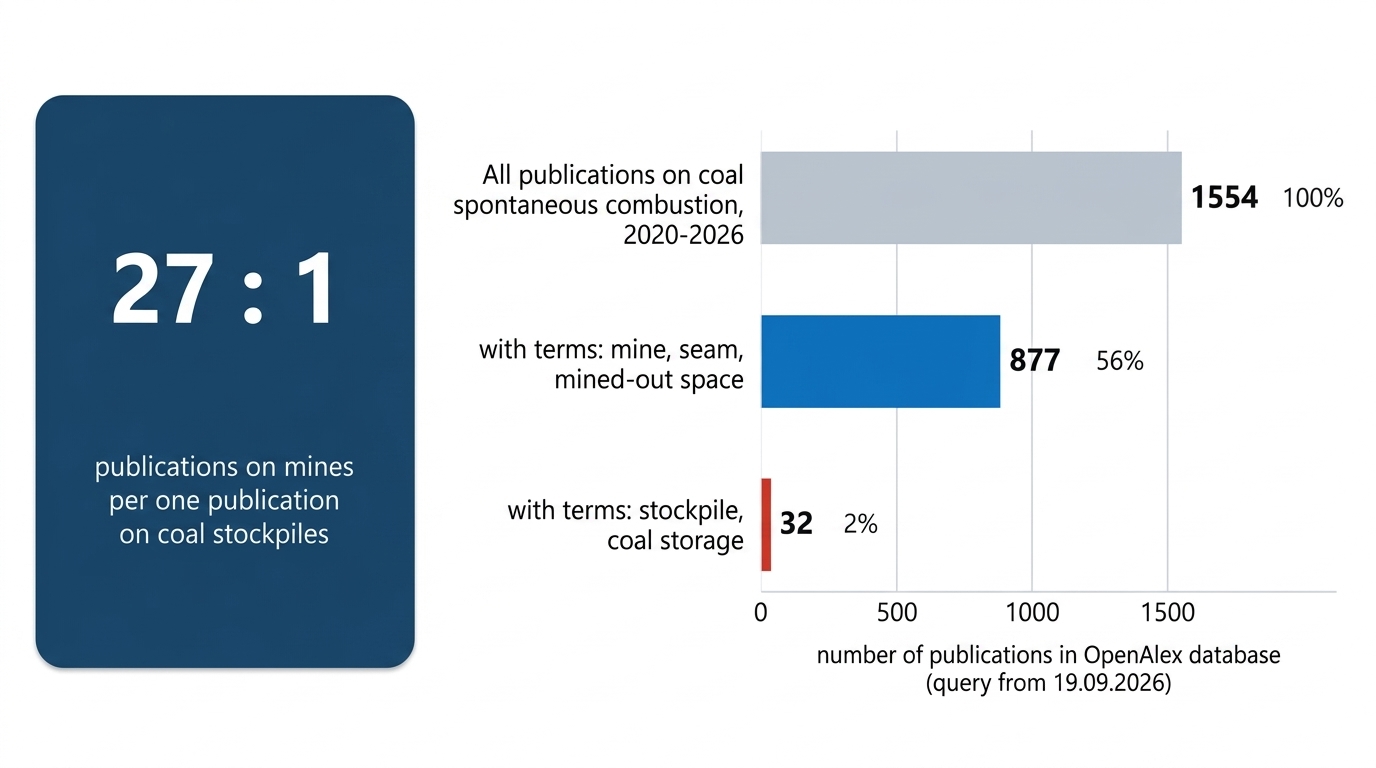
Fig. 1. Publications on spontaneous coal combustion in 2020–2026: for every paper on stockyards, there are twenty-seven papers on mines
This priority is understandable: people are underground, and an underground fire always poses a threat to life. However, this imbalance has a downside. Modern reviews of fire suppression agents describe nitrogen inerting, three-phase foams, and gels—technologies designed for enclosed spaces. A manager of an open stockyard spanning dozens of hectares finds virtually no applicable solutions in them.
It is precisely the stockyard that remains underestimated. After extraction, transportation, and stacking, coal begins to be perceived merely as a commodity. Meanwhile, it remains a hazardous asset, the responsibility for which lies with the operating organization.
Why Stockyard Conditions Are Worse Than Underground
Spontaneous heating is the oxidation of coal by atmospheric oxygen. The more accessible the oxygen, the more active the process.
In a mine's goaf (worked-out area), air is scarce. It is customary to distinguish three zones. Near the working face, there is plenty of air, but it also carries heat away. Deep inside, oxygen content drops below eight percent, and the process subsides. Only the intermediate zone with an oxygen content of eight to eighteen percent is dangerous: oxidation is already underway, but heat is not dissipated.
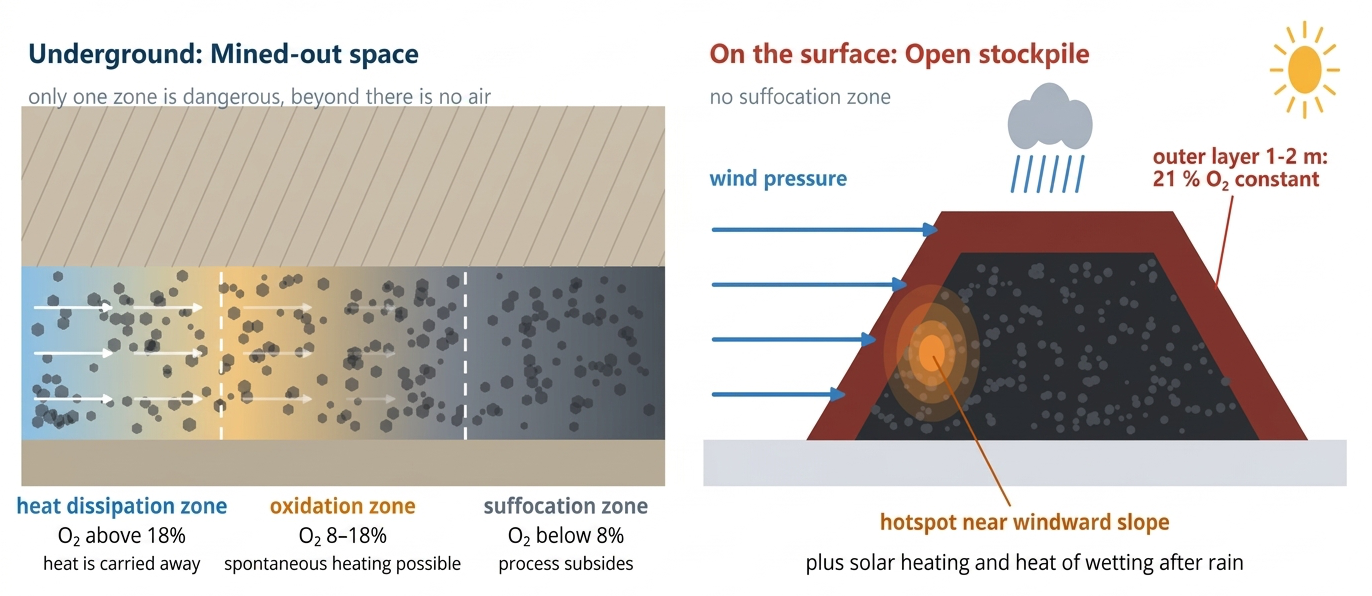
Fig. 2. Underground, only one zone is dangerous. In an open stockpile, there is no extinction zone: the entire outer layer remains at full oxygen content and subject to wind pressure
In an open stockyard pile, there is no extinction zone. The top layer, one to two meters thick, remains loose and constantly exposed to twenty-one percent oxygen, while the wind forces air through the slopes. Solar heating of the dark surface and precipitation add to this. The role of precipitation is non-obvious: dry coal releases heat when wetted, so a stockpile hit by a downpour after a dry spell receives an additional thermal boost.
Field experience confirms this. In July 2026 in Olenegorsk, a stockpile at a power supply company's yard caught fire overnight; alternating heavy rains and heat were cited as the cause. In August 2026 in the Altai Krai, two fires broke out at coal yards within twenty-four hours, both caused by spontaneous combustion.
A Calculation Available to Any Enterprise
Every coal type has an incubation period—the time it takes in a heap to heat up to a dangerous state. The regulatory classification is as follows: less than fifty days for highly prone coals, fifty to eighty days for prone coals, and more than eighty days for non-prone coals.
Only two metrics available at any stockyard are needed for assessment: total inventory volume and annual shipment volume. The ratio of the former to the latter, multiplied by 365, yields the average residence time of coal in the stockyard in days.
For a terminal with an inventory of three million tonnes and an annual throughput of sixteen million tonnes, the average residence time is sixty-eight days. This exceeds the incubation period of highly prone coals.
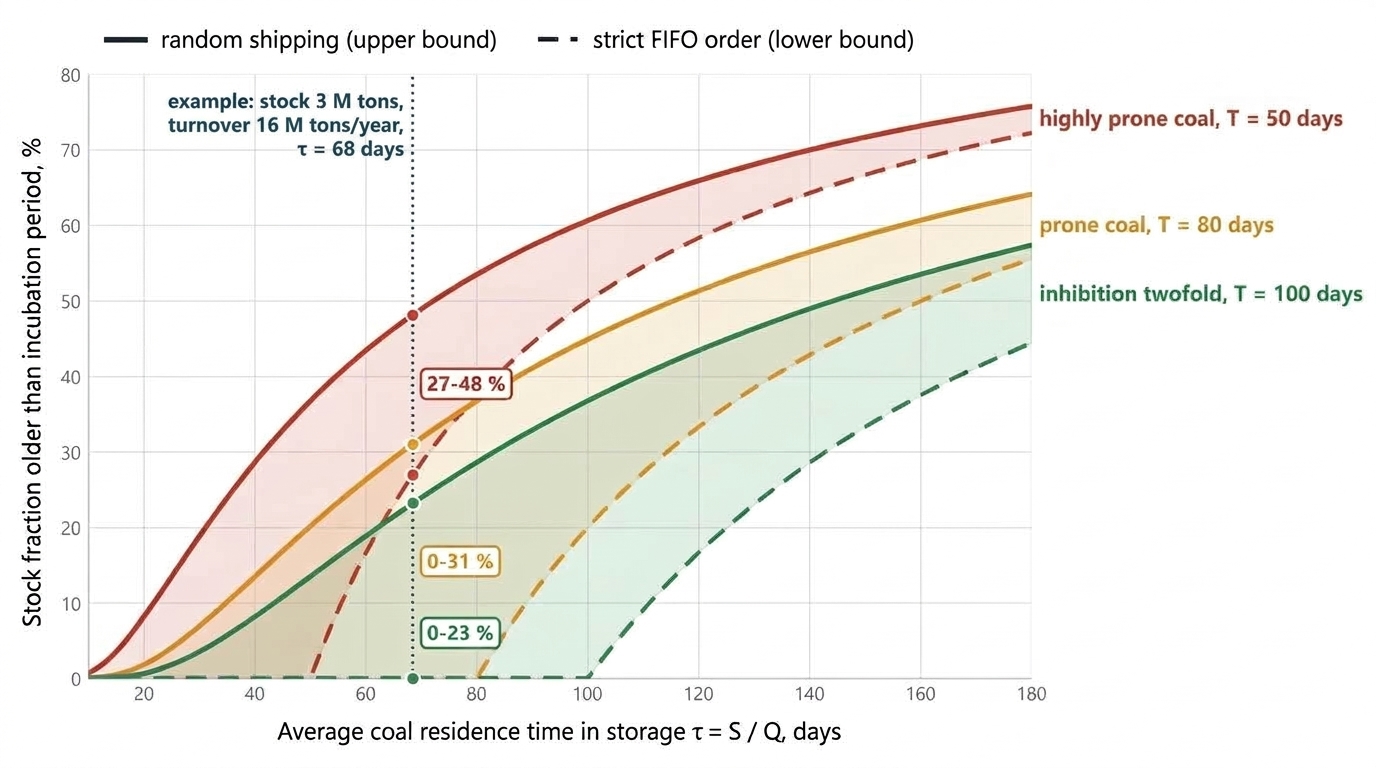
Fig. 3. Share of inventory whose age exceeds the incubation period. Solid line: shipment without age tracking; dashed line: strict age-based queue (FIFO)
What happens next is determined by dispatch discipline. Under a strict queue, where the oldest coal is shipped first, about a quarter of the inventory exceeds the incubation period. When coal is shipped without regard to age—where stockpile selection is dictated by rank, vessel batch, or equipment convenience—this share approaches half. The difference between the two scenarios exceeds half a million tonnes of coal at risk and requires no capital expenditure: stockpile age tracking and a rule prioritizing the dispatch of older batches are sufficient.
There is also a threshold. As long as average residence time is below the incubation period, a strict queue completely eliminates time-factored risk. For the example given, the threshold is around 2.2 million tonnes. Inventories above this value can no longer be mitigated by dispatch management alone, requiring additional measures.
Procedure for Hot Spot Suppression
Sources are unanimous on this issue. Russian federal regulations, standard instructions for power plant stockyards, the International Energy Agency report, South African guidelines, and Indian thermal power plant practices all describe the exact same sequence of actions.
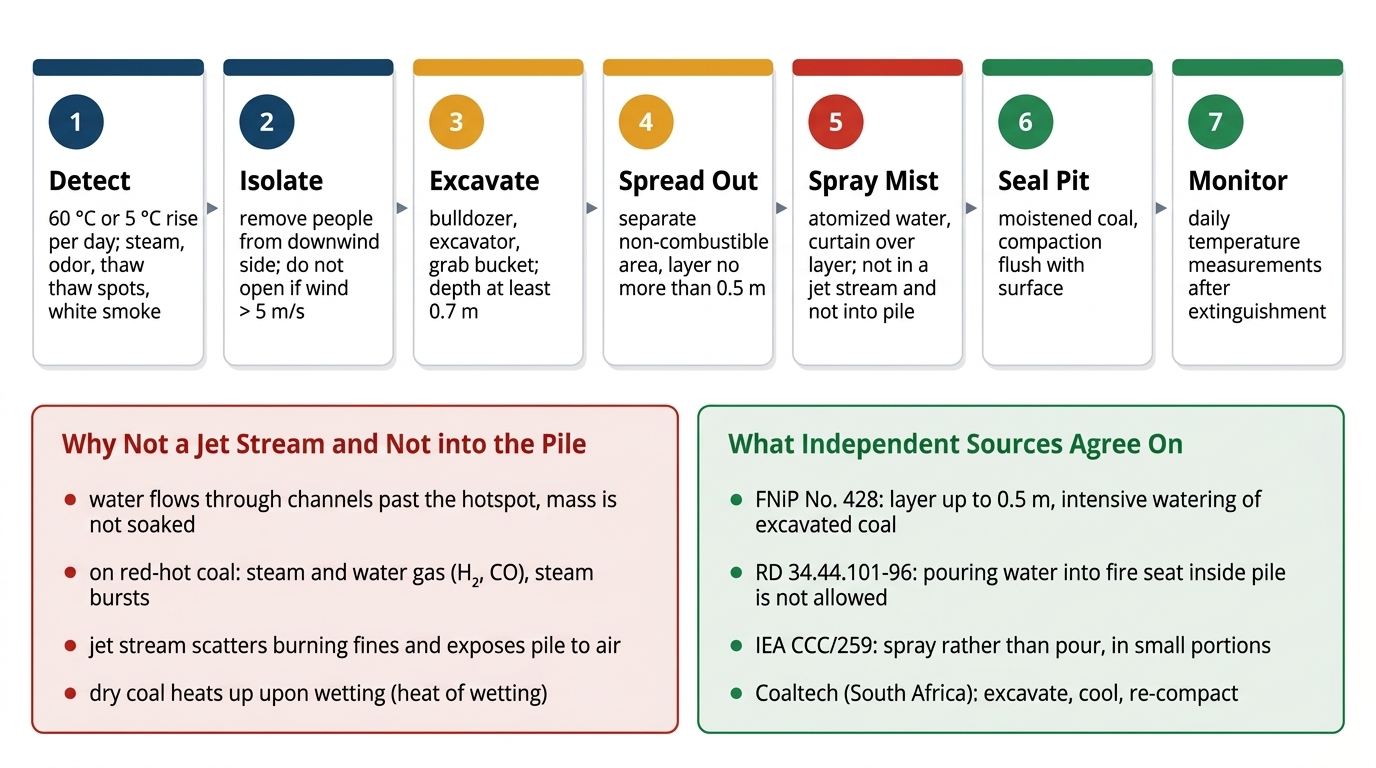
Fig. 4. Procedure for suppressing a spontaneous heating hot spot in an open stockpile
The hot spot is not extinguished in place; it is excavated using a bulldozer, excavator, or grab bucket to a depth of at least seventy centimeters. The excavated coal is spread on a separate non-combustible pad in a layer no thicker than half a meter. In a thin layer, heat dissipation exceeds heat generation, allowing the coal to cool. Only then is it sprayed with water.
Spraying is crucial here. The common saying "coal is not extinguished with water" is inaccurate. The correct phrasing is: hot spots must not be flooded with a solid stream or injected with water into the stockpile. There are four reasons. Water does not saturate the bulk coal but channels away past the hot spot. On incandescent coal, it produces steam and, at high temperatures, water gas containing hydrogen. A solid jet scatters burning fines and opens the stockpile to air inflow. Dry coal heats up further when wetted.
A water curtain above the spread layer, on the other hand, is effective. Water mist, not a high-pressure monitor stream, is used.
The excavation in the stockpile is then backfilled with moistened coal and compacted flush with the surface; a compacted section generally does not re-ignite. Daily monitoring of the stockpile is then established.
Two rules are violated most frequently. First: a hot spot must not be opened during strong winds, since at wind speeds exceeding five meters per second, smoldering turns into active flaming. Second: equipment access must be maintained to every side of the stockpile, as hot spots form on slopes and edges where compaction is poorest.
What Does Not Work in an Open Stockyard
Inert gases are effective in silos, dome storage, and ship holds. Gas cannot be contained on an open stockpile.
Foam does not penetrate coal, and the blanket it creates traps heat and combustible vapors. It is suitable for locally covering an already excavated hot spot, but not for suppressing the bulk mass.
Gels and costly chemical inhibitors show tens of percent effectiveness in laboratory settings. In a mine, they are injected into a confined volume, whereas a stockyard involves hundreds of thousands of tonnes exposed to rain. Complete impregnation of a three-million-tonne inventory would require hundreds of thousands of tonnes of solution.
Four approaches scale effectively: proper stacking with compaction, age-based dispatch, rapid hot spot excavation, and stream treatment of coal during stacking—when a small dose of liquid covers the entire volume rather than just the stockpile surface.
Experimental Proposal: Molasses Solution
A team of Chinese researchers published three papers between 2022 and 2025 on the use of molasses, a byproduct of sugar production, to suppress spontaneous coal combustion.
The results are as follows. A thirty-percent molasses solution adheres to coal roughly forty times better than water and binds fines one hundred and forty times more strongly. Sugars form a film on the particles that retains moisture and limits oxygen access to the surface. Adding calcium and magnesium chlorides reduces coal's oxygen consumption by sixty to eighty percent. In field trials inside a mine goaf, carbon monoxide concentration was reduced by 35–48 percent.
Sugar does not affect the properties of the coal itself; it merely restricts contact between coal and oxygen.
This method has not been tested on open stockpiles: no relevant publications were found. This makes a field trial in a port stockyard setting worthwhile.
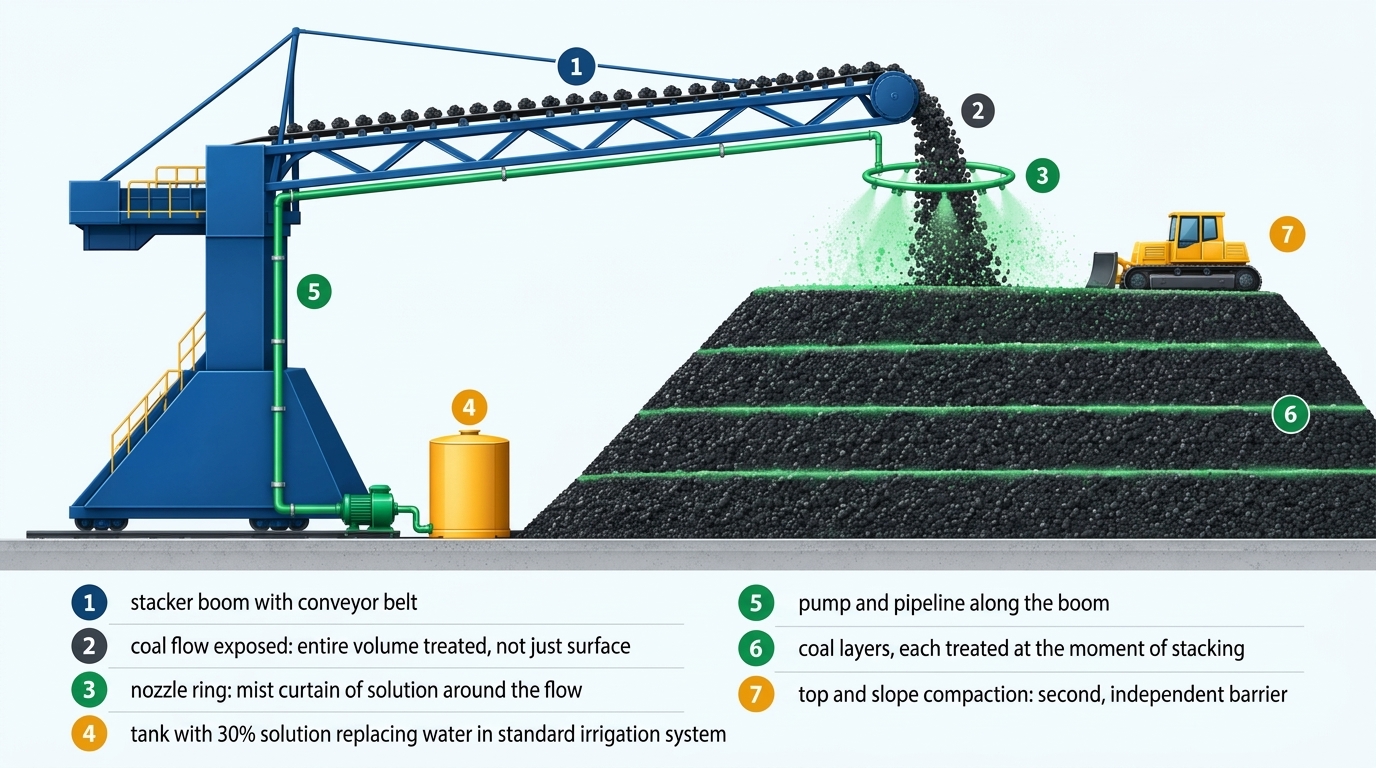
Fig. 5. Trial schematic: solution is fed into the existing dust suppression system, a spray ring treats the coal stream during stacking, and each layer is laid down already protected
The experimental setup is as follows. Solution is poured into the tank of the standard water-spraying system instead of water. Coal discharging from the stacker boom is treated from all sides by a fog curtain at the moment the stream opens, so every layer is deposited already treated. The top and slopes of the stockpile are compacted as usual. This creates dual protection: the film limits oxygen access to each particle, while compaction restricts airflow into the bulk mass. A control stockpile from the same batch is built alongside, with its stream treated with plain water in the same volume, ensuring comparison validity. Over two months, temperature is measured at three depths, carbon monoxide concentration near the surface is tracked, thermal imaging is conducted, and samples are taken to test quality parameters.
The limitations of the method are known and must be taken into account. Molasses itself oxidizes, releasing heat, so solution concentration must not exceed thirty percent. Sugar serves as a nutrient medium for microorganisms, and microbial activity also generates heat; the behavior of treated coal in a large stockpile during warm weather has not been studied. The solution adheres to machinery and thickens at sub-zero temperatures. The effect of the additive on contractual coal quality metrics requires laboratory verification.
Doubling the incubation period fundamentally alters the calculation above: under a strict queue, zero inventory remains at risk. A negative trial result is also subject to publication, as it is no less informative for the industry.
Operational Threshold for an Export Terminal
Russian regulations establish an immediate action threshold of sixty degrees Celsius or a temperature rise of five degrees per day. For a terminal shipping coal by sea, the practical threshold is lower. The International Maritime Solid Bulk Cargoes Code (IMSBC Code) prohibits loading coal onto a vessel at temperatures above fifty-five degrees Celsius. A stockpile that does not yet require immediate action under stockyard rules will be rejected by the vessel, resulting in downtime, demurrage, and buyer claims. It is advisable to set the monitoring system to fifty-five degrees.
It should also be considered that carbon monoxide appears before temperature begins to rise. Russian stockyard regulations do not require gas monitoring. A portable gas detector placed near the stockpile surface is inexpensive and warns of hot spot development several days earlier than a temperature probe.
Conclusion
Coal in a stockyard is not a passive commodity awaiting shipment. It is an asset with its own accident scenario that unfolds slowly, imperceptibly, and without anyone's fault, making it easy to overlook.
The primary control measures are simple and inexpensive: know the coal residence time in the stockyard, ship older batches first, compact slopes, excavate hot spots rather than dousing them, and use misting rather than a high-pressure hose. They require organization, not capital investment.
For decades, the industry studied coal behavior underground. The behavior of coal on the surface, in stockpiles measuring millions of tonnes, is far less understood, and this gap will need to be filled by operating organizations themselves, including through field trials at active stockyards.