Why Your Fire Alarm "Lies" and How Much a False Alarm Costs Your Business
A siren blares on the shop floor. Workers head outside, the production line grinds to a halt, and the duty engineer investigates the cause. Forty minutes later, the culprit is clear: steam from equipment washdown. A week later, it happens again. By the third time, half the shift doesn't even leave their workstations, and someone from facility maintenance suggests "temporarily" switching the detection loop to manual mode.
Sound familiar? For a long time, we treated false alarms as an unavoidable "technical margin of error"—the price we pay for sensor sensitivity. Today, however, a false alarm must be viewed differently: not as a localized electronics glitch, but as an indicator of underlying flaws in asset management and safety culture. It is a symptom, and it costs real money.
The Scale: A False Alarm Pandemic
This is a global problem; other countries simply track it more accurately.
- United Kingdom. According to 2022 data, 39% of all fire and rescue callouts in England were triggered by automated false alarms—over 246,000 wasted dispatches in just six months. The Fire Industry Association (FIA) estimates the cost to the nation at over £1 billion annually, including business losses from downtime.
- United States. According to the National Fire Protection Association (NFPA), around 1.3 to 1.4 million false alarms are recorded each year, accounting for more than 10–12% of all emergency calls.
- Australia. In the state of New South Wales, over a ten-year period, 97% of automatic fire alarm signals sent to emergency dispatch centers turned out to be false. Actual fires accounted for only 3% of cases.
In Russia, the situation is even more acute for two reasons. First: equipment wear and tear. According to Rosstat, the depreciation rate of industrial machinery and equipment stands at roughly 57%. Aging cable runs, oxidized contacts, and detectors past their service life constantly generate interference that the system interprets as a fire. Second: underreporting. EMERCOM statistics only capture incidents where firefighters are actually dispatched—around 233,000 cases a year. Hundreds of thousands of activations that on-site personnel silence themselves without calling emergency services go completely unrecorded. Losses from micro-downtime and scrapped materials are buried under "miscellaneous expenses." Up to a third of data center operators, for instance, have experienced accidental gas suppression discharges.
The Boy Who Cried Wolf
Yet the greatest risk isn't financial—it's psychological.
Frequent false activations trigger "alarm fatigue." People stop perceiving the siren as a signal for immediate action, dismissing it as "just another glitch" or a drill. Research shows that if a building experiences more than three false alarms within a three-month period, occupant response times during a real evacuation drop sharply. People either ignore the signal entirely or waste precious seconds looking for confirmation of real danger.
The worst-case scenario occurs when maintenance teams disable the "nuisance" automation themselves. To avoid stopping the conveyor and upsetting management, they switch the system to manual mode, mute the notification system, or physically disconnect detection loops.
A textbook example of where this leads is the 2018 Winter Cherry shopping mall tragedy. The investigation revealed that the fire alarm and voice evacuation system had been switched to manual mode or turned off precisely because of frequent false alarms in the days prior. Everyone knows the tragic outcome.
This is where the line between administrative and criminal liability is crossed. From the moment a system is rendered inoperable—even under the pretext of "repairs" or "keeping it from disrupting work"—it is no longer a technical error. It becomes a criminal violation of industrial safety requirements (Article 217 of the Criminal Code of the Russian Federation) or criminal negligence (Article 293). In the event of an actual fire, blaming "glitchy sensors" will not convince a court; instead, it will serve as an aggravating circumstance.
Regulations: From a "Green LED" to True Reliability
With the introduction of Code of Practice SP 484.13130.2020 and State Standard GOST R 59638-2021, the regulatory approach shifted fundamentally. Previously, inspectors only cared whether a system was installed and formally operational. Now, the primary focus is on how reliably it detects an actual fire. In essence, regulators have acknowledged that a system generating false signals is not merely useless—it is dangerous.
Here are three key things you need to know.
What counts as a false alarm. GOST R 59638-2021 provides a strict definition: "a fire alarm signal generated in the absence of a fire." Any signal without actual fire is considered a system failure. The American standard NFPA 72 usefully complements this with the concept of a "nuisance alarm": a properly functioning detector responding to a real physical stimulus (steam, dust, aerosol) that is not a fire. This means the root cause is often not defective hardware, but a design flaw—specifically, selecting the wrong type of detector for the environment.
The "Rule of Six." For the first time, SP 484 established a quantitative limit: no more than 6 false alarms per year for an entire facility, or one activation per 5,000 m² of protected area. Exceeding this threshold means the system is non-compliant, and the facility is operating in violation of fire safety regulations (Article 20.4 of the Code of Administrative Offenses of the Russian Federation). This leads to regulatory enforcement notices, potentially requiring a complete system replacement. Simply "resetting" fault alerts is no longer an option.
Verification algorithms. To stay within this limit, SP 484 requires moving away from the simplistic "one triggered sensor equals a fire" logic:
- Algorithm A is permitted only where false activations are physically impossible; it is virtually never used in industrial settings;
- Algorithm B: a fire signal is generated only after a repeat query or confirmation from the same detector within a set timeframe, protecting against transient electrical interference;
- Algorithm C: a "Fire" condition is triggered only when two or more detectors are activated within the same detection zone.
Furthermore, technical regulation TR EAEU 043/2017 mandates verified equipment immunity to electromagnetic interference and harsh climatic conditions, which is gradually phasing cheap, unstable solutions out of the market.
The Sensor Isn't Lying—It Honestly Sees Dust
A fire detector lacks the intelligence to "lie." It simply registers changes in environmental parameters: optical density, temperature, or radiation. In 90% of cases, a false alarm is the correct response of a properly functioning sensor to improper operating conditions or environmental interference.
The root causes fall into three categories.
- Hardware. Conventional non-addressable threshold systems installed 10–15 years ago. Early-generation detectors (such as the IP 212 series) cannot compensate for dust buildup: dust accumulates in the smoke chamber, the sensor gradually drifts toward its alarm threshold, and the slightest air current triggers an alert. In workshops equipped with variable frequency drives (VFDs) and heavy motors, unshielded cables act like antennas, picking up electromagnetic interference.
- Environment. An optical smoke detector cannot tell what is scattering its light beam: combustion smoke, flour dust in a grain elevator, oil mist in a turbine hall, or welding fumes. High humidity and temperature swings cause condensation on optical components. In food processing, steam from equipment washdowns is a classic culprit. Meanwhile, office-grade detectors are often installed on industrial shop floors simply to cut costs during the design phase.
- Human factor. The most common scenario: welding, cutting, or wall chasing performed without switching the zone to "Maintenance" mode and without putting protective covers over the detectors. Construction dust instantly triggers a "Fire" signal. Added to this is false economy on detector cleaning, leaving the system operating on the edge of its sensitivity threshold for years.
The takeaway is simple: you cannot solve this problem by issuing a decree to "prevent false alarms." False activations arise from a clash between a delicate safety system and a harsh industrial reality, and they can only be resolved through engineering adaptation of the system to its environment. Replacing hardware without addressing environmental factors and operating procedures won't help either—it will just be money down the drain.
How Much Does a Single False Alarm Cost?
Executives usually see only the tip of the iceberg: the invoice for refilling fire suppression cylinders and the service call from contractors. That accounts for no more than 10–15% of total losses. The bulk of the cost remains hidden beneath the surface (Fig. 1).
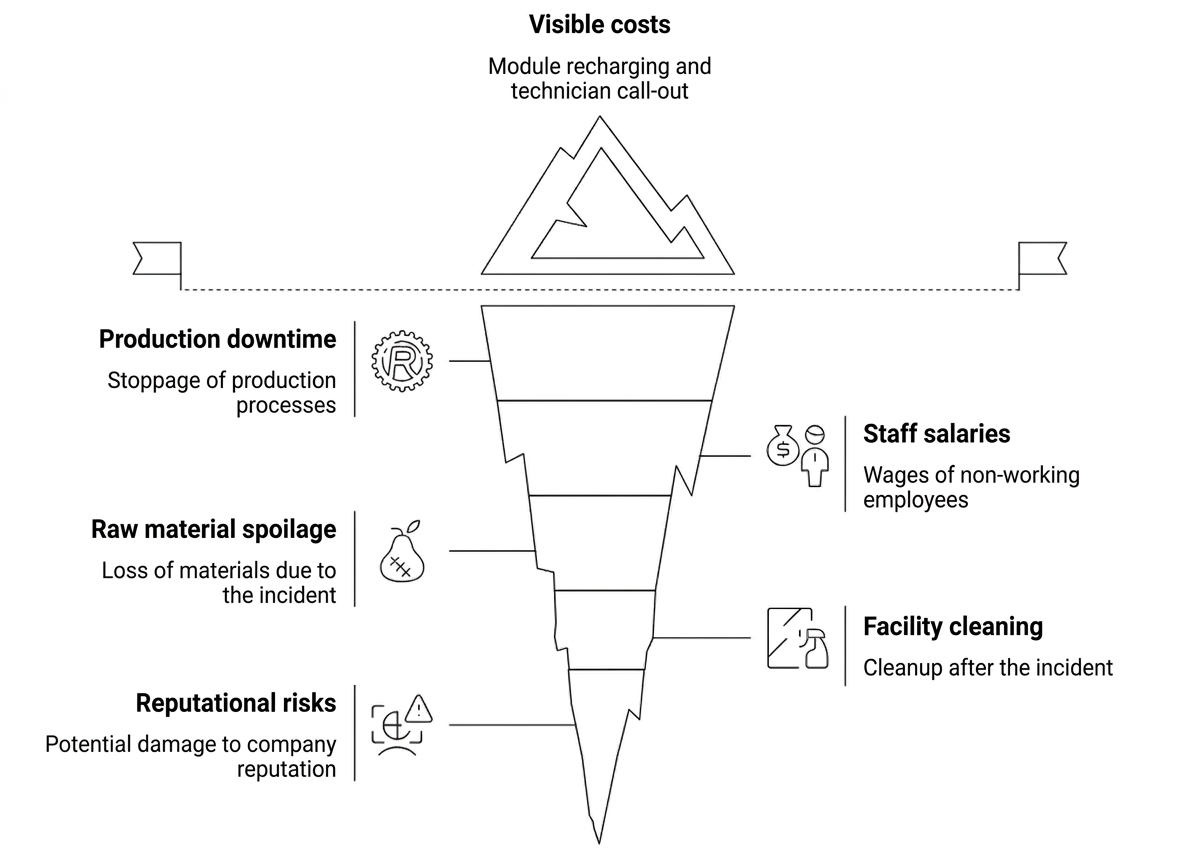
Calculating these losses is straightforward. A false alarm without suppression discharge costs:
Hourly downtime cost × evacuation and recovery time + wages of idle personnel.
If the fire suppression system discharges, add the following:
- system restoration (recharging a clean agent gas suppression system can cost hundreds of thousands of rubles);
- direct property damage: a flooded server room, spoiled raw materials, or a ruined production batch;
- post-discharge cleanup of dry chemical powder and drying out the premises;
- extended downtime, lasting anywhere from 8 to 24 hours.
Server rooms are a special case. The acoustic shockwave from a gas suppression discharge can destroy hard drives, just as happened at an ING data center in 2016.
We ran the numbers for a typical large manufacturing plant: annual revenue of 3 billion RUB, 1,000 employees, 24/7 operations, and hourly revenue of roughly 0.75 million RUB.
| Scenario | False alarms per year | Downtime | Suppression discharge | Annual losses | Share of profit |
|---|---|---|---|---|---|
| Strong fire safety culture, modern system | 1 | 0.5 hours | once in 10 years | approx. 0.7M RUB | 0.2% |
| Typical industrial baseline in Russia | 3 | 1 hour | once in 5 years | approx. 4.5M RUB | 1.5% |
| Asset depreciation over 50%, formalistic maintenance | 6 | 2 hours | once in 2 years | approx. 25M RUB | 8.3% |
Things get really interesting when you compare these losses to capital investment. In the pessimistic scenario, the enterprise loses 25 million RUB a year, whereas a complete fire alarm upgrade for such a facility costs 10–15 million RUB. The payback period is under 7 months. Assuming a 10% profit margin, these losses eat up more than 8% of net profit—making this a board-level issue. And this calculation doesn't even factor in reputational damage or data center data loss, which could multiply the total financial impact several times over.
Maintaining a "lying" system is far more expensive than replacing it. Today, the illusion of safety costs more than safety itself.
What to Do: A 30-Day Action Plan
Week 1. Start tracking. Set up a log for all false activations, including those handled internally without calling emergency services. For each event, record the zone, specific detector, time, and root cause category: hardware, environment, or human factor. Without this data, you are managing impressions, not a safety system.
Week 2. Identify "repeat offenders." As a rule, a handful of problem zones generate the vast majority of false alarms. Investigate them individually: replace the faulty detector, change the detector type, or relocate it.
Week 3. Close procedural loopholes. Update your hot work and dust-generating work permits to include two mandatory steps: switching the affected detection zone to "Maintenance" mode while fitting protective covers over sensors, and a signed sign-off confirming the system has been restored to normal operating mode once work is complete.
Week 4. Crunch the numbers and present your business case. Plug your own facility's data into the formula: hourly downtime cost, headcount, and alarm frequency. This is an argument any CFO will understand immediately. For more on how to defend these budget items, see our article "HSE and Fire Safety Budgeting: Structure, Calculation, and Approval."
From there, you can move on to engineering solutions:
- intelligent signal filtering: multi-criteria detectors (combining smoke, heat, and CO sensors) that can distinguish real combustion from welding fumes or dust;
- aspirating smoke detection (ASD) systems instead of point detectors in areas with high ceilings and heavy dust loads;
- Algorithm C for critical scenarios, such as automated equipment shutdown and gas suppression release;
- scheduled preventive maintenance rather than reactive repairs triggered by complaints.
And enforce one rule without exception: switching a system to manual mode or disconnecting a loop may only be done via written authorization, backed by compensatory safety measures and a strict deadline for restoration.
Self-Assessment Checklist
- Do we know the exact number of false alarms over the past year, including those that didn't trigger an emergency dispatch?
- Do we comply with the SP 484 "Rule of Six"?
- Have we mapped the specific zones where false activations repeatedly occur?
- Does the detector type match the operating environment in every zone (steam, dust, aerosols, welding)?
- Does our hot work and dusty work permit procedure mandate switching the zone to "Maintenance" mode?
- Do we have a detector cleaning schedule, and is it actually followed?
- Which verification algorithm is configured in zones with automatic fire suppression release?
- Are there any disconnected loops or systems in manual mode at the facility right now—and who authorized them?
If you answered "no" or "I don't know" to three or more questions, false alarms are already costing your company money. The only question is how much.
Final Takeaway
Eliminating false alarms is not about making life more comfortable for the control room operator. You cannot expect employees to trust a life safety system that "lies" five times a week. False alarms carry a heavy financial toll, system reliability is now a strict legal requirement, and systematically tackling false activations is a hallmark of leadership integrity. It is the only way to break the vicious cycle of "false alarm, disabled system, catastrophe" and restore people's trust in workplace safety systems.