
Monitoring Hazardous Substances in Workplace Air
Modern industrial facilities use a large number of substances that enter the workplace air as gases, vapors, or dust, potentially posing a health risk to workers.
When entering the human body, hazardous substances can cause various disorders, manifesting as acute or chronic occupational poisoning. Acute poisoning often occurs due to accidents, equipment failures, or severe safety violations. It is characterized by short-term exposure to relatively high concentrations of harmful substances, entering the body either immediately upon exposure or after a relatively short (usually a few hours) latent period. Chronic poisoning develops gradually through long-term exposure to hazardous substances entering the body in relatively small amounts. These develop due to the accumulation of the substance in the body (material cumulation) or the changes it causes (functional cumulation).
Monitoring the concentration of hazardous substances in workplace air must be conducted by accredited (certified) laboratories equipped with the necessary analytical tools. This equipment must be registered in the state register and calibrated in accordance with established procedures using methods approved and certified under the legislation of the Russian Federation on ensuring the uniformity of measurements.
When introduced into economic activities, these substances must undergo mandatory toxicological assessment and hygienic standardization.
Identifying chemical factors in modern enterprises is quite difficult due to the multi-component composition of gas emissions.
Based on toxicity studies, a special commission legally establishes Maximum Permissible Concentrations (MPC) for hazardous substances in workplace air. These are adjusted or supplemented as new experimental research results become available.
Decisions on the necessity of justifying MPC and TSEL (Tentative Safe Exposure Levels) in workplace air and ambient air of residential areas are made based on hygienic criteria.
Hygienic standardization of hazardous substances consists of 4 stages. At the first stage, the feasibility of conducting hygienic standardization studies is determined. At the second stage, information analysis is used to identify substances that do not require the development of hygienic standards according to the proposed criteria. At the third stage, the sequence and scope of research needed for the accelerated justification of hygienic standards (TSEL, MPC). At the fourth stage, the decision to develop a hygienic standard is made based on toxicological and hygienic studies conducted in accordance with methodological guidelines.
The list of hazardous substances, including TSEL and MPC in workplace air, physical states, and specific effects on the body, is provided in SanPiN 1.2.3685-21.
Implementing an effective air quality monitoring system at enterprises will create the prerequisites for improving working conditions across all sectors of industrial activity.
The figure shows a modern system of toxicity categories.
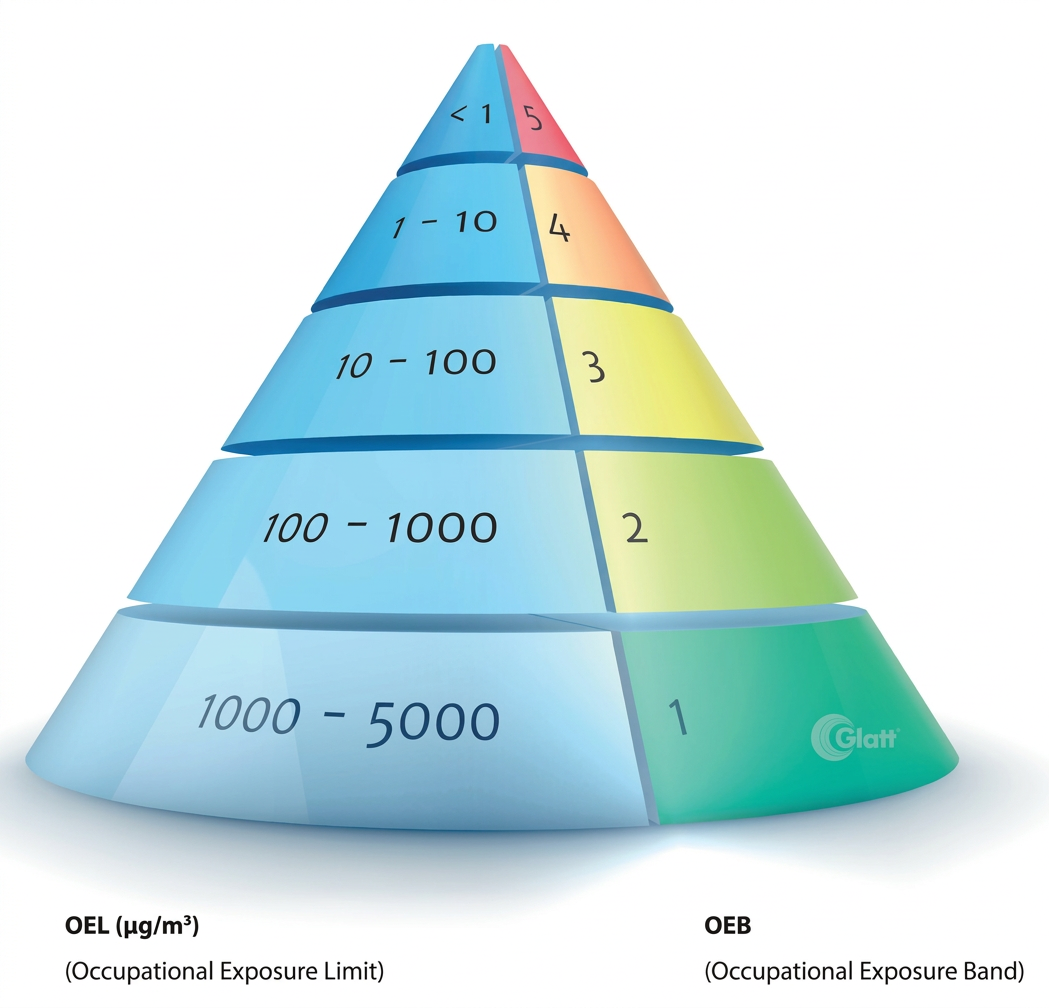
Occupational Exposure Limit (OEL) – the average concentration (µg/m3) of a substance in the work area over an eight-hour period.
Occupational Exposure Band (OEB) – the toxicity level of a substance.
Each of the five toxicity categories (OEB1-OEB5) corresponds to a specific OEL value.