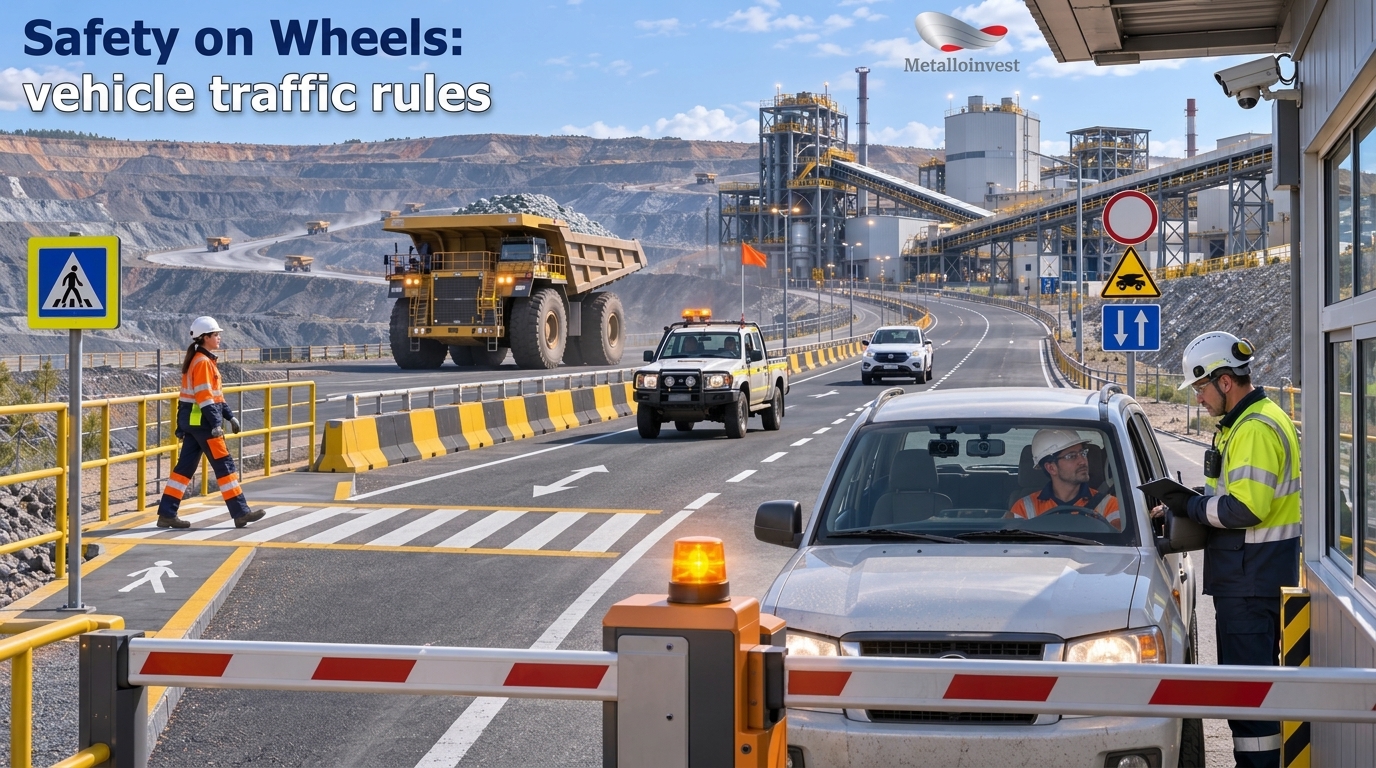
Safety on Wheels: Vehicle Traffic Rules
JSC Lebedinsky GOK has developed the Regulation "On Improving Safety in Vehicle Operations at Production Sites and Facilities." The document consolidates requirements for vehicles, drivers, pedestrians, and contractors — from pre-trip inspections to traffic accident response procedures. Here are the key takeaways.
For one of the largest mining and processing plants, transport is not a support function but an integral part of the production process: dump trucks, specialized machinery, passenger cars, and freight trucks operate side by side with people every day. That is why the new document covers not only drivers, but also pedestrians, passengers, and contractor organizations. The Regulation's requirements also apply to third parties performing work at the plant's sites using their own vehicles.
Traffic Plans: The Foundation of Order
In every division operating motor vehicles, personnel responsible for traffic safety are appointed by formal order, and the technical director approves the site traffic plans. These plans designate vehicle and pedestrian routes, road signs and markings, points where traffic flows intersect, loading and unloading zones, parking areas, wash bays, and speed limits.
Vehicle Dispatch: Only Through the Technical Inspection Checkpoint
No vehicle is dispatched without a pre-trip technical inspection. This check is performed by qualified inspectors holding relevant secondary vocational education or professional retraining in the field of Ground Transport Engineering and Technology. The inspector verifies that all components and systems affecting traffic safety are in working order and comply with Customs Union Technical Regulation TR CU 018/2011 and Russian Road Traffic Regulations, confirms that the trip sheet bears a medical professional's clearance stamp, and only then signs off.
What Every Vehicle Must Have
All vehicles — including contractor machinery — have been equipped with a first-aid kit, fire extinguishers, high-visibility vests, warning triangles, and at least two wheel chocks. Every vehicle is fitted with a dashcam that activates automatically when the engine starts; vehicles transporting personnel have dual-channel systems, with one camera recording the road and the other recording the driver.
A separate "equipment inspection" has been introduced for entering the open pit: passenger cars and category M1–M2 and N1 vehicles must be fitted with a safety whip flagpole at least 1.5 meters tall carrying a flag with reflective elements, all-around reflective striping, and an LED light bar. Entry without a mining site work authorization certificate and a special "OPEN PIT" pass is prohibited.
The Open Pit: A Zone of Special Rules
A dedicated section of the Regulation focuses on the open pit. Overtaking, coasting downhill in neutral, parking within 10 meters of a bench slope, driving over high-voltage cables on the ground, and approaching heavy-duty equipment closer than 30 meters (a dump truck's blind spot is 5 meters) are prohibited here. Passing mining and road machinery is permitted only after requesting clearance via radio, on the left side, on a straight stretch of road, and with an explicit "go-ahead" from the operator or the person in charge of the relocation.
Mandatory for all: low-beam headlights at all times of day, a flashing beacon or LED light bar, a safety whip flagpole, and workwear and PPE when exiting the cab. Two-way radios are also required on vehicles operating in the open pit.
Contractors Go Through the Same Screening
Before entering the plant's premises, all contractor vehicles are inspected by a specialist from the Traffic Safety Division of the HSE Directorate; following the inspection, a checklist (Appendix A) is completed to assess fitness for operation. No checklist means no work and no entry.
Contractor drivers complete a safety induction, and those working in open pits must undergo an additional briefing and obtain a "Right to Work in the Open Pit" certificate.
Penalties for Violations
Responsibility is distributed across levels: division managers are accountable for implementing the Regulation, training, and oversight; employees for complying with it; and contractor managers for ensuring their personnel follow the requirements. In the event of a violation, the vehicle pass is revoked for two months; upon a repeat violation, site access is revoked — for plant employees for up to one year (reinstatement is possible only by decision of the managing director), and for contractors up to termination of access for their vehicles and contractual penalties.