Risk Under Control
Occupational safety has long ceased to be a set of instructions posted on a bulletin board. Modern safety systems are built as a management process: hazards are identified, measured, ranked, and systematically reduced. At Lebedinsky GOK, this approach is anchored in its HSE risk management system. Its core section—risk management—describes the complete cycle, from how to properly formulate a risk to how it makes its way into the budget and onto meeting agendas. Let's look at how it works.
Knowing How to Name a Risk
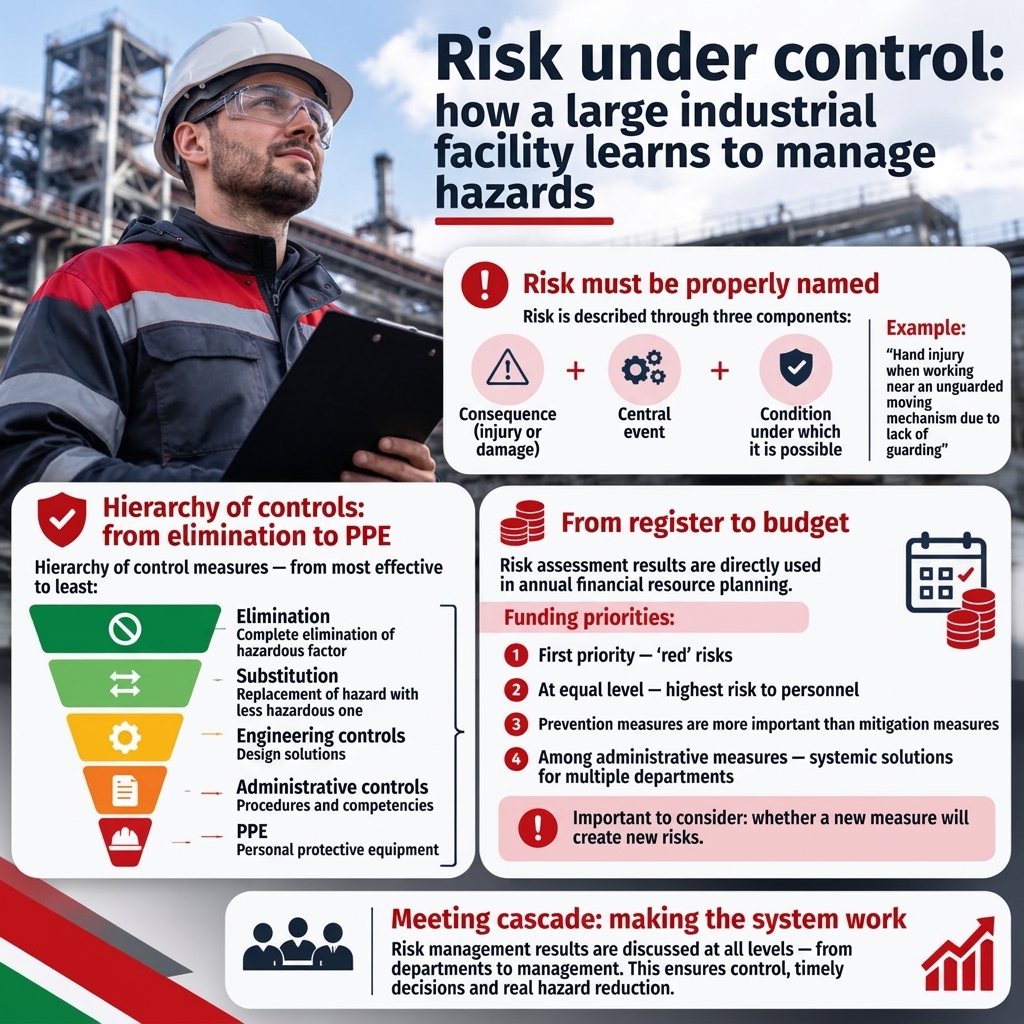
Any work with risk starts with its formulation—and this is not bureaucracy, but the foundation of the entire process. A risk is described through three mandatory components: the consequence (injury or damage), the central event, and the condition under which it can occur. A root cause may also be specified. This structure forces teams to describe risks specifically rather than in vague terms: without the pathway to the event and a specific severity of consequence, the formulation is not considered valid.
Why such strictness? The answer is simple: a vaguely worded risk can neither be assessed nor eliminated. "Something might go wrong" is not a risk. "Hand injury while working near an unguarded moving mechanism due to the lack of a guard" is actionable material for analysis.
The Ladder of Controls: From Elimination to PPE
Once barriers are identified, the next question is which controls to choose. The answer comes from the hierarchy of controls—a ranking of risk-reduction methods by effectiveness, from most effective to least effective:
- elimination — completely removing the hazard;
- substitution — replacing the hazard with a less hazardous alternative;
- engineering controls — design solutions that prevent the risk from materializing;
- administrative controls — procedures and competencies used to control the hazard;
- PPE — personal protective equipment, the least effective tier.
Controls at the top of the ladder take priority by definition: they act on the source of the risk rather than on the worker. The highest value lies in measures that completely eliminate the root causes of the risk.
From Risk Register to Budget
The risk management system does not stop at assessment: its results feed directly into annual financial planning. The risk register serves as the basis for including corrective actions in the budget plan, with clearly defined priorities:
- measures addressing "red" risks are funded first;
- when risk levels are equal, priority goes to hazards posing the greatest risk to personnel;
- preventive measures take precedence over mitigation measures;
- among organizational measures, priority is given to systemic ones—those that reduce risks across multiple departments at once.
At the same time, specialists must also consider the flip side: whether the new control itself could introduce new risks. This foresight is the hallmark of a mature system.
Cascading Meetings: Keeping the System Alive
The final element is the risk management meeting cascade: a three-tier system of meetings that keeps the HSE risk management system running. The first tier is the steering committee meeting at the management company level, the second is the committee at the production division level, and the third consists of meetings of department heads.
The objectives of these meetings are standardized at every tier: monitoring the implementation of action plans and KPIs, reviewing new key risks, analyzing problem areas, and promoting best practices. Issues that cannot be resolved at one level are escalated upward, while successful solutions are cascaded downward for replication. The quality of the meetings themselves is also monitored: at least once a quarter, the agenda, report quality, and participant engagement are audited.
Why All of This Matters
Formally, it is a set of procedures. In essence, it is a philosophy: any risk can be named, measured, broken down into barriers, and systematically reduced—not through punishment or slogans, but through a transparent system where every risk has an owner, every action has a deadline and an accountable person, and best practices have a clear path upward. That is how safety stops being a standalone function and becomes part of everyday enterprise management.