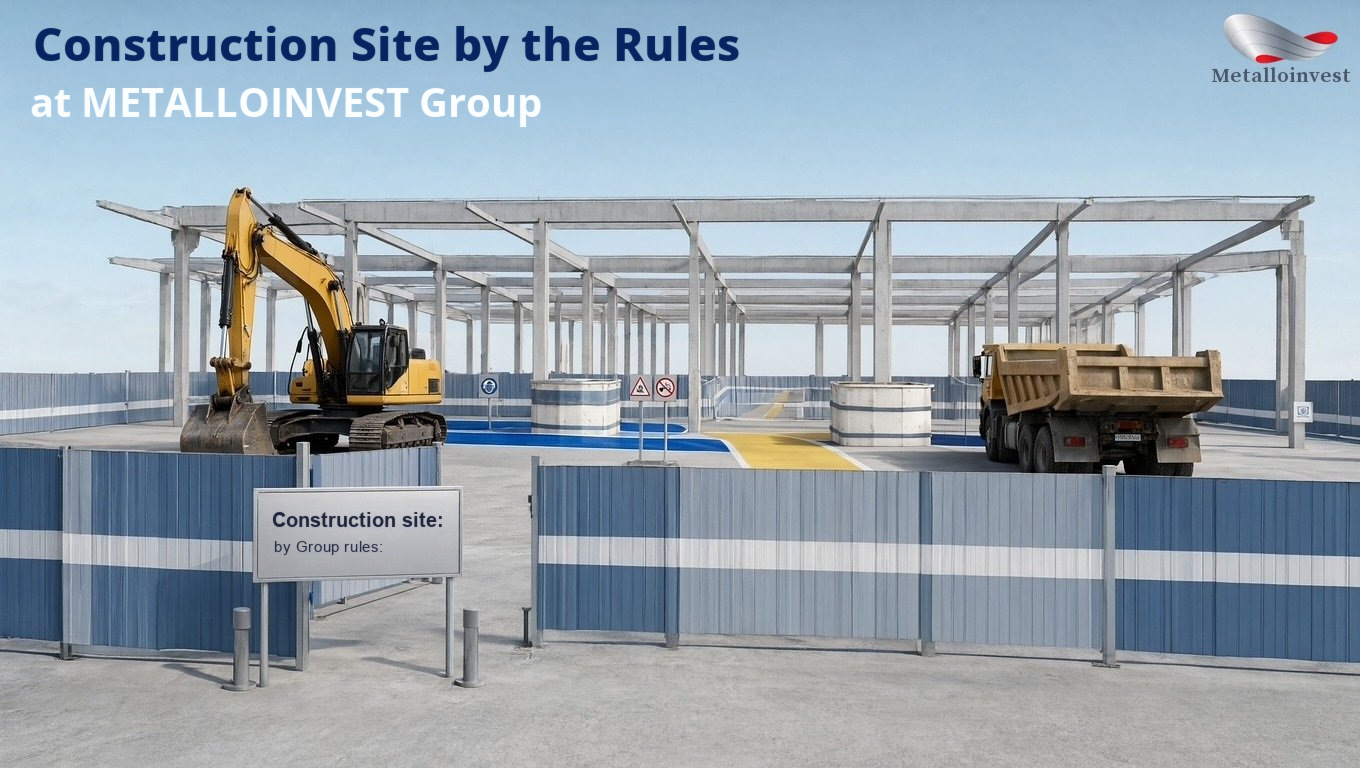
Construction Sites by the Rules: Metalloinvest Group's Unified Construction Organization Standard
Anyone who has ever visited a major industrial construction site knows that simultaneous sense of order and chaos: dozens of contractors, machinery, materials, and worker welfare compounds. Bringing order to all of this is just as serious a challenge as the construction itself. To address this, Metalloinvest Group has a Construction Site Organization Standard in place. Here is a look at what it regulates and how compliance is monitored.
Why a Unified Standard Is Needed
The standard applies to all projects implemented under the capital expenditure program of the Group's managed subsidiaries—including new construction, reconstruction, and technical upgrades of operating production facilities. It establishes unified rules for organizing construction sites, from perimeter fencing and traffic layouts to requirements for welfare compounds, waste management, and lighting.
The standard's objectives are stated with complete candor: to ensure a strong operational culture and the safety of client, general contractor, and subcontractor personnel; reduce occupational injuries; cut costs resulting from the loss or damage of material resources; minimize the environmental impact of construction; and establish a unified approach to managing construction, installation, and commissioning works.
The document's core principle is that contractor personnel safety is no less a priority for the client than the safety of its own employees. This is not a mere declaration, but a working rule on which all subsequent requirements rest.
What Must Be on Site
The standard details what a properly organized construction site should look like. Key focus areas include:
- Perimeter fencing and access control — solid or mesh fencing at least 2 m high, security checkpoints equipped with barrier gates and turnstiles, and prevention of unauthorized access;
- Information signage — a project notice board and site layout plan at every vehicle and pedestrian entrance, safety signs, and operational information boards for engineering and technical personnel;
- Traffic infrastructure — hard-surfaced roads with traffic signs (10 km/h speed limit, no overtaking), pedestrian walkways at least 1 meter wide, and protective canopies over entrances to buildings under construction;
- Welfare facilities — modular site camps providing 6–8 sq. m per person located 100–200 m from work areas, along with changing rooms, drying rooms, showers, warming shelters, dining areas, and designated smoking areas built from non-combustible materials;
- Hazardous areas — protective and warning barriers, safety signs, and emergency assembly point maps for personnel;
- Storage area organization — leveled storage pads protected from surface water runoff; a ban on storing materials on uncompacted soil or grassed areas; and specific storage requirements for rebar, gas cylinders, and combustible materials;
- Waste management — segregated collection across five hazard classes, labeled containers with lids, properly equipped container pads, and contracts with the regional waste operator and licensed disposal contractors; burying or burning waste on site is prohibited;
- Temporary utilities — power supply and lighting (working, emergency, evacuation, and security) compliant with GOST 12.1.046-2014, as well as water and heat supply installed per design documentation layouts;
- Fire safety — for sites of 5 hectares or more, at least two entrances on opposite sides, gates at least 4 meters wide, a fire water supply in place before main works begin, 15×15-meter turnaround areas for firefighting vehicles, and fully equipped, labeled firefighting equipment stations;
- Personnel site access authorization and PPE compliance.
A separate section of requirements covers work at operating production facilities. During reconstruction and technical upgrades, construction and installation zones are separated using portable and permanent barriers with protective canopies, and all work execution plans are approved by shop management—the overall production process must remain uninterrupted.
Who Is Responsible for What
The standard clearly divides responsibilities. At the design brief stage, the client incorporates the standard's requirements and provides the contractor with the construction organization plan and the remaining documentation. Based on this plan, the general contractor develops work execution plans and organizes and funds compliance with the requirements—including supplying fencing, information boards, and signs per requisitions derived from the plan.
Site preparation must be completed no later than two months before construction and installation works begin, and the site itself is handed over to the contractor under a formal site handover permit with a geodetic survey control network. At operating production facilities, work is performed under a permit-to-work. Designated engineering and technical personnel are appointed to manage site upkeep across each area of supervision: environmental compliance, fire safety, and electrical safety.
How Compliance Is Verified
The oversight mechanism is laid out in a separate procedure approved under the same corporate directive. At its core is a monthly checklist prepared by the general contractor and submitted to the client for audit. As early as the first month of preparatory works, the site is presented to the client for inspection against the completed checklist.
The Result
In essence, the standard moves operational culture on the Group's construction sites from informal agreements into measurable indicators. Unified requirements for fencing, welfare facilities, environmental protection, and fire safety, combined with a transparent audit procedure and clear accountability for all parties, make construction predictable—both for the people working on site and for the company itself.