Reducing Fall Risks: ZARUBEZHNEFT-dobycha Kharyaga’s Practice of Using Anchor Lines on Vertical Ladders
According to the Federal Service for Labor and Employment, in 2022, there were 4,639 industrial accidents in Russia with severe consequences for the victims. 991 of these incidents were fatal. The Federation of Independent Trade Unions of Russia provides even more serious figures: according to this organization, the number of accidents in Russian companies at the end of 2022 was 5,563. At the same time, falls from height are the leading cause of these cases, accounting for 23%.
Falling from height has always been among the top three causes of industrial injuries. A fall is an event in which a person loses their balance, resulting in them hitting the ground or a protruding object below.
Whenever possible, an employer should eliminate work at height; however, if this is not possible — as is the case in most instances — we must move from total risk elimination toward mitigating the severity of consequences. ZARUBEZHNEFT-dobycha Kharyaga has carried out proactive work in this direction.
According to Clause 84 of the "Occupational Safety Rules for Work at Height," approved by Order of the Ministry of Labor of Russia dated November 16, 2020, No. 782n, ladders used for ascending or descending employees to workplaces at a height of more than 5 meters must be equipped with safety systems.
How should this clause be interpreted? After all, a ladder can be equipped with any type of safety system — for example, by hanging a retractable fall arrester at the upper exit point to the work platform. Alternatively, one could require all employees to use safety harnesses equipped with two lanyards and continuously move them to the next rung while climbing, placing mandatory safety signs at every ladder. Formally, the rule is met. But is the risk reduced? Will such measures truly lead to a reduction in the consequences of a fall? Or perhaps these measures will actually increase the risk, as it is very inconvenient to re-attach lanyards at every step and rung.
 |
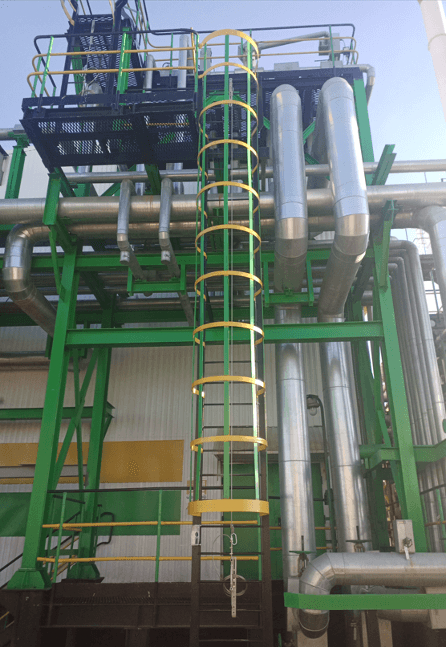
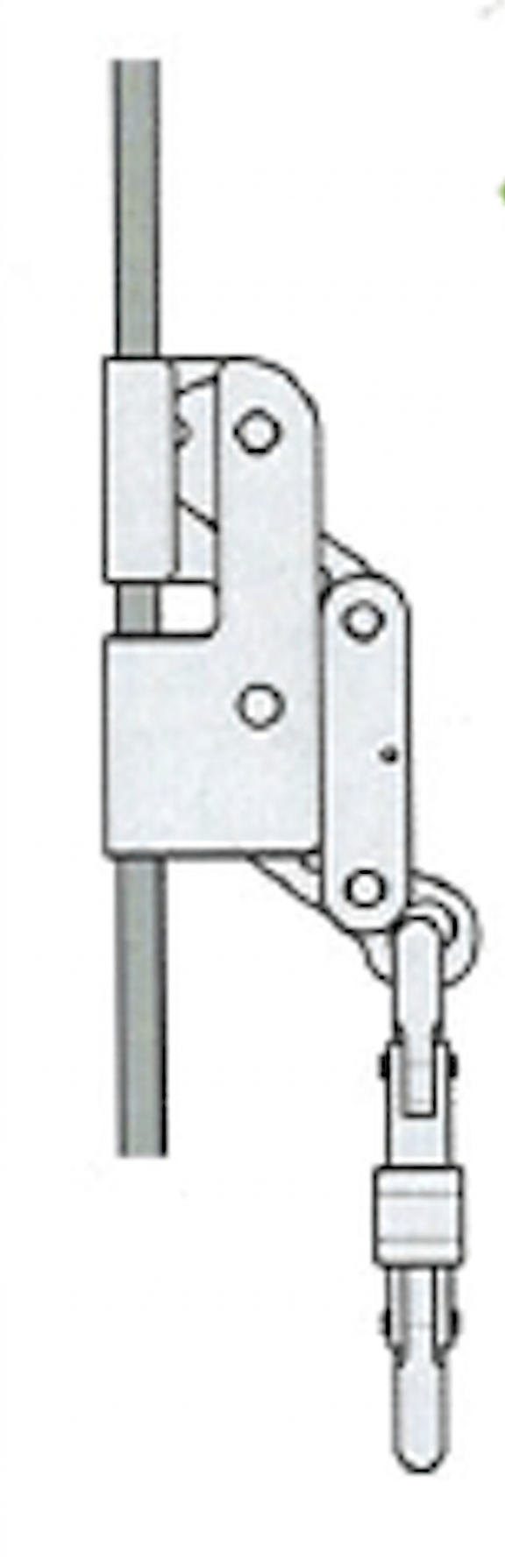
The most optimal solution was the installation of vertical anchor lines with a slider mechanism. At the same time, after counting the number of ladders 5 meters or higher and comparing it with the total number of ladders not covered by the rules (i.e., less than five meters), the company decided to allocate additional funding and establish an internal rule: to equip ladders with a height of 3 meters or more with anchor lines. Thus, when climbing, the worker clips into the slider at the bottom point and can concentrate directly on the ascent using both hands, rather than on the moment of re-clipping. In the event of a fall, the locking mechanism triggers automatically, and the shock absorption function is integrated into the grab design. The fall depth is minimal. |
 |
In 2022-2023, 147 vertical ladders at ZARUBEZHNEFT-dobycha Kharyaga were brought up to the internal safety standard, which we believe has led to a reduction in the probability of workers falling from height. And this is far from everything that has been implemented. The next article will be dedicated to the implementation of the standard for securing objects when performing work at height and how this practice was realized. Follow us on HSE DAYS, and see you soon!