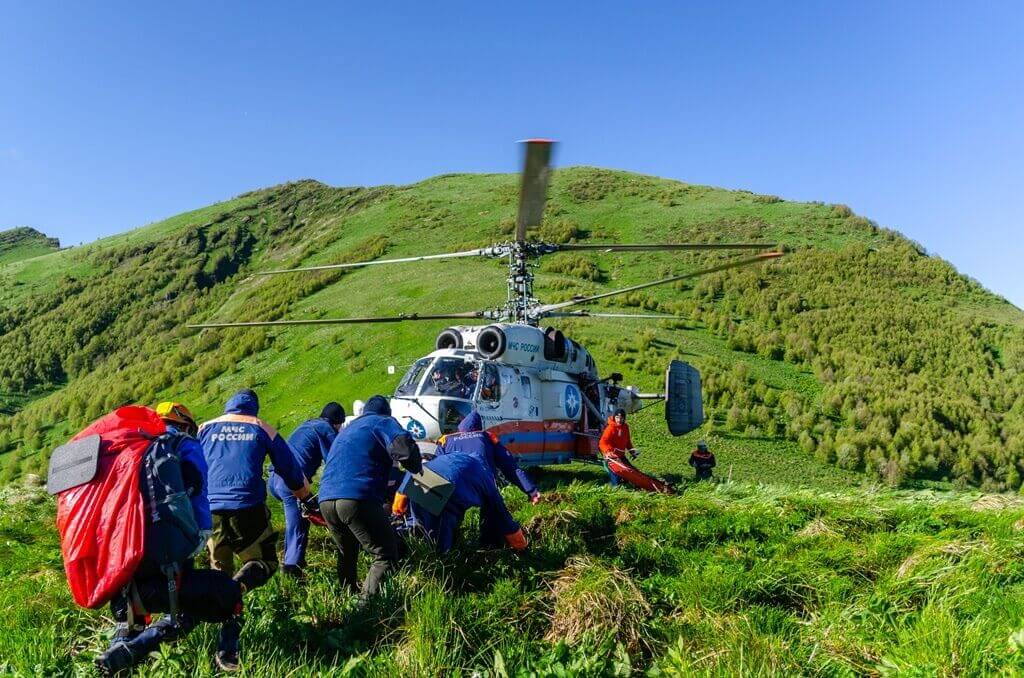
Challenges of Evacuating Workers During Accidents and Incidents from Remote Areas and Ways to Solve Them
Organizing the evacuation of mineral exploration industry workers from remote and hard-to-reach areas during accidents and incidents is a complex and significant challenge. Our task is not only to organize the timely and safe transport of workers located 200-300 kilometers from the nearest settlement but also to do so with minimal time and resource expenditure. All regulatory acts currently in force in the Russian Federation only govern personnel evacuation activities during natural and man-made emergencies and do not provide answers regarding actions to take when workers are injured in extreme conditions. Since a significant portion of exploration activities takes place in remote areas that are virtually inaccessible to transport, the personnel evacuation process faces several problems caused by the geographical, climatic, and landscape features of these territories, as well as technical and organizational complexities of the evacuation process itself.
What we have to deal with when evacuating personnel from remote areas:
- Lack of developed infrastructure. In remote areas, the necessary transport and communication infrastructure is missing, making the evacuation process to medical facilities, which is standard for an average person, completely inaccessible. This leads to delays in the arrival of rescue services and medical workers, and often to the impossibility of prompt communication with the victims and other group members.
- Difficulty of access to victims. Difficulties in reaching the scene of an incident may be due to the lack of roads, complex terrain, marshy ground, and other factors. All of this combined complicates rescue operations and the evacuation of the injured person.
- Limited capabilities of rescue equipment. In some cases, the rescue equipment and tools used for evacuation may not meet the conditions of work in remote areas. For example, helicopters may be limited in their capabilities during rescue operations in mountainous terrain, due to distance from the incident site, or in poor visibility conditions.
- Lack of qualified specialists. Not all work areas have a sufficient number of qualified rescuers or medical specialists capable of responding promptly to accidents in remote areas and conducting the evacuation of victims.
- Lack of medical devices and equipment. Remote villages often lack the necessary equipment, which may only be available in regional centers.
- Use of work groups without paramedics (workers without medical education). Most groups operating in remote areas consist only of members trained in first aid programs and actions in extreme situations. Having a paramedic on the route without the necessary medical equipment does not guarantee the provision of high-quality medical care if the victim sustains severe injuries.
- Climatic conditions. Climatic conditions can also become a serious obstacle to evacuation efforts. Low temperatures, strong winds, snowfall, and other weather phenomena can significantly hinder the work of rescuers and medics.
- Problems with evacuation organization. Organizing the evacuation process requires clear planning and coordination of various services and structures. In remote areas, this can be difficult due to the lack of a single evacuation control center and a lack of information about the incident.
- Psychological issues of group members. Workers caught in an accident or other extreme situations may experience severe stress and fear, which can negatively affect their ability to make rational decisions and provide assistance to both the victim and the rescuers.
As a result of the combination of factors described above, the time required for rescue operations can increase significantly, which may lead to a deterioration in the victim's condition and an increased risk to their life.
How we approach solving the problems mentioned above:
- Operational Headquarters. To resolve issues requiring prompt response, the Holding has established an Operational Headquarters structure that functions 24/7 and handles all emerging emergency issues, including victim evacuation.
- Development of an evacuation plan before starting any work in remote areas. In the Holding's subsidiaries, documents are developed before a project begins to plan activities in the event of accidents and incidents in remote areas.
- Documented algorithms for transmitting data on accidents and incidents. The Holding operates a data transmission system that involves all stakeholders in the shortest possible time.
- Employee training program for first aid in such areas. Before being sent to work in remote areas, all employees undergo training in first aid, actions in extreme situations, and the transmission of operational data during incidents.
- Use of telemedicine technologies. The use of telemedicine technologies in areas with satellite and internet coverage allows for the involvement of qualified medical specialists in solving problems.
- Evacuation reception points, intermediate evacuation points. Algorithms allow for the creation of routes along which victims will be promptly delivered to receive high-quality medical care.
- Analysis of actions based on evacuation results. Upon completion of evacuation measures, an analysis and evaluation of the results are conducted. This allows for the identification of weaknesses in the organization and execution of evacuation measures, as well as the development of measures to improve their effectiveness in the future.
Evacuating a worker during accidents from remote areas is a complex task that requires an integrated approach and interaction between various structures and organizations. The development and implementation of innovative technologies, infrastructure improvements, and specialist training can significantly improve the situation and make the evacuation of a victim more effective and safe.