#Professional development
Professional development for OHS specialists. The shift from 'bureaucratic controller' to business partner. Includes competency matrices, facilitation, soft skills, and mentoring the next HSE generation.
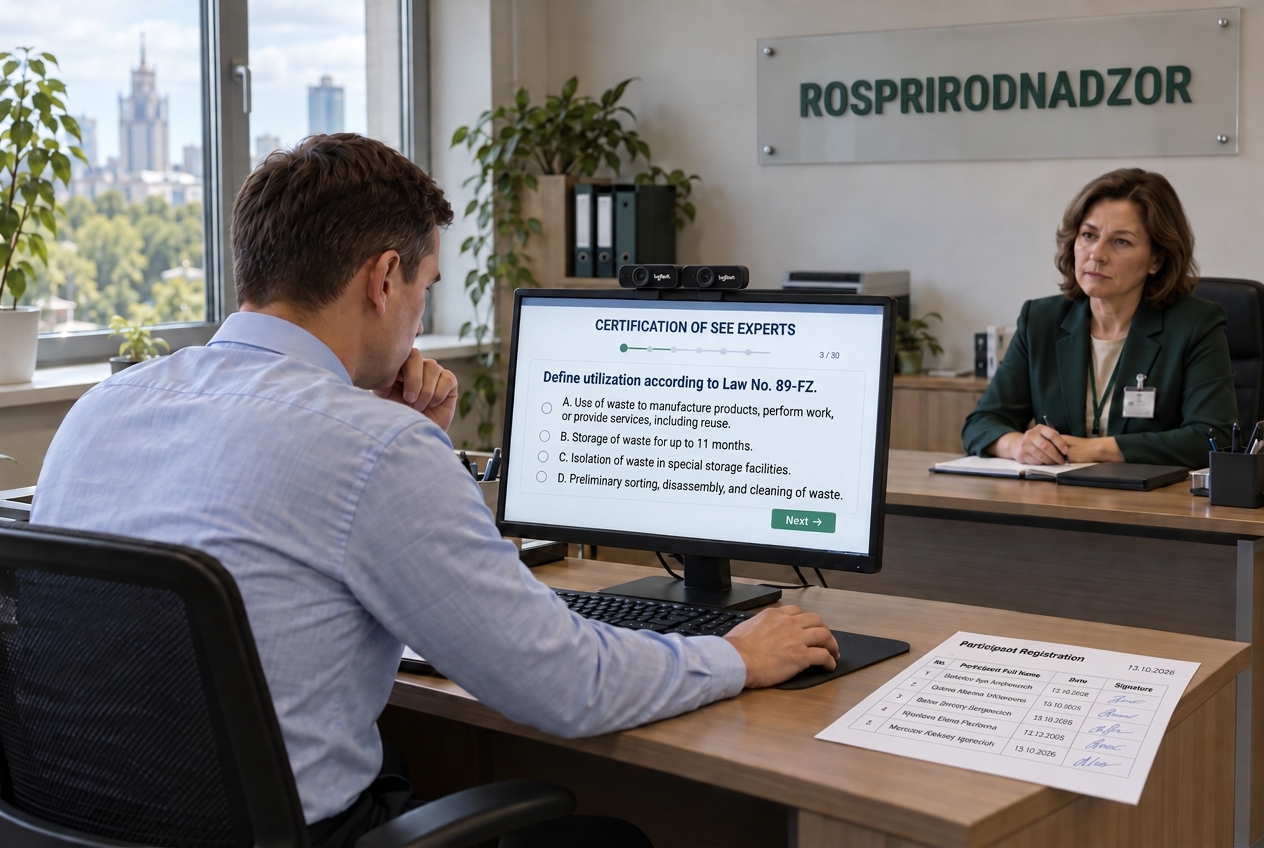
SER Expert Certification at Rosprirodnadzor: Preparation Experience and Pitfalls
A practical breakdown of State Environmental Review expert certification at Rosprirodnadzor under Order No. 110. How to choose certification areas, apply via Gosuslugi, avoid testing traps, and why practical environmental experience alone is not enough to pass the exam.
The Image of the HSE Function as a Tool for Safety Culture Development
Why do workers hide risks from safety professionals, and how can companies shift from policing to partnership? We explore Nornickel's experience: four factors of HSE perception, shop floor placements, and a feedback system that turns the department's image into a practical safety tool.



Environmental Competence Development Program: Generating an ECO-Future
A practice-oriented system for developing environmental competencies and a safety culture at Novovoronezh NPP, spanning the entire cycle from kindergarten to school, university, and enterprise in partnership with 7 universities, 15 educational institutions, and 35 commercial enterprises. The approach integrates educational initiatives, corporate volunteering, and active learning methods (role-playing simulations, case studies, scenario-based drills, and incident root cause analysis via 8D and 5...

Malleable as Wax: Onboarding Young HSE Specialists in Enterprises Amid Talent Shortage
Amid a severe talent shortage, inexperienced newcomers are joining the HSE field. How do you prevent burnout and turn them into loyal professionals? We break down a step-by-step onboarding system for young specialists: from mentorship and development plans to a three-year checklist.

Where to Grow When the Traditional Career Ladder Reaches Its End?
Professional and career development methodology for safety specialists based on the portfolio career concept. Identifying and monetizing unique competencies (superpowers), working with mentors, and targeted soft skills development to increase market demand.

The occupational safety specialist: a profession that never loses relevance
The Deputy Head of the Occupational Health and Safety Service at Mosgortrans on a profession that almost always remains behind the scenes: why an occupational health and safety specialist today works not only with documents, but also with people, how "invisible" work affects company risks and expenses, and why the development of technology makes this role more complex, rather than simpler.

AI Agents and Vibecoding: What Has Changed in HSE Over the Last 6 Months
The application of autonomous AI agents and vibecoding technology to automate routine processes in industrial safety. The practice includes using neural networks to independently identify hazards from photos, fill out risk registers, calculate budgets, and generate local regulatory acts without involving IT specialists. Implementing this approach transforms the role of the HSE specialist into a "knowledge broker," radically reducing the time spent on analyzing regulatory frameworks and investiga...

Mentorship: A Key Link in Developing Professional Competencies
A two-tier mentorship system featuring workforce requirement calculations, rigorous selection, and continuous support through workplace supervision. To practice hands-on skills, a full-scale training and production site was created, operating on a shift schedule synchronized with main production. Bureaucratic burden was reduced by implementing a single three-year additional agreement, while a professional Telegram community was launched to foster engagement.
AI Prompting: A Fundamental Skill for the HSE Specialist of the Future
Integration of artificial intelligence into the daily tasks of an HSE specialist through mastering prompting skills and using no-code platforms. Practice includes automating routine processes, delegating analytical tasks to AI assistants, and transitioning to the Prompt First paradigm to improve management system efficiency.

Developing Competencies in HSE
Transformation of the HSE competency development system, shifting from formal training to practical skill building. Implementation of centralized providers, in-house trainer-mentors at production sites, and an LMS for training management.

Development Tools Without Million-Dollar Budgets: Practice of Building a Strong HSE Team
Forming an ecosystem for HSE team development without external budgets. Implemented cross-functional internships, role exchange with business trainers, brainstorming for idea testing, and internal coaching on practical skills.

Mentorship Experience: An Inside Look
The author shares personal experience of mentoring in the field of occupational health and safety and explains why the transfer of practical knowledge from an expert to a novice specialist becomes a strategic necessity for building a safety culture. The article examines the personal benefits of mentoring for both sides: the expert gains the opportunity to structure their own experience and hone management skills, while the mentee receives proven action algorithms and support for confident career...