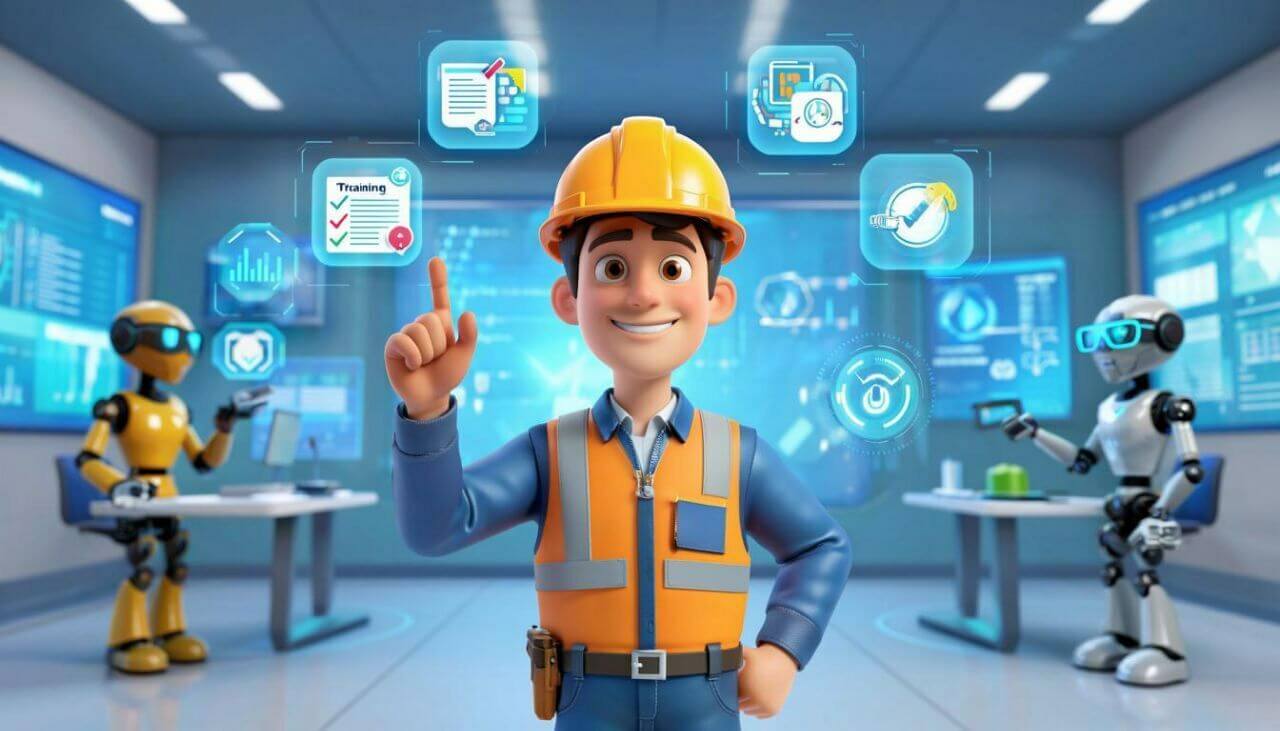
From Digital Literacy to AI Literacy: New Competencies for HSE Professionals
Digital transformation in HSE is undergoing a new, qualitative stage. While the focus was previously on digital literacy — the ability to work with ready-made tools for data collection and analysis — it is now being replaced by AI literacy. This is not just a change of software; it is a paradigm shift in the professional's work.
Evolution of Key Tasks and Competencies
-
Before: The goal was to quickly obtain and present data.
The professional acted as an operator: their task was the accurate and rapid collection of data, entering it into an information system (Excel, 1C, etc.), and visualizing it, for example, in Power BI or DataLens. The key skill was the technical ability to work with a ready-made interface.
-
Now: The goal is to teach the neural system to think and work, freeing up time to work with people.
The professional becomes a process architect. Their goal is to teach the neural network to think and work in order to free up their own time for strategic and human-oriented tasks: direct work with personnel, in-depth risk analysis, and prevention.
What AI Literacy Includes in Practice:
-
In-depth work with documents. This is not about simple storage, but about structuring arrays of information, analyzing and categorizing them using AI for instant search and identifying connections.
-
Creating and training a knowledge base. The professional "feeds" the AI assistant regulatory documents, instructions, and past cases, "teaching" it to provide accurate and contextual answers.
-
Designing interaction logic. This is a key task. The architect thinks through how the dialogue between human and AI will be structured to minimize errors and increase process efficiency, rather than simply reacting to requests.
Conclusion
The key skill of a modern HSE professional has shifted from mastering interfaces to prompting — the ability to correctly set tasks for AI, verify, and adjust its work. This requires not only technical savvy but also deep subject matter expertise in their field. Only in this way does AI transform from a simple tool into an intellectual ally capable of building a new safety culture at the enterprise.