Digital Checklists: Managing Facility Maintenance Readiness and Strengthening Accountability
Over more than 20 years of working in industry—from frontline operational roles to management positions—I have become convinced that maintenance safety is established at the stage of facility preparation and crew work authorization.
Therefore, one of the areas of my work in digitalizing occupational health and industrial safety is the "Digital Checklists" project for a major chemical enterprise.
At a production site, multiple facilities are prepared for maintenance simultaneously. The shop superintendent cannot always personally inspect every preparation item at every workstation. This creates a risk of incomplete inspection coverage: tasks are distributed among different personnel, and information on their completion arrives in a fragmented manner.
Digital checklists help organize this workflow. The shop superintendent delegates inspections to responsible employees, assigns specific tasks for assessing facility maintenance readiness, and receives feedback on the results.
For each checklist item, one can record task completion, actual readiness status, identified deficiencies, and the need for additional actions. The manager receives a detailed picture of facility preparation, based on which they can assess whether to authorize crews to start work under established procedures.
This approach strengthens the personal accountability of everyone involved in the preparation. It becomes clearer who is verifying a specific condition, what issues have been identified, and what still needs to be done. Delegating inspections makes it possible to expand facility coverage and provide the shop superintendent with the information needed for decision-making.
Additional reliability is ensured by dual verification: an inspection by a responsible employee followed by an evaluation of the results by a manager. When issues are found, feedback must clearly show which corrective measures have been completed and which items remain open.
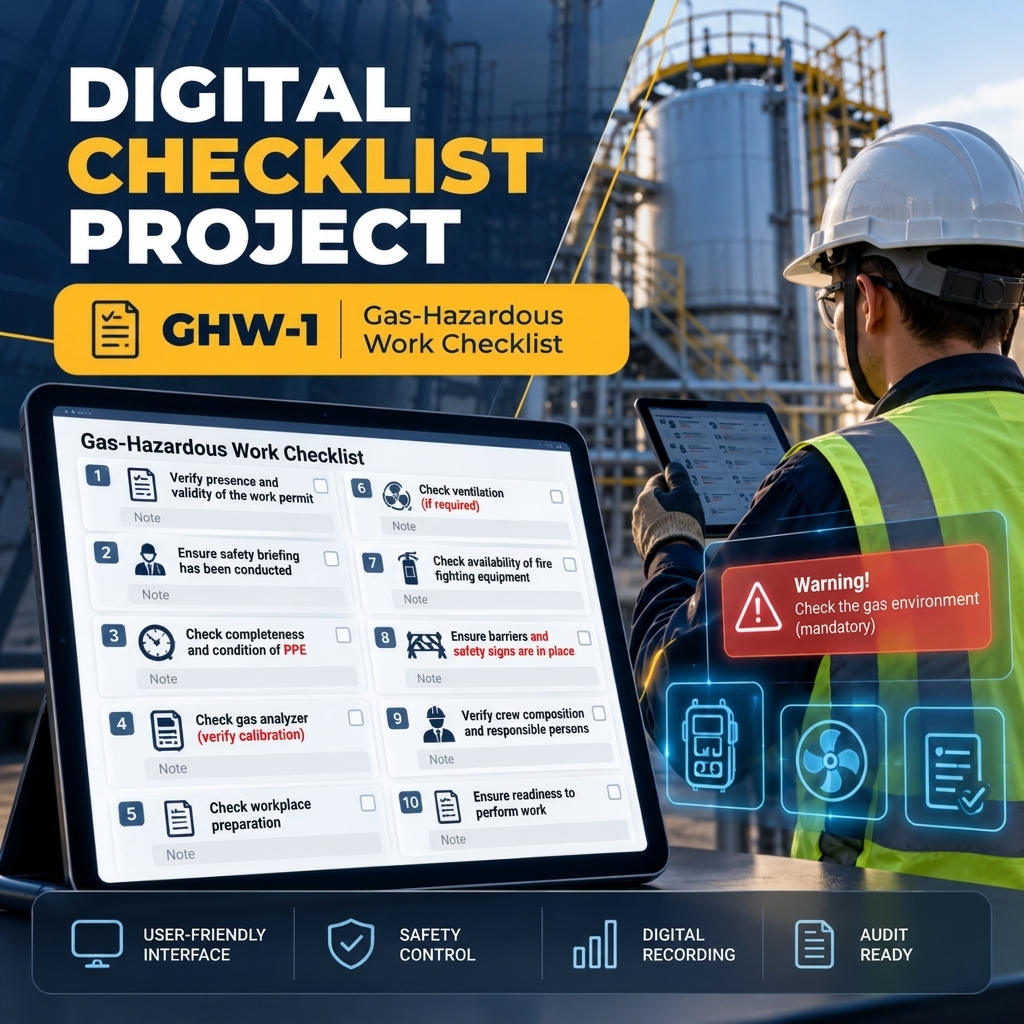
For hot work and gas-hazardous operations, sequential verification of equipment and area preparation, required PPE, firefighting equipment, and stipulated safety measures is especially critical. The digital form helps guide personnel through all checkpoints and record the outcome for each one.
A key requirement for the project is offline functionality without an internet connection and ease of use directly at the workstation, including on mobile devices, along with timestamping the actual inspection.
The managerial value of checklists also lies in data accumulation. Inspection results make it possible to analyze recurring deficiencies, identify weak spots in facility preparation, and determine priority preventive measures.
The effectiveness of such a tool should be evaluated by the completeness of facility inspection coverage, the timeliness of feedback, the time taken to resolve issues, and the reduction in recurring deficiencies.
My goal is to integrate digital checklists into a unified digital industrial safety ecosystem, enabling the shop superintendent to organize inspections, see the actual readiness of facilities, and make informed decisions on authorizing crews to begin work.