The Occupational Safety Quadrant (Injury and Incident Quadrant)
The Occupational Safety Quadrant shows that injury and incident rates depend on two key factors:
- safe working conditions at the workplace, and
- safe human behavior.
This means we are dealing with two groups of management targets:
- passive elements (equipment, materials, processes, and the worker as an object of control), and
- active elements (the worker as an autonomous agent with their own will and interests).
Managing these two groups clearly requires different management approaches and tools.
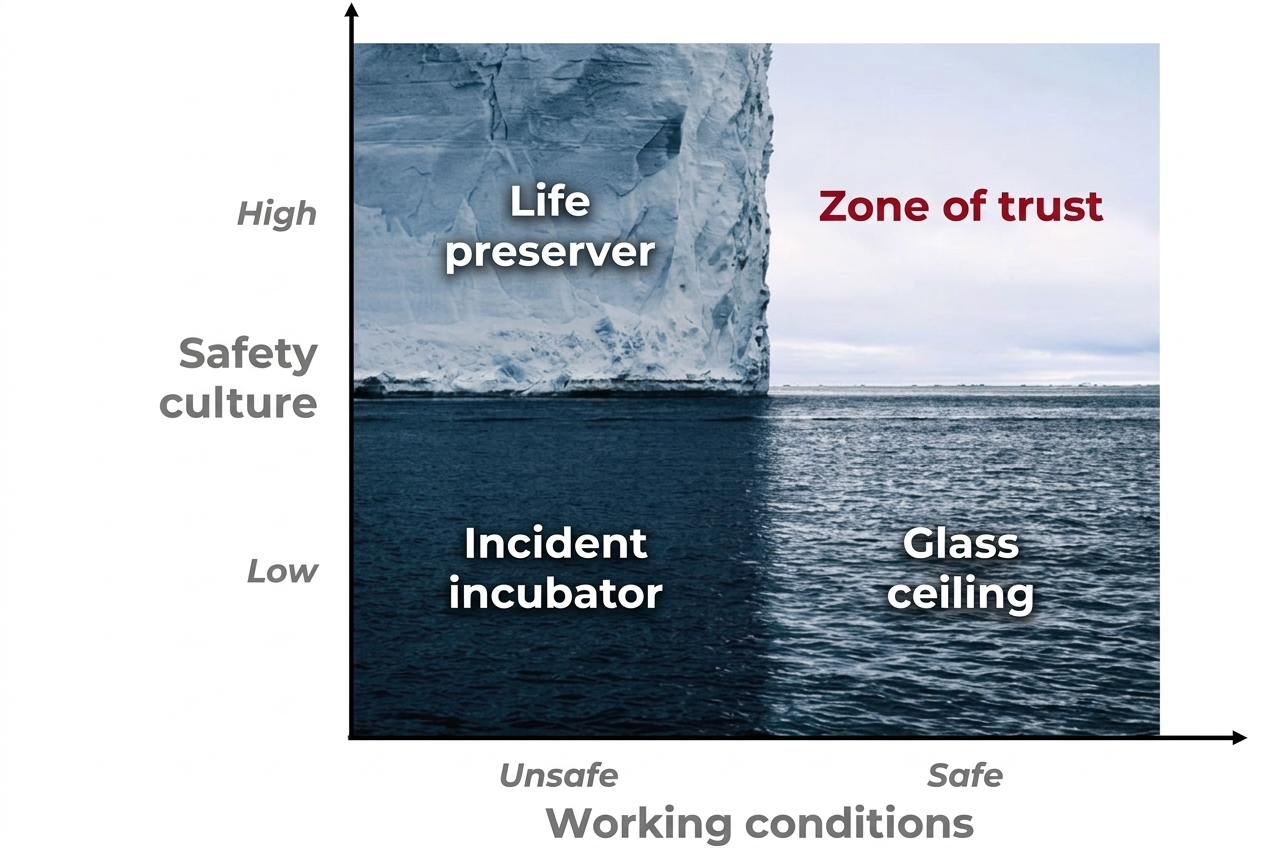
The relationship between them can be visualized as the Occupational Safety Quadrant or Injury and Incident Quadrant (Mazhkenov, 2023): the horizontal axis represents working conditions (from unsafe to safe), while the vertical axis represents safety culture (from weak to strong).
Different combinations of management effectiveness across each group produce the following outcomes:
- Incident Incubator (chaos, lack of management and control) — unsafe conditions + weak safety culture (maximum injury rate).
- Glass Ceiling (illusion of protection, bull in a china shop)— safe conditions + weak safety culture (workers break rules despite outward compliance).
- Lifebuoy (culture against the system, behind enemy lines) — unsafe conditions + strong safety culture (high psychological strain and burnout risk).
- Zone of Trust (zero-harm operations) — safe conditions + strong safety culture (target state, sustainable safety).
Clearly, the optimal and only acceptable outcome for any business is combining high standards of safe working conditions with safe human behavior—resulting in zero injuries and incidents.
P.S. Unfortunately, I could not find the photographer behind the iceberg image.