On Defining the Concept of Occupational Risk
The Labor Code of the Russian Federation defines occupational risk as the probability of harm to health resulting from exposure to harmful and/or hazardous workplace factors while an employee performs duties under an employment contract.
The probabilistic approach to occupational risk assessment has been used in occupational safety for decades and has demonstrated its fundamental inability to properly solve the task of risk assessment. A proper solution implies traceability, reproducibility, and verifiability of both the risk assessment process and its results.
The main reasons for this are the lack of a statistically significant volume of incident data and the absence of reliable information on the causal relationships between a hazard and its consequences.
Well known in occupational safety is H.W. Heinrich's incident pyramid, which reflects the empirical ratio between incidents of varying severity (major, minor, and near misses). The value of H.W. Heinrich's incident pyramid lies in illustrating a clear hierarchy among incidents: their number increases as the severity of consequences decreases.
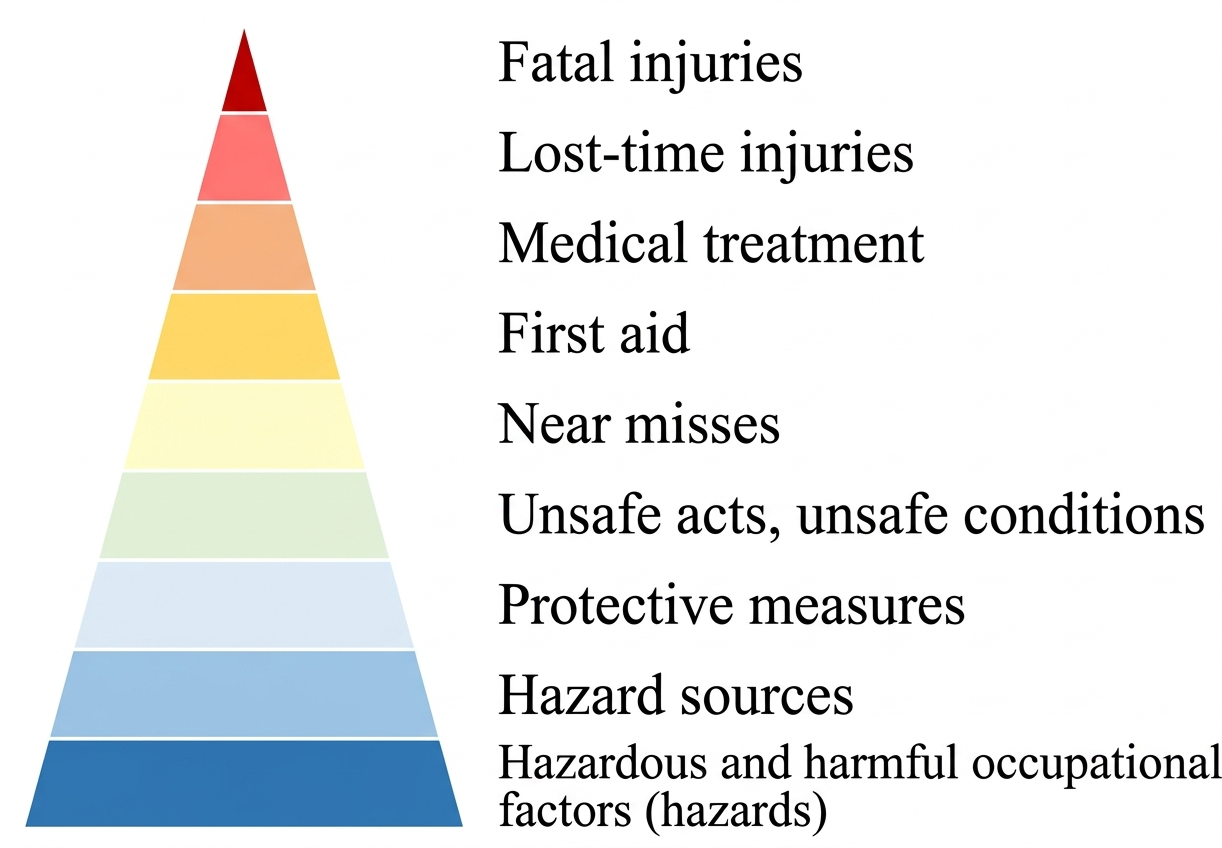
Guided by the principle of causality and a risk-based approach, it seems natural to refine the modern version of the pyramid by expanding its base (below unsafe acts and unsafe conditions), as shown in the figure.
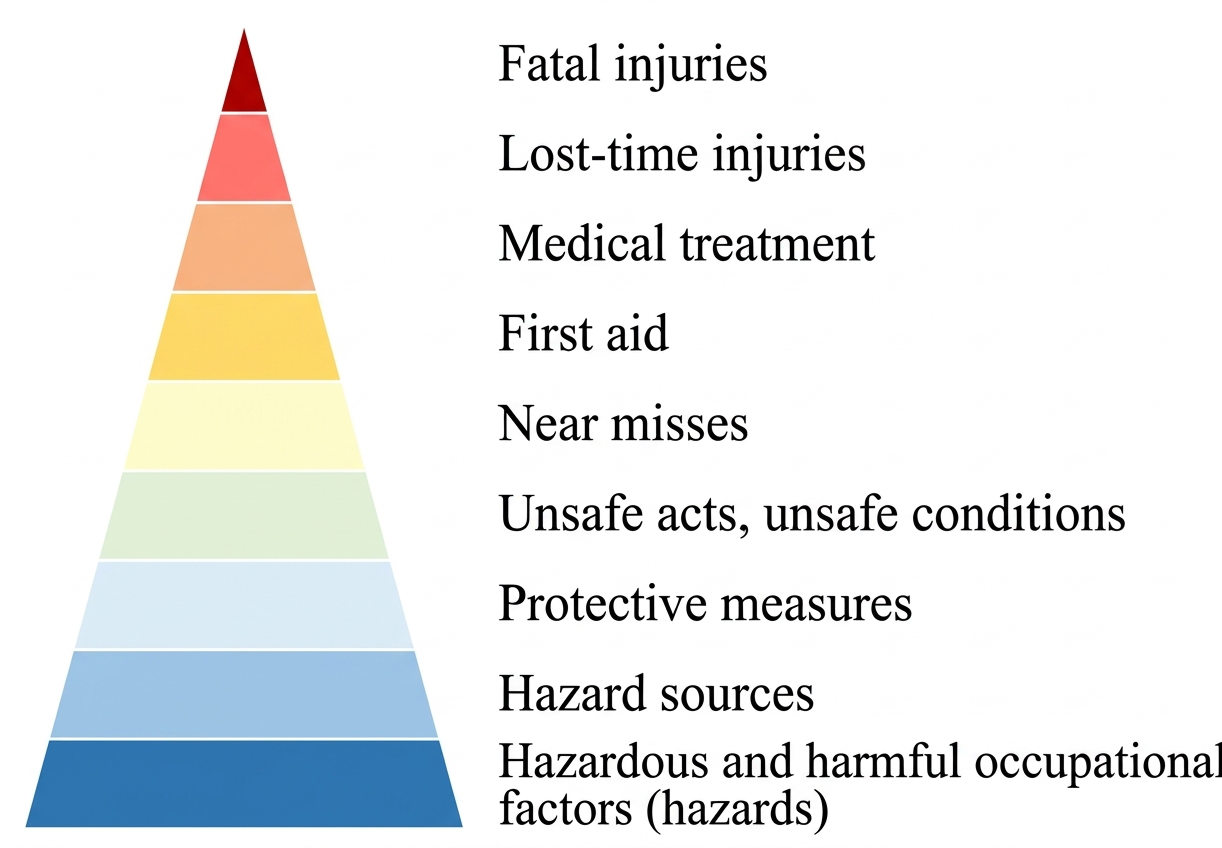
Modified incident pyramid
The modified version of the incident pyramid reveals the mechanism by which hazards transform into incidents. The five upper levels of the pyramid represent undesired events (incidents) with varying severity of consequences—ranging from a fatal injury to zero harm (an incident without consequences). The four lower levels describe different groups of factors that share a specific causal relationship with incidents.
Thus, the fundamental prerequisite for incidents to occur is the presence of hazardous and harmful workplace factors (hazards). The carriers of these factors are specific hazard sources (instruments, devices, machinery, tools, materials, substances, etc.). Eliminating or reducing the negative impact of hazards on people is achieved through protective measures applied to a specific hazard source. The absence of protective measures or a breach of their integrity manifests as unsafe conditions or unsafe acts in the workplace, which, under unfavorable circumstances, materialize into incidents with various consequences.
Based on the above and guided by the principle of sufficient reason (causality), which states that "nothing exists without a sufficient reason for its being," it can be asserted that occupational risk is the result of establishing a causal relationship between a hazard and its expected consequences, while occupational risk assessment is the result of determining the level or strength of the link between a hazard and its expected consequences. According to the modified incident pyramid, it is evident that the primary barrier preventing any hazard from materializing into an incident consists of protective measures, which effectively determine the level of risk.
This understanding of the nature of risk and its assessment opens up new opportunities for improving the effectiveness of occupational risk management.