Defining the Concept of Safety Culture
The concept of "safety culture" entered occupational health and safety (HSE) from the nuclear industry and was introduced by the IAEA in 1986 following the publication of the "Summary Report on the Post-Accident Review Meeting on the Chernobyl Accident" by the International Nuclear Safety Advisory Group (INSAG).
There are many different definitions of safety culture:
- that assembly of characteristics, organizational practices, attitudes, and individual behaviors which establishes that, as an overriding priority, nuclear plant safety issues receive the attention warranted by their significance (INSAG-4 report, 1991);
- fostering in every person involved in nuclear power a mindset in which they are simply incapable of taking any step to the detriment of safety, even if the probability of a hazard materializing is extremely low (O. L. Tashlykov, 2018);
- a set of values and actions resulting from a consensus reached within the workforce between senior executives and employees to give safety the highest priority over other priorities in order to protect people and the environment (V. Demchenko, Yu. Sotnikova, 2004);
- an integral part of the overall operational culture, representing the combination of management activities and personnel behavior aimed at ensuring the safety of radiation-hazardous facilities (SanPiN 2.6.1.07-03);
- a high level of development of the system for preserving the life and health of workers in the course of their work activities (Russian Encyclopedia of Occupational Safety);
- what a person does when no one is watching (a popular definition among HSE professionals).
Using all of these definitions to develop a safety culture proves quite challenging, as they are rather vague and do not allow operations managers to focus on specific areas of human behavior.
Why is defining any concept so important? A precise definition of key concepts and terms gives them a clear semantic framework that sets the direction for finding effective solutions—the foundation for further development. Clearly, if this conceptual framework is inaccurately defined or has become outdated, all subsequent decisions or actions based on these concepts and terms will be ineffective.
Our definition of safety culture is grounded in the following propositions.
Any corporate culture reflects the level of internal alignment among all members of an organization toward achieving a common goal. Naturally, people are the carriers of any culture, and the level of development and maturity of each employee determines the overall cultural maturity of an organization or society. Based on this, we first need to understand the mechanism behind how human actions are formed.
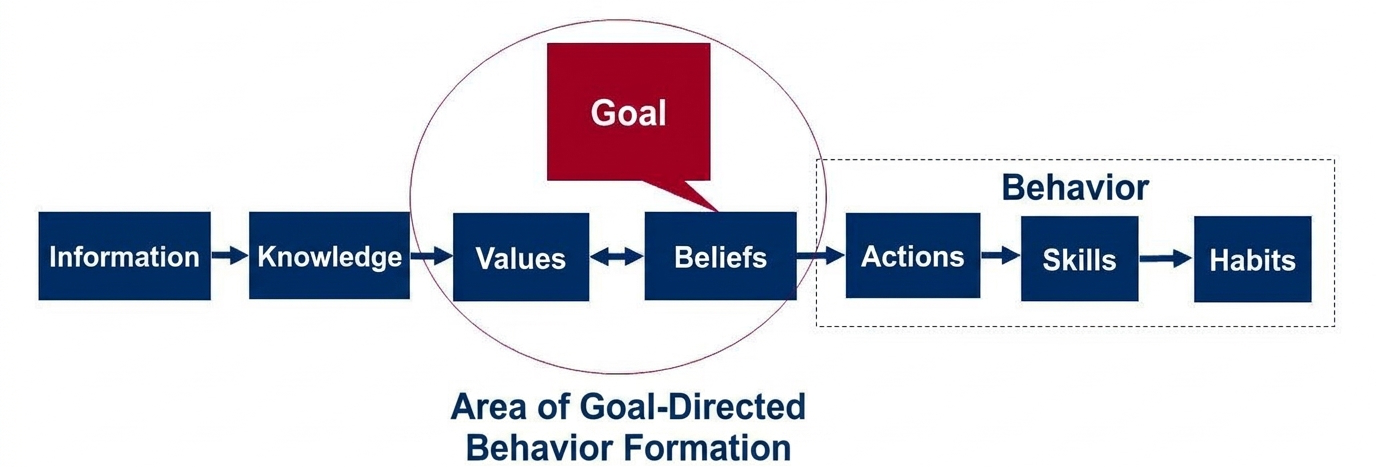
The general model of human behavior formation looks as follows: information coming from the external environment is transformed into a person's knowledge and, after passing through their filter of values, becomes their beliefs, which then manifest in various forms of behavior (actions, abilities, and habits). However, the behavior of a system that depends solely on incoming information is typically unstable and unpredictable. The susceptibility of human consciousness to manipulation under such conditions is well illustrated by the Overton window concept. Stability and predictability in the behavior of any system are achieved only when it has a clearly defined goal.
The considerations above lead to the conclusion that safety culture is the combination of a person's values, goals, and beliefs regarding the safe performance of work (S. A. Mazhkenov, 2018).
This definition focuses attention on the interconnection and development of a person's values, goals, and beliefs as the fundamental basis for driving behavioral change in a desired direction.
It follows that the primary objective of organizational leaders, HSE professionals, and HR specialists is to effectively convey the necessary knowledge to employees in order to shape specific values, goals, and beliefs aimed at safe behavior and work execution in accordance with established safety standards.