He Who Owns the Information, Owns the World
In 1815, all of Europe was terrified by Napoleon's return. The English stock exchanges were in turmoil — everyone anxiously awaited the outcome of the decisive battle between the armies of Napoleon and Wellington at Waterloo. At the start of the battle, it seemed to observers that Napoleon was winning, and this was immediately reported to London. However, Blücher's Prussian corps arrived just in time to decide the battle in favor of the allies, and Napoleon fled. Throughout this time, Nathan Rothschild, founder of the English branch of the Rothschilds, had a staff of spies at his disposal who followed the troops and immediately sent reports to their master about all important events via carrier pigeon. The last pigeons with encrypted instructions tied to their legs were released immediately after the battle. The next morning, Nathan Rothschild appeared at the London Stock Exchange. He was the only person in London who knew for certain about Napoleon's defeat. All other traders immediately began selling off their shares, assuming the British had lost. Securities plummeted in value, while Rothschild's secret agents hastily bought them up. The news of Napoleon's defeat only reached the exchange a day later. In a single day, Nathan earned 40 million pounds sterling and gained control over a large portion of the British economy. This gave rise to the famous phrase: "He who owns the information, owns the world."
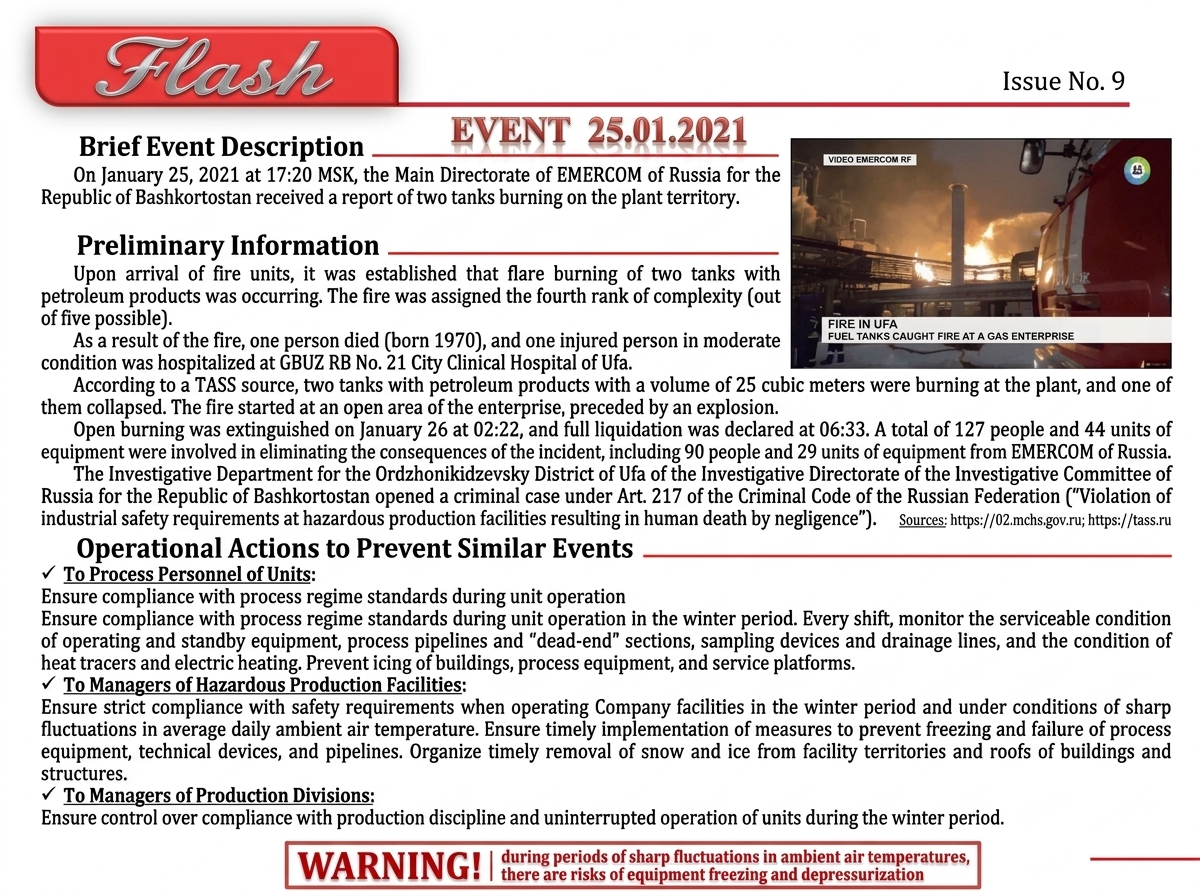
Understanding this, we created "Molniya" (Lightning), a tool for the rapid dissemination of information to employees regarding industrial incidents at production facilities. "Molniya" is an information sheet providing a brief description of the event, information on actions taken following the incident, and operational measures to prevent similar occurrences. "Molniya" is distributed to all structural units of the plant so that everyone, from managers to workers, can assess the possibility of such an incident in their own department and take necessary urgent measures as quickly as possible to prevent a recurrence in the future.
The distribution of "Molniya" is carried out via an automated system. Before reviewing the "Molniya" report, the employee must undergo mandatory photo identification via the system and then proceed to read the document. The advantages of this method of notification include:
- rapid delivery of incident materials and developed preventive actions to personnel;
- reduced risk of similar industrial incidents;
- the ability to monitor employee acknowledgment of the distributed information materials.