
Safety Culture Starts in the Mind: The Role of Metacognitive Skills
Metacognition: What Is It and How Does It Work?
Safety culture manifests not only in having rules and procedures in place, but also in how people recognize hazards, evaluate their own decisions, share doubts, and learn from deviations. Between knowing a requirement and taking safe action lies human self-regulation: whether a person notices a change in the situation, understands the limits of their competence, double-checks their initial decision, and is willing to stop and ask for help.
This process can be described through metacognition—awareness and regulation of one's own cognitive processes. In HSE, what matters most is not merely what a person knows, but how accurately they understand what they know and why, where they might make a mistake, and how they will verify their decision.
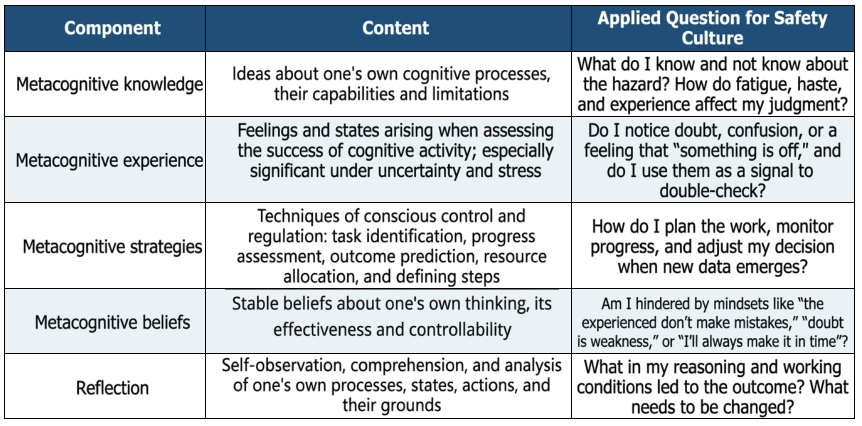
In scientific literature, metacognition is defined as "knowing about knowing," "thinking about thinking," and the conscious regulation of cognitive activity. Drawing on J. Flavell, the concept relates to an individual's knowledge of their own cognitive processes and ways to control them. Five interconnected components of metacognition are commonly identified, as shown in Table 1.
How Metacognition Connects to Safety Culture
- Recognizing the limits of competence: distinguishing between familiar and unfamiliar tasks, not confusing years of experience with universal competence, and bringing in a subject-matter expert in time.
- Confidence calibration: comparing subjective confidence against actual verification results.
- Monitoring uncertainty: treating doubt and confusion as warning signals rather than signs of incompetence. For instance, in a mature safety culture, an employee can say: "I'm not sure, so let's stop and check."
- Planning and forecasting consequences: evaluating not only task steps before starting work, but also personal resources, potential disruptions, points of no return, and stop-work triggers.
- Flexible adjustment: not forcing new data to fit the original plan, and revising decisions when conditions change.
- Learning from experience: analyzing expectations, decision rationales, missed signals, and organizational conditions rather than just the final violation.
- Shared metacognitive regulation: using peer questions, cross-checks, and team debriefings to uncover individual blind spots.
Metacognitive Characteristics of an HSE Specialist
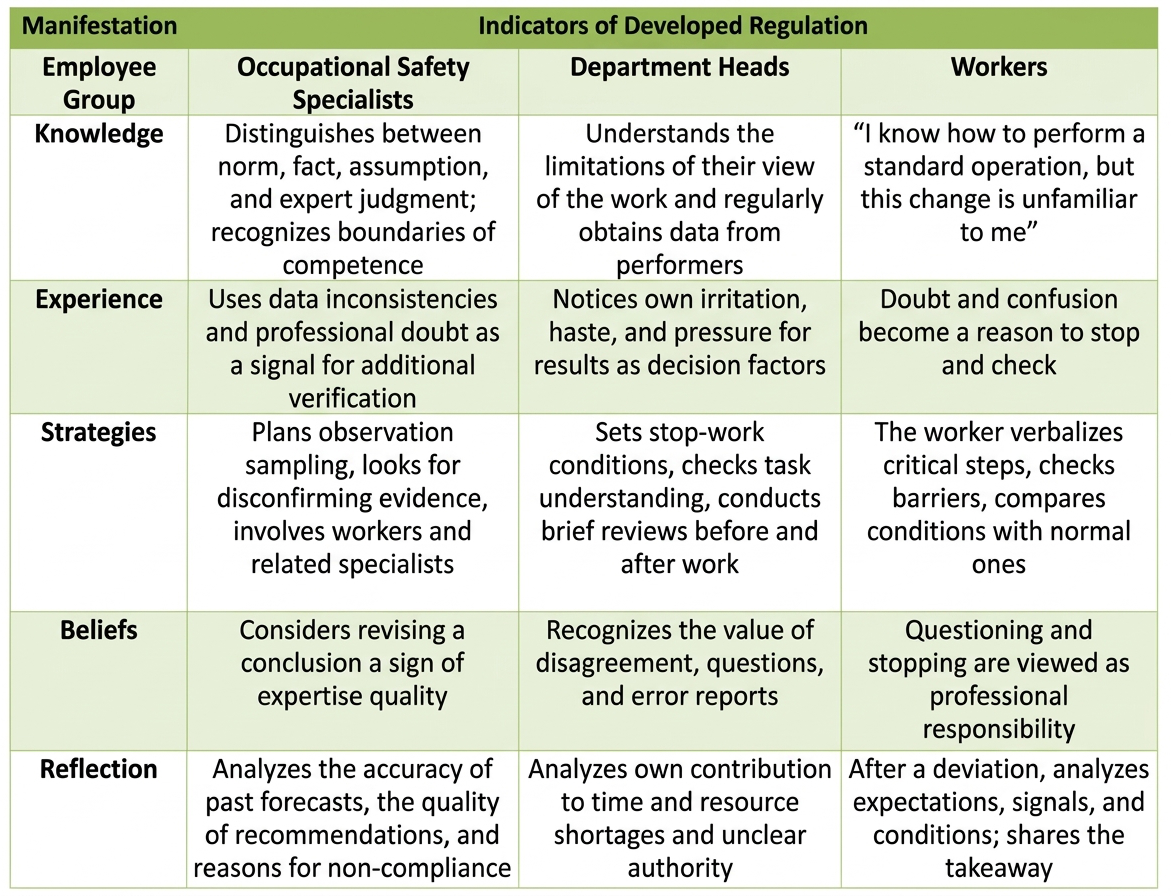
An HSE specialist does more than audit compliance; they build a framework of professional judgment by interpreting regulatory requirements, assessing risks, selecting diagnostic methods, explaining non-conformities, and monitoring control implementation. Their metacognitive task is to recognize the limitations of their own risk model and turn inspections into organizational learning.
Pathways for professional development:
- working through case studies with incomplete and contradictory data, including knowing when to conclude "there is insufficient evidence so far";
- peer review of colleagues' findings and regular cross-functional case reviews;
- observing work-as-done and interviewing frontline workers before reaching a final conclusion;
- analyzing not only safety violations, but also the effectiveness of one's own recommendations;
- training in cognitive biases and human factors without reducing incident root causes to "lack of discipline."
Metacognitive Characteristics of Line Managers
A line manager sets the real priorities on the ground: what takes precedence when deadlines clash with safety, whether it is safe to voice doubts, and how management responds to errors and stop-work interventions. A manager's metacognitive traits shape not only their own decisions, but also their team's capacity for reflection.
The core management skill is reflective leadership: the ability to openly refine one's own decisions, invite dissenting views, distinguish honest error reporting from willful violations, and translate lessons learned into improved working conditions.
How the HSE team can develop line managers:
- running "Decision – Doubt – Check – Adjust" training based on real operational dilemmas;
- conducting pre-shift toolbox talks;
- holding structured debriefings after high-potential incidents and near misses;
- assigning a designated challenger on complex jobs with the authority to ask probing questions;
- giving managers feedback on how their reactions affect hazard and risk reporting;
- tracking the implementation of agreed safety improvements.
Metacognitive Characteristics of Frontline Workers
For a frontline worker, metacognitive regulation shows up as pausing in time, self-checking, recognizing unfamiliar situations, asking for help, and applying past experience to new tasks. This is not about constant slow deliberation—in routine operations, many processes run automatically. Transitional moments are where it matters most: changes in technology, parameter deviations, non-routine work, rushing, fatigue, and working with a new crew.
How the HSE team can develop frontline workers:
- exposing workers to unfamiliar scenarios in simulators or training workstations;
- practicing voicing doubts out loud and asking for assistance;
- comparing pre-task confidence ratings with actual performance on training tasks;
- reviewing real cases and near-miss events;
- mentoring through guiding questions rather than merely demonstrating ready-made answers.
Ready-to-Use Training Exercises
- "Confident – Checked – Refined." A participant receives a case study, records their decision and confidence level from 0 to 100%, and then receives new information. Both accuracy and the appropriateness of revising the decision are evaluated.
- "Disprove Your Hypothesis." A specialist formulates an initial risk assessment and lists three pieces of evidence that could prove it wrong.
- "Three Versions of an Incident." A team explores technical, organizational, and cognitive hypotheses for an event.
- "Four-Question Debriefing." What did we expect? What actually happened? Why was there a gap? Which specific condition or action will we change, and who owns it?
- "The Right to Doubt." A role-play exercise practicing how a worker voices concern, how the supervisor responds, and the follow-up verification. Evaluation focuses on maintaining mutual respect and taking real action on the concern.
- "When Experience Backfires." Participants analyze a case where prior experience helped and another where it led to an unsafe action.
Conclusion
Metacognitive skills explain the internal mechanism that bridges knowing safety requirements and taking conscious safe action. For the HSE team, this means sound expert judgment and the ability to revise conclusions; for managers, reflective leadership and creating an environment where employees can openly question whether an action is safe; for frontline workers, self-checking, stopping work in time, asking for help, and learning from experience. Developing these capabilities works best when embedded into existing processes: risk assessment, work planning, mentoring, incident reviews, and continuous improvement. The most effective approach combines individual exercises, team debriefings, and organizational change.