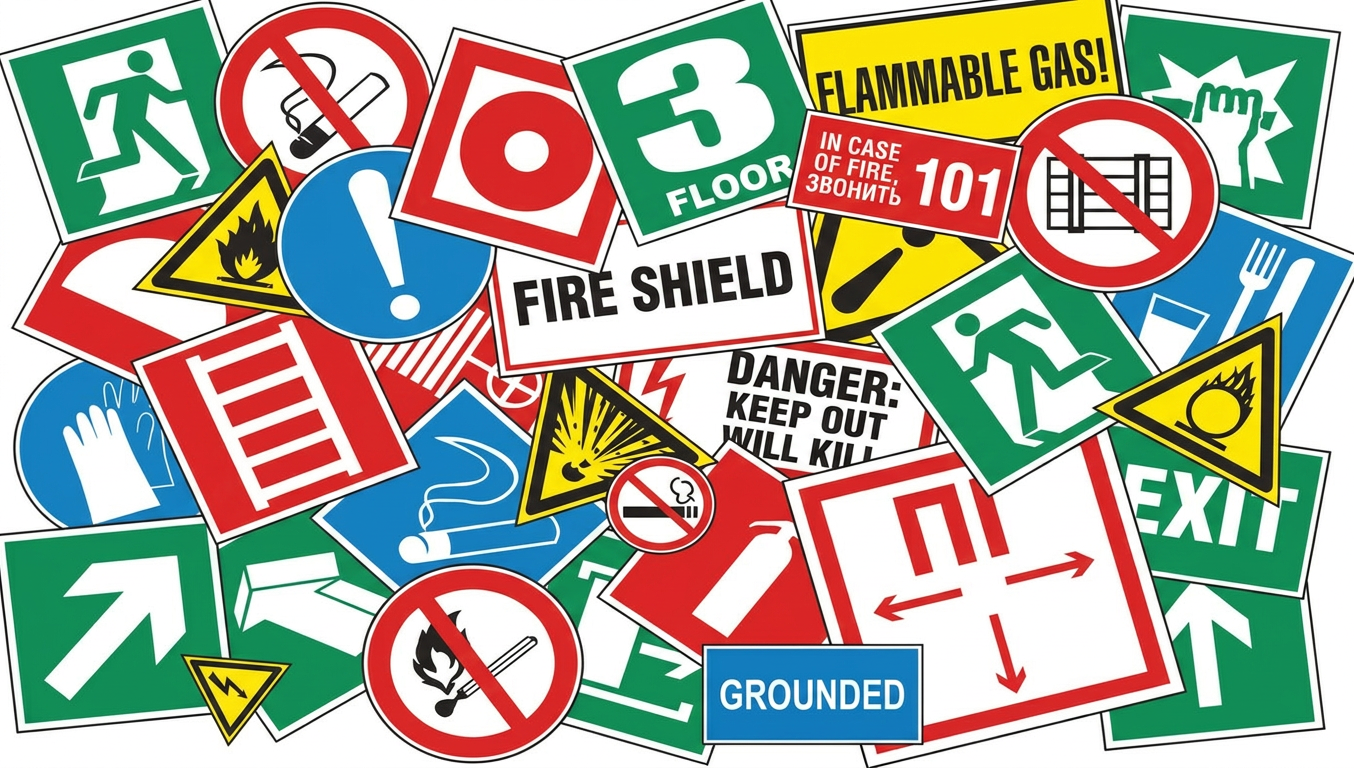
The Universal Language: Safety Signs
Imagine a noisy production floor: machines are running, forklifts are moving, conveyors are humming. In such an environment, a shout of "Watch out!" can easily get lost. This is exactly where a universal, silent, yet perfectly clear language comes to the rescue — the language of safety signs.
These are not just plaques on the wall, but an integral part of the HSE management system, one of the key elements of visualization that works 24/7, preventing injuries and saving lives.
Why are they needed? More than just a "warning".
The primary function of safety signs is to convey unambiguous information to a person in conditions where their attention is distracted and verbal communication is difficult. They solve several critical tasks:
- Hazard warning: inform in advance about a potential threat (high voltage, toxic substances, risk of falling objects).
- Prohibition: clearly indicate actions that are forbidden (no smoking, no entry without a hard hat, do not extinguish with water).
- Mandatory action: define actions that must be performed (wearing PPE, washing hands, moving along a specific route).
- Indication: show the location of rescue and medical equipment (fire extinguishers, first aid kits, emergency exits, assembly points).
The power of visualization: why does it work?
The human brain processes visual information faster and more efficiently than text. Under conditions of production stress, this advantage becomes decisive.
- Instant perception. The combination of color, geometric shape, and pictogram is perceived in a fraction of a second. There is no need to read and analyze text.
- Overcoming the language barrier. In a multinational production facility, a sign with the pictogram "Danger! Rotating parts" will be understood by all workers, regardless of their native language.
- Shaping behavior. Constantly encountering the same sign, a worker begins to follow the rule automatically. This fosters a safety culture.
- Structuring space. Signs help zone the territory, creating visually understandable "green", "yellow", and "red" zones based on the hazard level.
A language understood by everyone: color and shape.
For the system to be effective, it must be unified. Modern safety signs are standardized and use an intuitively understandable code:
- RED (Prohibition, Fire safety signs): stop! Prohibition, danger, location of firefighting equipment.
- YELLOW (Warning): attention! Warning of a potential hazard.
- BLUE (Mandatory): act! Requirement of mandatory actions for safety.
- GREEN (Emergency escape, First aid signs): safety! Indication of evacuation routes, rescue equipment.
A bit of history: from cave paintings to ISO.
Attempts to visually warn of danger are as old as humanity itself. But a systematic approach to safety signs began to form with the advent of the Industrial Revolution.
Early 20th century: with the growth of factories and plants, the first, often text-based, signs appeared: "Do not enter — it will kill you!". They were effective but not standardized.
After World War II: the active development of transport and international trade showed the need to create a universal system. Different countries began to develop their own standards.
1970s and later: the work of international organizations, such as the International Organization for Standardization (ISO), led to the creation of global standards (for example, ISO 7010). This allowed signs to be harmonized worldwide, making them a truly international language.
Safety signs are not just a "check mark" for inspecting officers. They are silent but vigilant guards in every area of production.