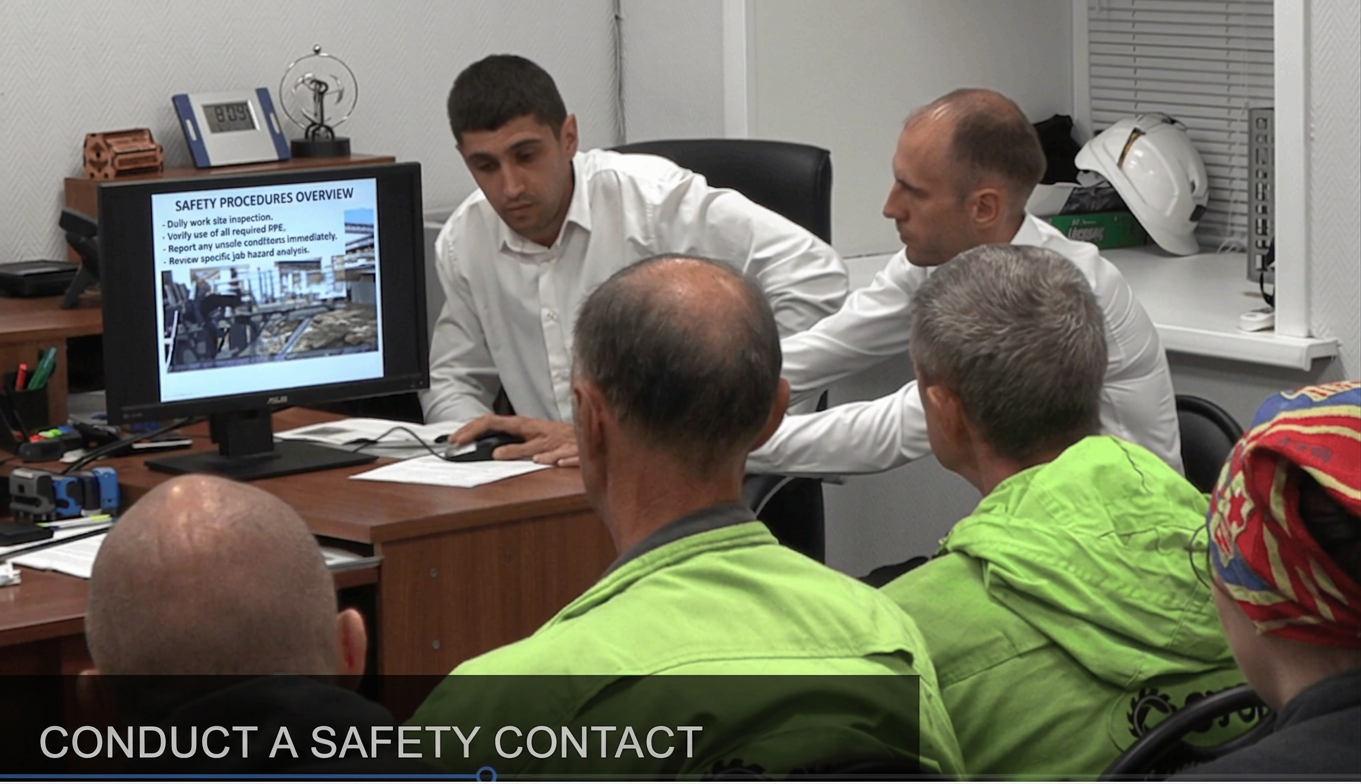
"Safety Contact": A Targeted Strike on Risks
In today's fast-paced production environment, time is a key resource. However, there is one tool that is always worth finding 5 minutes for. We are talking about the operational "Safety Contact" — a targeted, fact-based strike on risks.
This is not a long philosophical discussion, but a short, powerful, and timely signal for the entire team.
What is it? The essence lies in three points.
- REASON: A specific event. An accident, incident, alarming trend, or seasonal risk (ice, heat).
- CONTENT: A concise analysis. What happened or could happen? What are the root causes?
- GOAL: Clear recommendations. "What should we do to avoid finding ourselves in a similar situation?"
Example:
Event: A hand cut while changing tooling on a machine.
Cause: The worker did not use protective gloves, assuming it was a "quick" job.
Recommendation: "Dear colleagues! A reminder: personal protective equipment (gloves) must be used during ANY operation involving the replacement of cutting tools, regardless of how long it takes. Stop for 30 seconds — protect yourself."
Why is this so effective?
- Relevance: The information is not abstract; it is tied to a recent real-world case. This generates a stronger response than general rules.
- Timeliness: We react immediately while the event is still fresh in memory. This prevents a chain of recurring incidents.
- Memorability: A short and specific format is absorbed better than a multi-page manual.
- Scalability: Such a contact can be quickly communicated to the entire shift during a briefing, posted on a notice board, or shared in a chat.
How do you make such a contact truly work?
- Only facts. No fluff or general phrases. The essence, the cause, the conclusion.
- Focus on solutions.
- Language everyone understands. Avoid complex terminology. Speak to employees in their language.
- Regularity. Turn it into a system. One event means one operational contact. This builds a habit within the team of constantly learning from experience.
An operational "Safety Contact" is a kind of "vaccine" against repeating mistakes. It is a fast and precise channel that turns hazard information into a practical lesson for the entire team, strengthening overall safety.