Incident Investigation: Not About Blame, But Hunting for Root Causes
At a coal mining enterprise, any mistake can come at a high price. A conveyor stoppage, a shearer breakdown, a ventilation failure — the classic "find and punish" reaction here is not just ineffective, but dangerous. If an employee is afraid to report a minor malfunction, tomorrow it could turn into an accident with human casualties.
It is time to change the approach. Incident investigation at a production facility is not a punitive process, but a strategic "hunt for causes." Its goal is not to find a scapegoat, but to discover the weak link in the safety system, technology, or work organization and eliminate it forever.
Why is the "hunt for causes" a matter of enterprise survival?
The fear of punishment is the main enemy of industrial safety. If people on the ground are afraid to report violations or minor failures, management is deprived of vital information. Problems are hushed up, accumulate, and create the preconditions for a disaster. By shifting the focus from the person to the systemic cause, we create a culture of openness and collective responsibility. Every incident becomes not a reason for a dressing-down, but a valuable opportunity to make the mine safer.
The "5 Whys" Method: Digging Down to the Coal Seam of Problems
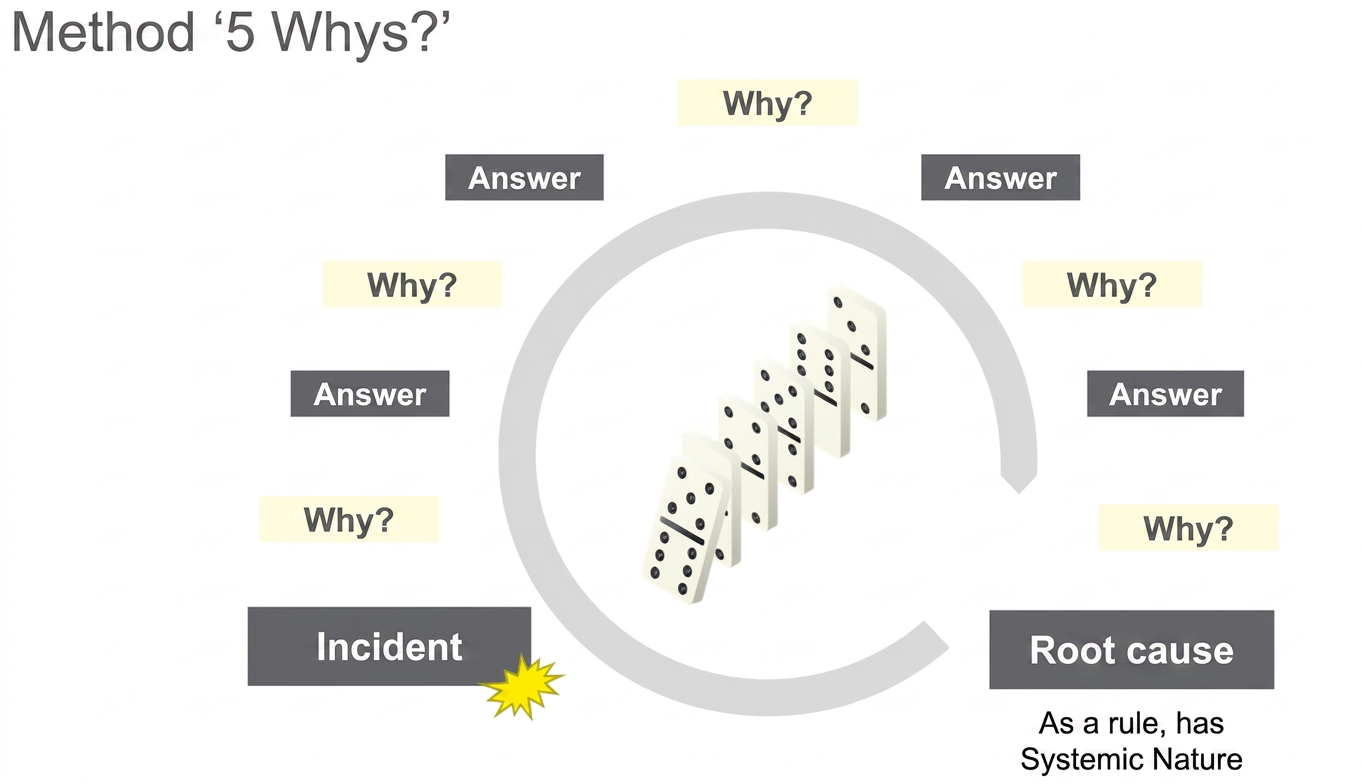
The "5 Whys" method works perfectly in the mining industry. Its essence is to consistently ask the question "Why?" until we reach the root cause, rather than a superficial one.
Let's look at a real-life example from a mine.
Incident: A sudden conveyor stoppage occurred, leading to a 2-hour production downtime.
1st Why? Why did the conveyor stop?
Answer: The electric motor's overheat protection was triggered.
2nd Why? Why was the overheat protection triggered?
Answer: Because the motor overheated due to an excessive load.
3rd Why? Why did the excessive load on the motor occur?
Answer: Because a large amount of collapsed rock fell onto the conveyor belt, which was not accounted for by the design capacity.
At this stage, we could stop: The "guilty" parties are the miners who failed to reinforce the roof. A reprimand, a disciplinary hearing — case closed. But we continue the "hunt"! After all, if we don't understand why this happened, the collapse will happen again.
4th Why? Why did the rock collapse in the conveyor's operating area?
Answer: Because the roof bolting in this working was installed with a deviation from the design (the spacing between the bolts was increased).
5th Why? Why was the support installed with a deviation from the design?
Root cause: Because the shift foremen received incorrect data about the geological conditions at this face due to an outdated geological model, which had not been promptly updated based on the results of advance exploration. The crew was working according to the old plan, unaware of the tectonic fault zone.
What did we get in the end?
Instead of punishing the miners, we uncovered a systemic problem: insufficient speed in updating geological documentation and communicating it to the shift personnel. The solution: introducing digital tablets for foremen with shift-by-shift updates of mine workings maps and geological risks.
This approach does not punish people, but gives them modern tools for safe and efficient work. The hunt for causes has been completed successfully: we found and neutralized a real threat, rather than simply writing the incident off as "human error."
Remember: Behind every "human error" lies a systemic cause. Our job is to find it.