First Aid Kit: Statutory Minimum or Maximum for Saving Lives?
Every enterprise has a first aid kit in accordance with the Ministry of Health Order No. 262n. Its presence is a mandatory requirement, and it handles micro-injuries well. But let's ask the main question: what if a real emergency occurs? Severe bleeding, a penetrating chest wound, a fracture, a burn? Will a standard first aid kit be able to help in a critical moment?
The Problem: Savings vs. Efficiency
The fact is that the contents of the first aid kit under the Ministry of Health Order No. 262n allow it to be equipped with supplies that, although compliant with the requirements, often fall short in quality and reliability compared to their more modern and versatile counterparts.
Take, for example, a tourniquet for stopping bleeding. In a standard kit, this is often a simple narrow fabric strap (at best, an Esmarch tourniquet), which may not withstand the pressure, could injure soft tissues, fail to stop the bleeding, or even tear at the most crucial moment.
At the same time, there are more modern tourniquets that reliably stop bleeding, providing the necessary compressive force through high-quality elastic material, and are safe for the victim. Importantly, the legislation does not prohibit us from replacing the existing tourniquet with an alternative one. The main thing is that it must be registered according to the rules for registration and examination of the safety, quality, and effectiveness of medical devices, approved by the Decision of the Council of the Eurasian Economic Commission on February 12, 2016, No. 46 — for example, a tourniquet with the registration number RZN 210370.
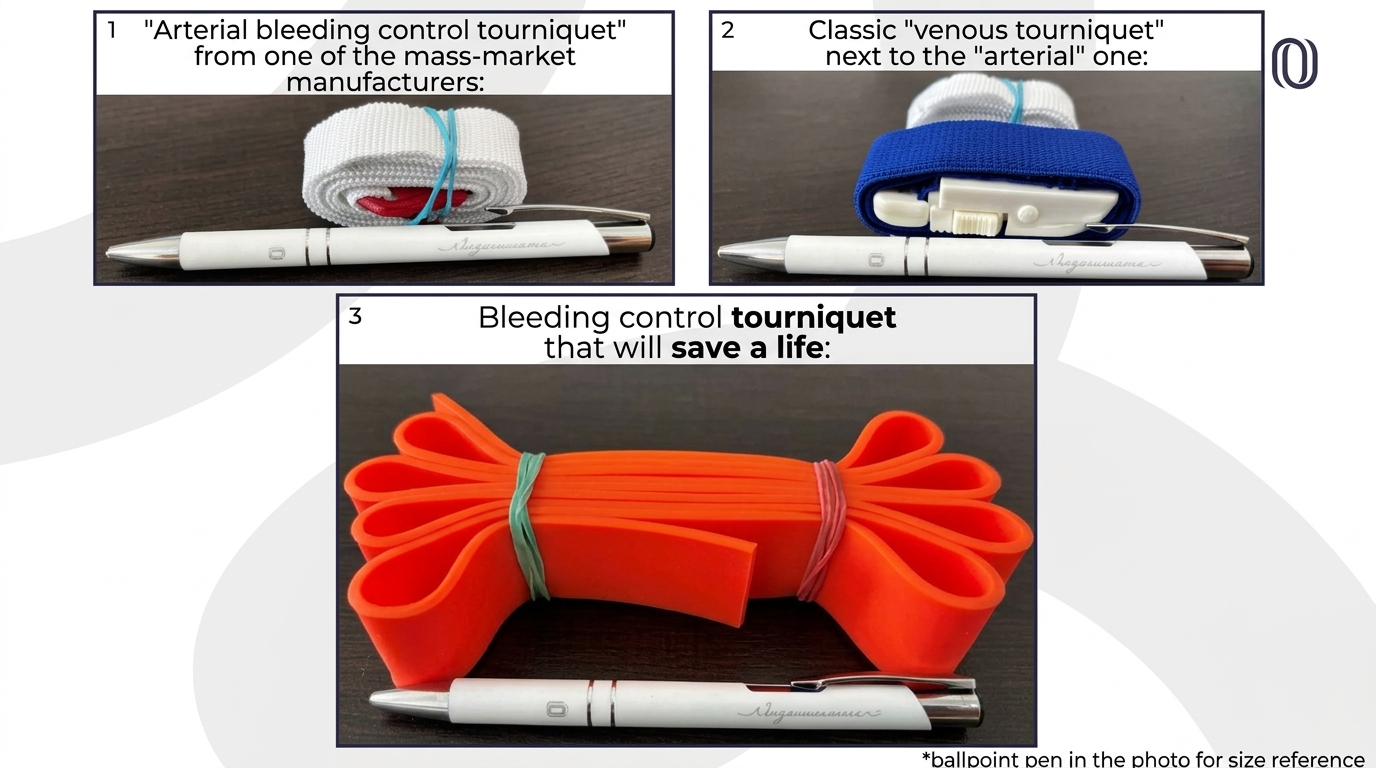
The difference between an attempt to help and guaranteed life preservation in a critical situation is clear:
Photo No. 1 – a tourniquet from one of the well-known mass producers of employee first aid kits
Photo No. 2 – a venous tourniquet against the background of the very "arterial" one that many of us have seen when giving blood for analysis in a laboratory. The material is of higher quality and wider
Photo No. 3 – a truly high-quality, modern tourniquet that will save a life
OTEKO Strategy: Two Levels of Workplace Safety
Currently, a simple and effective first aid system is in the implementation phase:
Level 1: Equipped First Aid Kits under Order 262n (purchased and placed as before)
We keep the standard first aid kits for micro-injuries. Legislative requirements are met.
Level 2: Specialized First Aid Kits for Critical Situations
We will place additional fully equipped kits throughout the enterprise. Each contains items we have tested:
- Alpha tourniquet – 1 pc.
- Windlass tourniquet – 1 pc.
- Vented chest seal – 2 pcs.
- Burn dressing 24x24 cm – 4 pcs.
- Individual dressing packet (Israeli bandage) – 2 pcs.
- Compact immobilization splint – 1 pc.
- Soft frameless stretcher – 1 pc.
- Gauze bandage 10 cm x 2 m – 4 pcs.
- Gauze bandage 5 cm x 5 m – 4 pcs.
- Elastic fixing bandage 10 cm x 5 m – 1 pc.
- Mouth-to-mouth CPR device – 1 pc.
- Nitrile gloves – 5 pairs
- Tactical scissors 15 cm – 1 pc.
- Universal marking pen – 1 pc.
Why Exactly This Way?
First aid aimed at preserving and maintaining the life and health of victims must be provided right here and now. It is the colleagues in the office, workshop, or construction site who can provide it in the shortest possible time. At OTEKO, two fully equipped ambulance crews and several on-duty paramedics are on standby 24/7, ready to depart at any second. However, even in the best-case scenario, arrival can take up to 4-8 minutes from the moment of the call, given the vast territory. And in the event of severe bleeding, a person has no more than 3 minutes to be saved.
The Key Element: Trained People
The most modern and expertly equipped first aid kit is useless in the hands of someone who does not know how to use it. The key element is practical training. It is not enough to know the theory of how to stop bleeding — it is necessary to practice applying a tourniquet, to feel the required force and compression. This is the approach that creates a real safety system.
You can read about how the training organization process is structured at OTEKO in the article by my colleague Ekaterina Gemberova, Head of the Safety Systems Development Department: https://hsedays.ru/1149-navyki-dlja-spasenija-zhizni-treningi-po-okazaniju-pervoj-pomoschi.html
Conclusion: The Ministry of Health Order No. 262n is the necessary minimum. But our responsibility for the lives of our employees should not be limited to it. By having high-quality first aid supplies in our arsenal and practicing practical skills, we invest in the most valuable thing — human life. And this is an expense item whose justification requires no proof.