"Time to Breathe": A Guide to Smoking Prevention
One of the most difficult tasks for an employer when implementing well-being programs is smoking prevention. Smoking is not prohibited by law, designated smoking areas must be provided, and many smokers are happy to visit the smoking room once again to "build communication ties."
Is it worth repeating how harmful it is? All smokers know this, but they continue. For many years, every cigarette pack has featured various frightening pictures and warnings — does it work? Not really. In a store, we might sometimes hear, "Noooo, I don't want the one with impotence, please give me the one with lung cancer." A conscious choice! Not a refusal in principle, but buying a "different" disease.
What exactly should be done?
We need to talk about the fact that employee smoking damages not only their health but also the business. A business loses an average of over 200,000 rubles a year (assuming an average wage of 4,000 rubles a day) due to:
- Loss of working time. 5-8 smoke breaks a day equals 18-30 working days a year = 96,000 rubles a year.
- Morbidity. Smokers get sick 30-50% more often, which means an additional 5-7 days of disability a year = 8,000 rubles a year.
- Efficiency. Smokers are 5-15% less efficient, which is equivalent to ~ 96,000 rubles a year.
We need to measure and identify. Conduct wellness surveys among employees, asking the question: "Do you use nicotine-containing products?" — followed immediately by a second question: "If yes, would you like to quit?" For example, at OTEKO, the number of people willing to quit smoking is 75% of the total number of smokers.
This way, we find the exact target audience that we need to and can work with; we just need to help them. Not with a stick! They already want to quit; we need to give them the tools to do so. What kind? For example, conducting wellness sessions among groups of employees, where our task is not to recount dry facts about how harmful and bad it is once again, but to change the smoker's mindset, to change their attitude towards themselves and their health.
Structure of a wellness session:
1. Highlight the statistics: show the ratio of smokers to non-smokers, emphasizing the absolute majority's desire to give up the bad habit.
2. Analyze the reasons; according to research, there are several:
- Stimulation — the smoker believes that a cigarette invigorates and relieves fatigue. They smoke when things go wrong. This type of smoking is characterized by a high degree of psychological dependence on nicotine.
- Support — this type of smoking is associated with situations of anxiety, emotional tension, and discomfort. They smoke to hold back anger, overcome shyness, gather courage, or deal with an unpleasant situation.
- Craving — physical attachment to tobacco. They light up when the concentration of nicotine in the blood drops. They often smoke in any situation, despite prohibitions.
- Playing with a cigarette — the smoker "plays" at smoking. Accessories are important to them: lighters, ashtrays, the type of tobacco. They often try to blow smoke in their own unique way. They mostly smoke "for company," but not much, 2-3 cigarettes a day.
- Relaxation — they smoke only in comfortable conditions. They get additional pleasure from resting through smoking. As a rule, they make attempts to quit, but return to smoking every time.
- Reflex — the smoker not only fails to realize the reason for their smoking but often does not even notice the fact itself. They smoke more often at work than during rest hours — the more intense the work, the more frequent the act of smoking. This also includes a number of common triggers that make hands automatically reach for a cigarette: after meals, with a morning cup of coffee, before bed, during stress and strong emotions (joy, anger, sadness), when bored, when waiting, when tired...
Every smoker will definitely find themselves among these archetypes. A special feature would be the "right" speaker — someone who used to smoke but quit. If this is the case, it is worth using the following phrase: "It probably seems to you that it is very easy for me to talk about this because I don't smoke. That's not true; I used to smoke, I quit, and my reason was the 'Reflex'." Or something else.
3. Having analyzed the reasons, we then ask an open question: "Are we really as dependent as we think?"
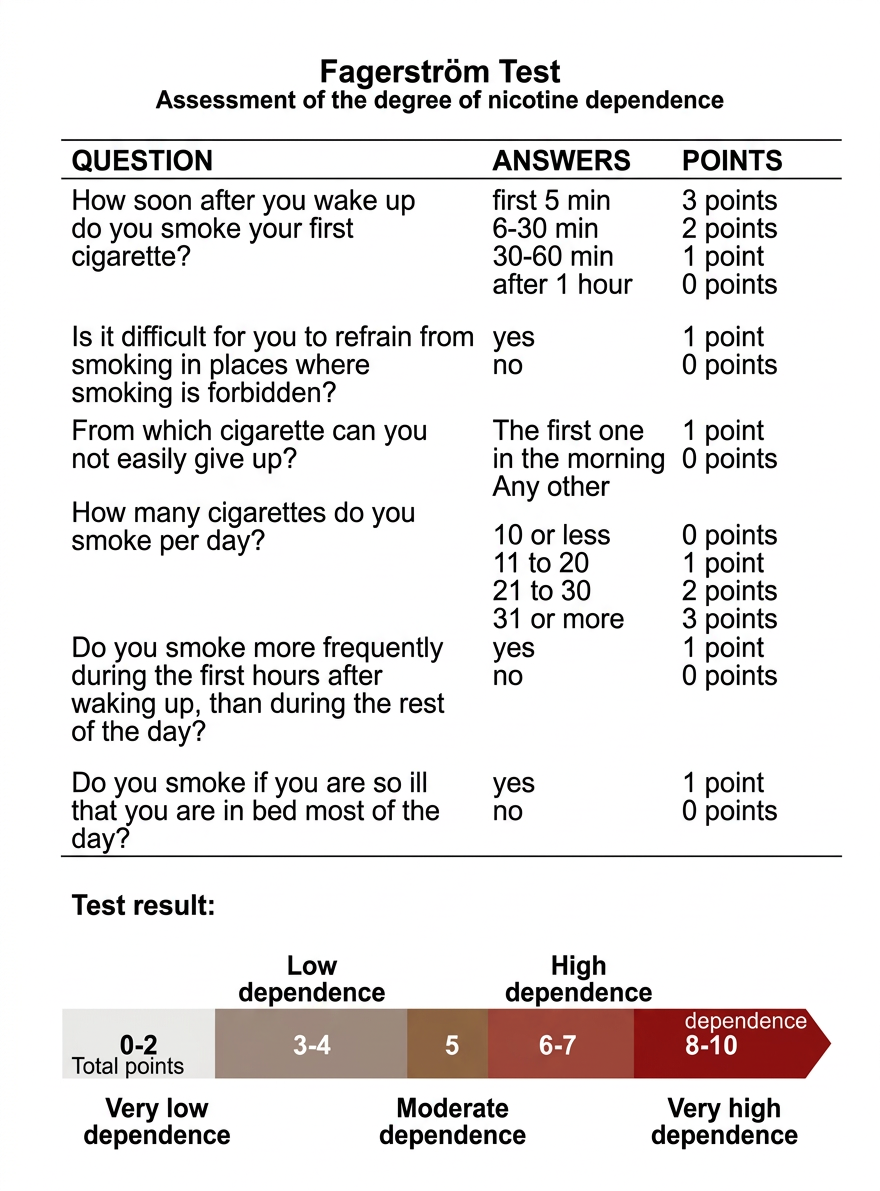
Here we suggest taking the Fagerstrom test to assess the degree of nicotine dependence. The test is extremely simple and contains 6 questions. You can use a printed version:
Or use an interactive approach by creating a survey, for example, in Yandex Forms by analogy:

Our experience conducting wellness sessions at OTEKO has shown that in 8 out of 10 cases, we get a result of "0-2" or "3-4" at most, which means "very low dependence" and "low dependence," respectively. This is the turning point that will plant a seed in the minds of smokers in favor of fighting smoking, and it is worth emphasizing. After all, only a small step towards oneself and one's health is needed to live free from nicotine. It is easy to fight a weak dependence; it is not a disease, but merely a habit.
4. The reasons have been analyzed, the degree of dependence has been assessed, and the attendees will ask themselves: "So what should we do?"
Here it is definitely worth sharing a few life hacks that will help:
- Give yourself a firm mindset to quit smoking. If we doubt ourselves, nothing will work out.
- Address the reason for smoking: find an alternative for relaxation, reflexes, stimulation, etc. This could be lozenges, physical activity, tea instead of a cigarette, and other possible substitutes — for the most difficult first few weeks.
- Do not take half measures: alternative nicotine consumption, a perceived reduction in the number of cigarettes smoked. There are no safe ways to smoke.
- Look for a leader. If there is a manager in the audience, emphasize the target behavior model. If the department head hasn't quit, the chances of their subordinates quitting drop sharply.
But most importantly, the desire to quit smoking must be reinforced with support and motivation measures, without promising "mountains of gold":
- Professional help: OTEKO has implemented the "Corporate Well-being Platform" project, where every employee has the opportunity (anonymously, if desired) to receive absolutely free consultations in a mobile app across several areas. This includes wellness experts who are ready to work individually to build a smoking cessation plan. The ability to connect to the platform is also integrated into visual warnings about the dangers of smoking via a QR code on posters and signs in every smoking area.
- Motivational literature. The best option is to purchase printed editions and freely distribute the famous book by Allen Carr, "The Easy Way to Stop Smoking," to those interested. The feedback on the book is incredible — I have yet to meet a single smoker who was not significantly impressed by it. But most importantly, the result: those who read it quit smoking. This book is exactly about what I mentioned at the beginning of the article — changing one's mindset and attitude towards oneself and one's health, and realizing that you can live freely without nicotine and that it is much easier than it seems.
If it is not possible to purchase the printed version, an audio version of the book can be found freely available on the internet (though the quality is not the best). Another option to provide your employees with access to the book is to purchase a corporate subscription on platforms like Litres.
Excellent, the wellness session has been conducted; now we "monitor" the department and "keep in touch" with the manager. By the way, to further engage the department manager, I recommend using "Nicotine-Containing Product Usage Monitoring." It's simple: spread the practice so that in every department, every manager knows exactly the ratio of smokers to non-smokers. If the department has up to 50 people, we use name lists as well. The information should be posted on department boards: visual management boards, industrial safety boards, manager's information boards, etc. There are many options; the main thing is for the manager to know every smoker.
Done! The main "skeleton" of the project has been implemented; from here on, it's just development, limited only by your creativity, imagination, and financial capabilities.
In particular, at OTEKO we plan to introduce the monitoring of wellness indicators as a factor influencing the motivation of line managers: implementing monitoring in each department for the quantitative and qualitative ratio of indicators such as smoking, passing GTO (Ready for Labor and Defense) fitness standards, the number of employees regularly engaging in sports, body mass index, and the number of disability days. These indicators and their dynamics will be evaluated during daily line walkdowns led by the HSE Directorate. If there is no positive wellness dynamic, the rating of the site, department, or workshop is reduced. If there is a dynamic — excellent, this is a factor that will positively influence the final rating of the department.
Another activity to develop the project is the "Health Relay." Recording an interview in which the hero shares their experience of quitting smoking. The target audience is top management, because, as we remember, the role model is the manager. At the end of the interview, the quitting relay is passed to another manager by prior agreement, with specific deadlines set.
Rewards. Do not forget to acknowledge the achievement of quitting smoking, because it truly is a victory! We do not promise this right away, but upon the fact of quitting, when the immediate supervisor confirms that this specific employee has quit smoking and has been "holding out" for two months, we express our gratitude. We announce it publicly — at pre-shift meetings, safety days, team-building events, and other gatherings.
Good luck, colleagues!