#Competence assessment
Holistic competence assessment examining production knowledge traits. Drills encompassing pre-shift riddles and corporate assessment center methodologies. Tailoring exclusive HSE career matrices.
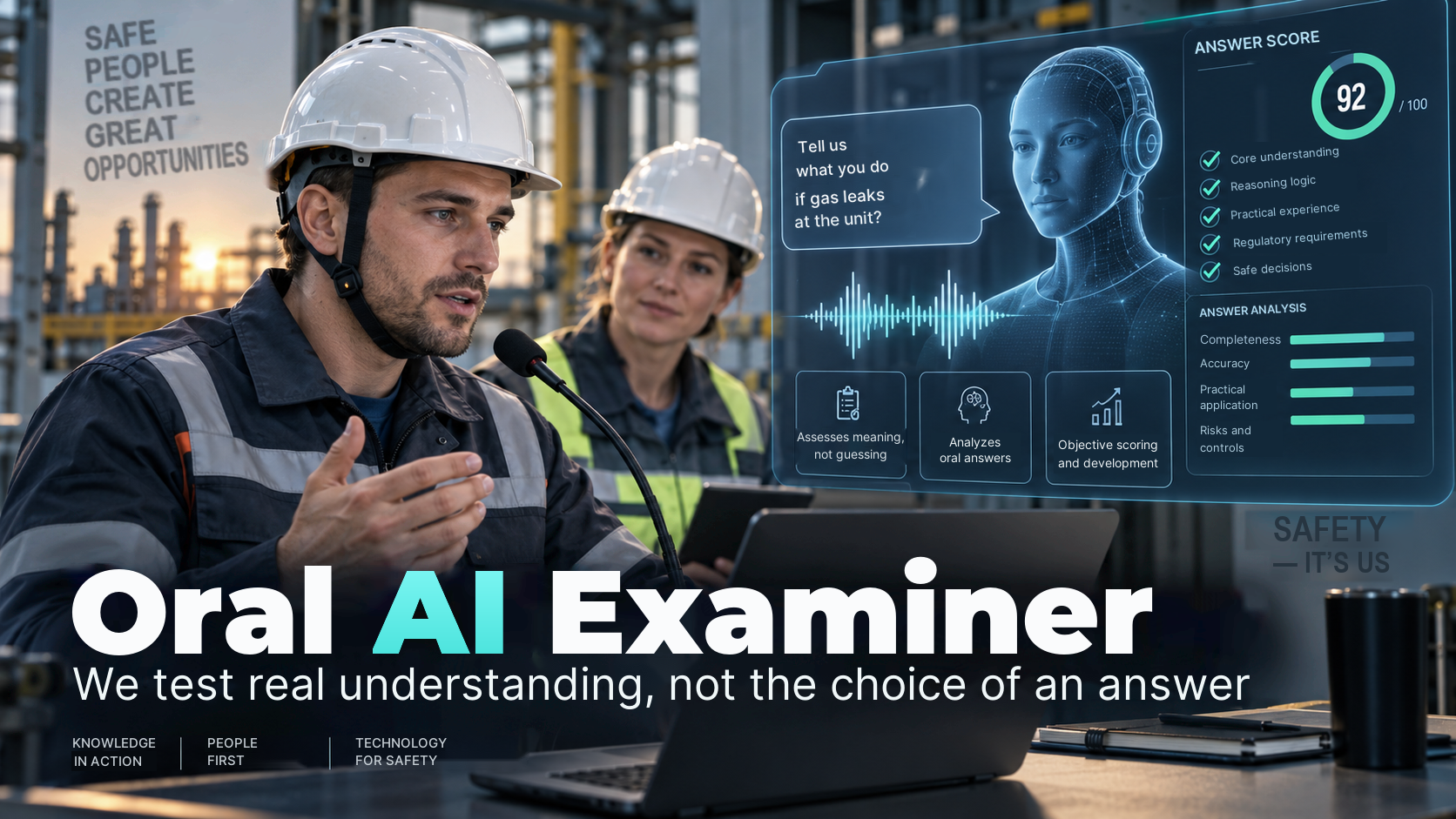
No Options A, B, and C: The Oral AI Examiner
How we went from a NotebookLM and Gemini combo and our own random question generator to a portable browser examiner that listens to the answer and assesses actual understanding. A pilot on 54 employees, an RSS code instead of a full name, and nine ready-made prompts to replicate it yourself.

Contractor's Foreman: Why Safety Is Decided at 7 AM by the Site Trailer, Not in the Contract
Flawless safety documentation does not guarantee safety. The real responsibility for human lives rests on the foreman's shoulders. Why shouldn't foremen be turned into supply clerks, and how should contractor control be built? We analyze where paper safety ends and real safety begins.

Mentorship: A Key Link in Developing Professional Competencies
A two-tier mentorship system featuring workforce requirement calculations, rigorous selection, and continuous support through workplace supervision. To practice hands-on skills, a full-scale training and production site was created, operating on a shift schedule synchronized with main production. Bureaucratic burden was reduced by implementing a single three-year additional agreement, while a professional Telegram community was launched to foster engagement.

New Paradigms in Personnel Training for Remote Sites and Fly-in Fly-out Operations
Transformation of the corporate training system for remote and FIFO sites amidst labor shortages and changing demographic profiles. A preboarding process has been implemented, starting remote training before arrival at the site, alongside targeted hybrid educational solutions. For safe skill practice, VR simulators with error analytics are used, while prompt libraries based on artificial intelligence and a 360-degree assessment system are utilized for on-the-job self-study.

Professional Skills Competition – Best HSE Specialist
For the first time, the Gazprom Energoholding Group of Companies held a competition for the best occupational health and safety specialist, aimed at motivating employees, enhancing their competencies, and sharing best practices. Participants competed in testing knowledge of regulatory and technical documentation, investigating workplace accidents, providing first aid, and selecting personal protective equipment. The competition helped identify the best employees and provided an opportunity for c...

Safety Starts With You: School of Lead Trainers
Creation and development of an internal industrial safety trainer academy from among company employees. Trainers undergo external certification, are assigned to specific production units, and train personnel from workers to top managers, as well as contractor employees.

From Knowledge to Skills. Basic Principles of Practice-Oriented Training for HSE Specialists
Development and implementation of a practice-oriented HSE training system based on competency assessment and a role model. The program includes distance modules with independent group work, gamification, and in-person workshops using WorldSkills mechanics to practice risk assessment skills in a simulated production environment.

Safety Leadership Visits: A Tool to Increase Management Engagement in Safety Issues
Implementation of safety leadership visits (SLV) for top management to demonstrate safety commitment and build open dialogue with employees. The practice includes integrating leadership assessment into HR processes, training internal trainers, and extending requirements to contractors.

Competency Barrier
A multi-stage admission system for contractors at an industrial facility, including risk appetite assessment, remote knowledge testing with proctoring, and practical skills verification. For on-site control, an admission passport with a tear-off coupon system for safety violations is used.


 +3
+3
Q&A Session with Expert Council Members and HSE TOP 100 Rating Candidates
Participation in the all-Russian HSE TOP 100 rating as a tool for professional assessment, benchmarking, and career development of HSE specialists. The practice includes preparing a structured self-presentation, visualizing achievements, passing an interview with the expert council, and working with feedback to improve the enterprise's HSE management system.

Managing Industrial Safety Risks Using Corporate IT Tools
Implementation of a three-level industrial safety risk management system using a suite of IT tools. The practice includes digitizing incident scenarios using the BowTie methodology, automating barrier operability control via mobile apps and dashboards, and creating digital admission barriers for contractors (remote testing, electronic passport, electronic permit-to-work).

Risk Management for High-Risk Work Performed by Contractors
A three-level risk management system for contractors performing high-risk work. It includes continuous supervision, maintaining a detailed violation registry, practical competence verification at training grounds, and a mandatory transition to standardized modular scaffolding with admission through independent technical supervision.