Visualizing Changes in Regulatory Documentation
It is essential to read, understand, and remember changes in regulatory documentation in order to apply them confidently in daily operations. This is the exact approach I took when designing a poster for our information board.
The material is intended for shop floor managers, safety representatives, and employees responsible for organizing and documenting safety training, on-the-job training, and clearance for independent work.
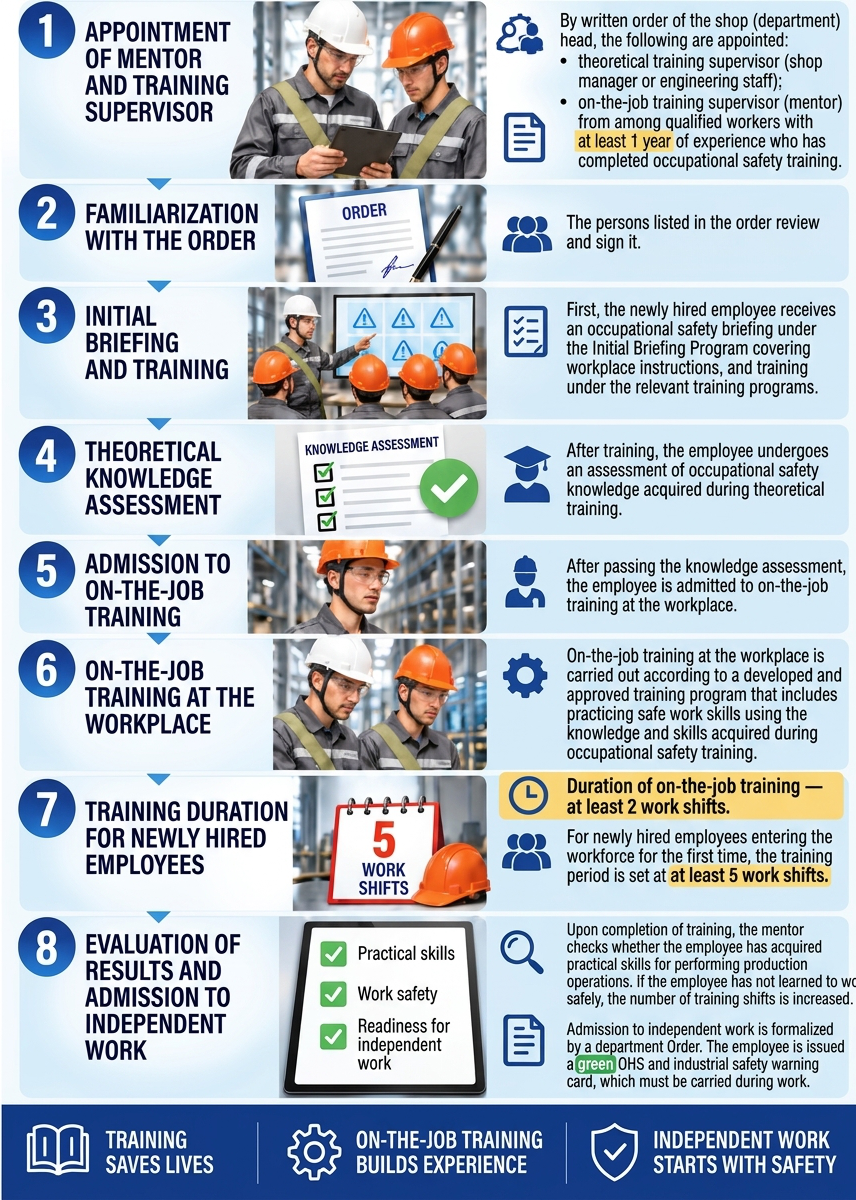
The regulatory text has been transformed into eight sequential steps—from appointing a mentor and training supervisor to evaluating on-the-job training results and issuing work clearance. Each stage features a number, a short heading, an illustration, and a brief explanation. Arrows show the flow between actions, while color coding highlights deadlines and key conditions.
The purpose of this design is to help people see the entire process at a glance, understand the sequence, and retain it. The visual layout serves as a memory aid: it makes it easy to recall the required action, identify the person in charge, and remember which documents need to be completed.
Displayed on the board, the poster serves as a permanent quick-reference guide. It is a convenient tool for explaining regulatory updates, drafting orders, working with mentors, and verifying that every stage has been completed. During briefings, a manager can point to a specific step and explain how it connects to subsequent actions.
This approach also supports the development of our operational and safety culture. It manifests in everyday habits: appointing responsible persons in advance, following the proper training sequence, completing paperwork on time, and verifying an employee's practical skills and readiness to work safely.
A shared visual flowchart helps build a unified understanding of the process among all participants. For a shop floor manager, it serves as a framework for organizing workflows; for the documentation coordinator, it is a guide to the paperwork sequence; and for a mentor, it acts as a reminder of their role in preparing the employee.
When the procedure is clear and constantly in plain sight, it becomes much easier to discuss emerging questions and spot any missed steps. This fosters a mindful attitude toward training, personal accountability, and well-coordinated teamwork within the unit.
A visual reference guide complements the regulatory document and must be updated right alongside it. To me, its real value lies in making requirements easy to grasp and helping embed the correct sequence of actions as a natural part of our safety culture.
Marat Fatkullin, Deputy Director for HSE, JSC BSK.