#Automation
Automation of internal occupational health and safety (OHS) processes. Moving from paper logs to a unified digital ecosystem. Reduces administrative burdens via electronic work permits, digital risk maps, and automated reporting.
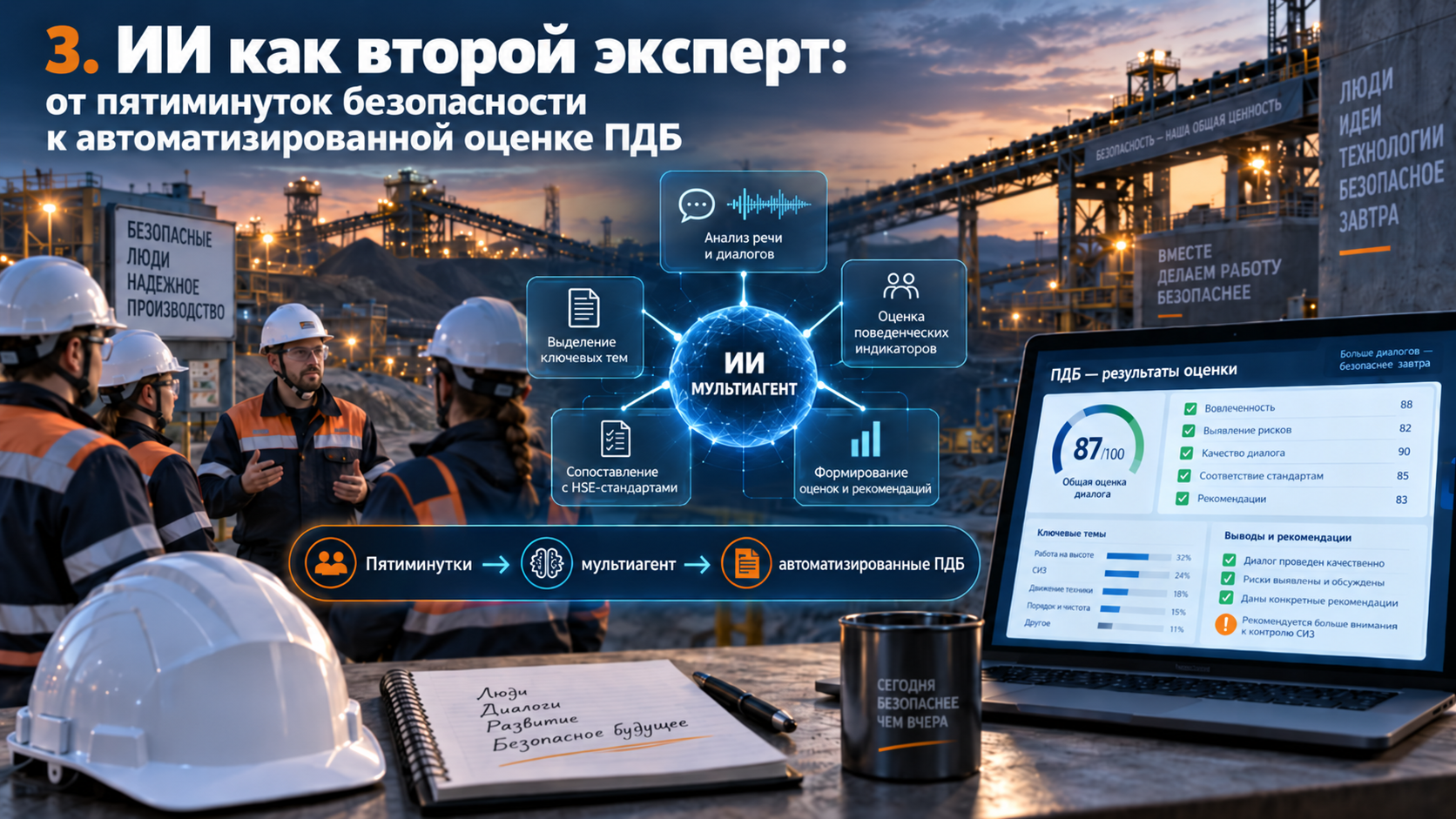
AI as a second expert: from safety talks to automated BSD evaluation
A conducted safety talk is easy to count — it is hard to understand if the conversation took place. The occupational health and industrial safety director of SSGPO JSC shows the next stage of their scheme: an AI assessor analyzes the audio recording of the safety talk and the behavioural safety dialogue using the same criteria, and the manager receives a personal review in about forty seconds. Inside: the path from a manual loop in Perplexity to a Telegram bot on Make and seven ready-made prompt...

AI Agents in Health and Safety
A chatbot carries out one instruction and stops; an AI agent drives the task through to the result. We compare the two on a real end-to-end fatal accident investigation — and explain why managing agents is becoming a skill everyone needs.
🛡️ Safety: HSE Risk Management — Sharing My Experience
An overview of the occupational health, safety, and industrial safety risk management system at OMK: from methodology to real case studies of fatal risk reduction and automation. Learn how to combine best practices and avoid a formal approach.
AI Agents and Vibecoding: What Has Changed in HSE Over the Last 6 Months
The application of autonomous AI agents and vibecoding technology to automate routine processes in industrial safety. The practice includes using neural networks to independently identify hazards from photos, fill out risk registers, calculate budgets, and generate local regulatory acts without involving IT specialists. Implementing this approach transforms the role of the HSE specialist into a "knowledge broker," radically reducing the time spent on analyzing regulatory frameworks and investiga...
The Future of HSE Through the Lens of AI Development Trends
Phased implementation of artificial intelligence tools in occupational health and safety processes to automate routine tasks and data management. The practice includes preparing internal "knowledge brokers," launching a secure corporate analog of generative neural networks, and integrating AI with accounting systems. Implementing this approach in a mining company reduced labor costs for intellectual tasks by 20%.
AI + Automation in HSE
Implementing artificial intelligence tools to automate routine HSE processes. Practices include using AI bots to collect Near Miss data, hybrid search systems (RAG) for regulatory databases, software robots (RPA) for reporting, and generating engaging content for briefings.
AI Prompting: A Fundamental Skill for the HSE Specialist of the Future
Integration of artificial intelligence into the daily tasks of an HSE specialist through mastering prompting skills and using no-code platforms. Practice includes automating routine processes, delegating analytical tasks to AI assistants, and transitioning to the Prompt First paradigm to improve management system efficiency.

AI and Machine Vision in HSE: From Idea to Launch
Implementation of a machine vision system based on the Open Source MoonDream model to monitor PPE usage and sanitary compliance in food production. The system analyzes real-time video streams, sends violation alerts to a Telegram bot for responsible managers within 15 seconds, and is accompanied by a positive employee motivation program without fines.

Automation of High-Risk Work in Metallurgy
Creation of an end-to-end digital system for managing high-risk work in a metallurgical company. Automated processes for issuing electronic permits-to-work, remote approval, mobile photo recording of measures, and contractor control using automatic violation blocks.

Digitalization of Audits: From Self-Assessment to Status Control
Transitioning the safety compliance audit process from Excel to a unified digital system. Automatic score calculation upon completion of corrective actions and real-time visualization of branch statuses.

Automating PPE Accounting and HSE Document Management, or How Enot Brought Order
Comprehensive automation of HSE processes and PPE accounting in a company with 30,000 employees. Implementation of electronic document management using UNEP, reduction of PPE nomenclature from 8,000 to 120 items, and conversion of the personal accounting card into a dynamic report format.


Current Trends, Regulator's Vector, Changes from 2026
Optimization of environmental payments for negative environmental impact (NEI) amid a multiple increase in rates. The practice includes transitioning from standard calculations to actual ones, detailing waste accounting, automating calculations, and strengthening financial discipline in interaction with supervisory authorities.