The "Digital Oracle" Illusion: Why AI in Safety Remains a Calculator, Not an Expert
The occupational health and industrial safety industry has found itself under immense pressure. This pressure comes not only from regulators but also from the so-called "technological hype." Top management, impressed by digital transformation presentations, demands the immediate implementation of artificial intelligence. A dangerous illusion arises: it seems that algorithms are a "magic button" that will instantly eliminate the human factor and reduce injury rates to zero.
However, behind the beautiful demos lies a fundamental substitution of concepts. The market is being sold AI as "intelligence" (a comprehending entity), although technically it remains a powerful probability calculator. In processes where the cost of an error is a human life, this confusion can lead to severe consequences. We risk facing harsh disappointment when the reality of mathematical statistics crashes against the chaos of actual production.
I am not imposing my opinion on anyone; I am simply sharing the experience of someone who has been actively implementing and working with AI since the beginning of 2024.
The Context Problem: AI Misses the Essence
The main difference between an experienced manager and a neural network is the understanding of context. An expert reads "weak signals": nervousness in a voice, crew fatigue, and non-obvious signs of deviations. Artificial intelligence works differently — it is confined within the framework of a mathematical model.
A computer vision system does not understand what a "violation" is. It simply sees a set of pixels and compares it with a template. For an algorithm, a glare on a hard hat and the absence of a hard hat are just data. This gives rise to the risk of "metric blindness." If control is fully entrusted to algorithms, the company will receive perfect reports and green charts, while the actual safety culture will degrade. AI will optimize numbers, ignoring real but non-digitized threats.
The Efficiency Paradox and Hidden Costs
The experience of implementing generative models and analytics systems allows us to derive the 70/30 rule, which has a clear financial expression. The first 70% of the work — creating a draft document, initial video analysis — is done instantly by AI. This creates a wow effect and the illusion of savings.
But the remaining 30% — perfecting the result and verifying accuracy — requires enormous resources. This is the hidden cost of implementation that vendors keep quiet about. Savings at the start turn into multiple costs for refinement, validation, and system support. Management must understand: an employee who previously spent an hour writing an instruction now spends that same hour correcting AI errors. This is not a reduction in the payroll fund, but a shift in activity: instead of creative work, the specialist is engaged in endless supervision of the machine.
New Risks and the Cost of Error
Implementing AI brings threats that have not only a technical but also a colossal financial dimension. A neural network error that leads to an incident is not just a code failure. It means lawsuits, fines, production shutdowns, and falling stock prices.
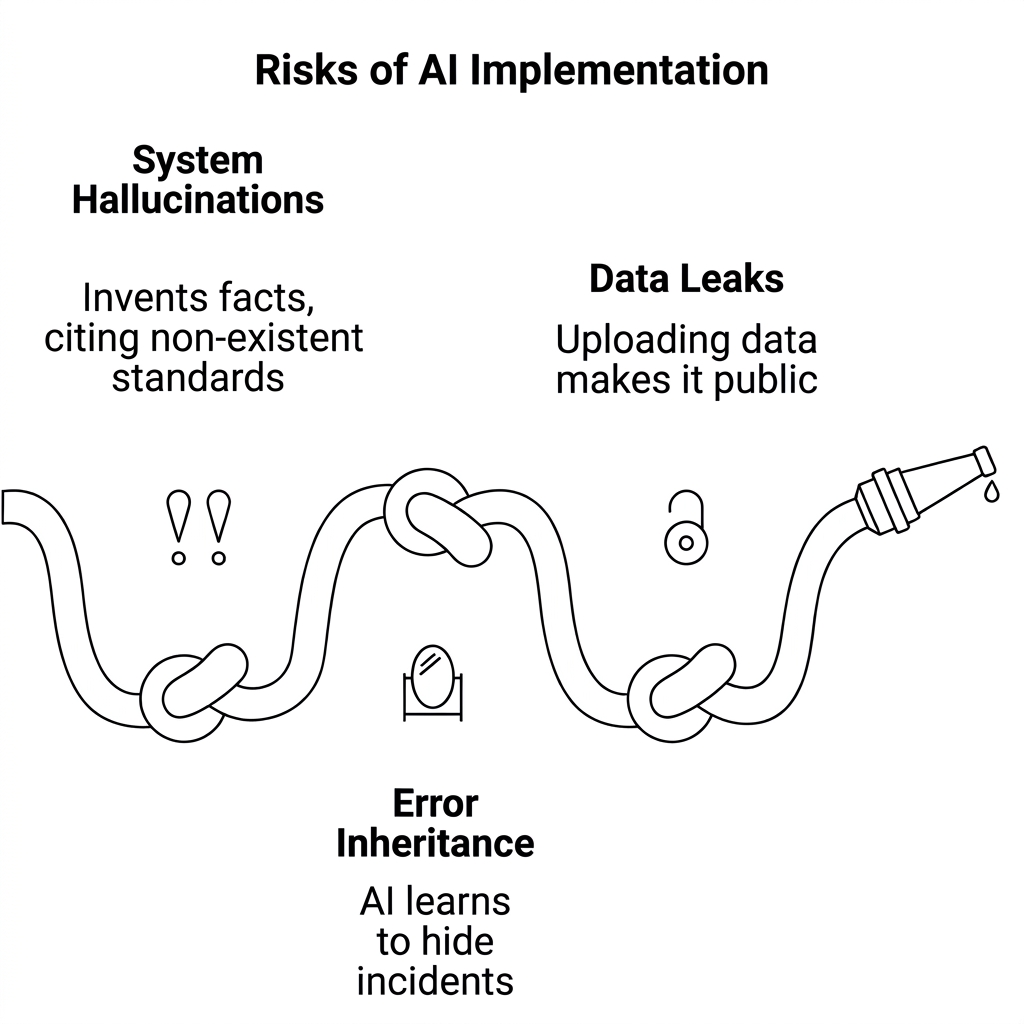
First, there are system "hallucinations." Generative models can convincingly invent facts, citing non-existent state standards (GOSTs). The application of such regulations is legally void, and the consequences for the business can be fatal.
Second, the inheritance of errors. An algorithm is a mirror of its data. If minor incidents have been hidden at an enterprise for years, the AI will learn to consider this the norm and will miss a real accident.
Third, data leaks. Uploading internal documentation to cloud-based chatbots makes the data public. Since May 2025, over 600 criminal cases related to leaks have confirmed that confidentiality is becoming vulnerable.
What to Do? Principles of Responsible Implementation
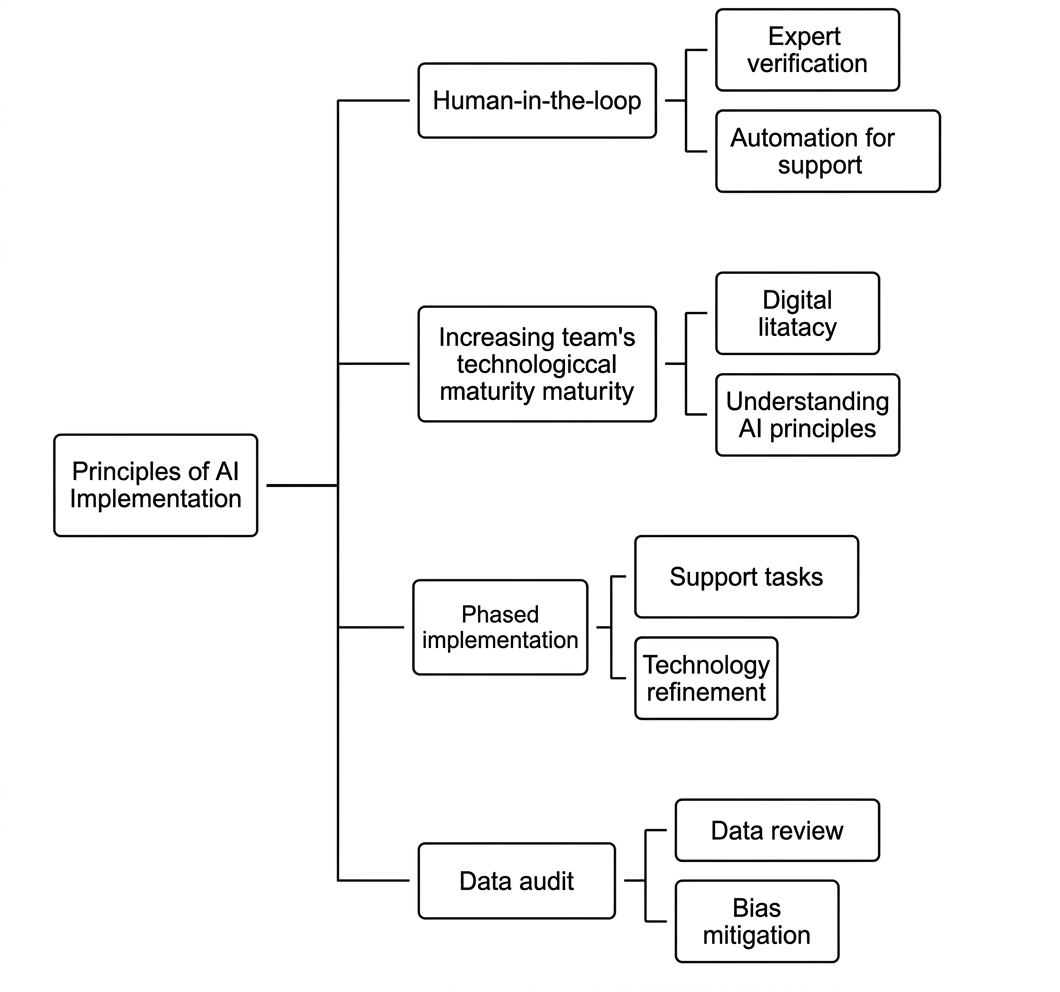
The diagnosis is clear, but how should practitioners act? To ensure AI implementation does not become a disaster, it is necessary to follow four principles of "digital hygiene."
The "Human-in-the-Loop" Principle. No full autonomy in critical areas. Any AI decision — whether imposing a fine or granting work clearance — must be verified by an expert. Automation is meant to assist humans, not eliminate them. AI proposes a hypothesis; the expert makes the decision.
The "Enhancing Team Technological Maturity" Principle. AI will not take off in an environment where people fear technology, do not understand its purpose, or perceive it as a threat. The team must undergo an "upgrade": basic digital literacy, an understanding of how AI works, skills to interpret model outputs, and responsibility for dialogue with the system. A mature team is an insurance policy against errors and the key to ensuring AI becomes a tool rather than another source of chaos.
The "Phased Implementation" Principle. Do not start with systems on which human lives depend. Begin with auxiliary tasks. Let AI look for hidden patterns in accident archives, draft standard reports, or check the completeness of first aid kits. Refine the technologies where the cost of an error is time, not health.
The "Data Audit" Principle. Before "feeding" data to an algorithm, conduct a strict review of it. Was there a culture of silence at the enterprise? If so, "dirty" data will ruin any model, even the most perfect one. Cleaning data of bias is a mandatory step before launch.
Future Strategy: From Replacement to Augmentation
The greatest fear among specialists — skill degradation and job loss — is based on a false premise. We need to shift the paradigm from AI (Artificial Intelligence) to IA (Intelligence Augmentation).
AI should not replace the HSE expert. It should become an "exoskeleton" for the mind — a super-assistant that processes tons of data ore, leaving the human with a pure concentrate for decision-making. Instead of degradation, we face a transformation of skills. New roles are emerging: specialists who will become the bridge between the world of algorithms and real production. They will be responsible for ensuring that "digital" adequately describes the physical reality of the shop floor.
Conclusion
Artificial intelligence in HSE is not a "magic pill," but a complex, expensive, and potentially dangerous tool that requires the highest culture of operation. Investments in AI are meaningless without parallel investments in people — in their expertise and ability to ask the system the right questions.
The future of safety belongs not to those who buy the most hyped algorithm, but to those who can build a symbiosis between human and machine. Where the cold logic of a calculator serves the warm mind of an expert without replacing it. And now, a new, inevitable task is added to the issues of building an industrial safety culture: the culture of working with AI. It is not just about implementing a system, but embedding it into the living context of the enterprise: into processes, training, responsibility, and the daily habits of the team.
It is precisely those organizations that learn to combine professional culture and digital maturity that will manage risks for real, not just on paper. Before implementing AI, ask yourself the main question: are you ready to bear responsibility for decisions you do not fully understand, and what should be done to achieve that very understanding?
Comments 1
Thank you, Vladimir.