Safety Architect: How an HSE Expert Can Create a Training Game in a Week Using AI
A game is a concentrated model of life. In it, we learn to make decisions and take responsibility for them. In the work of an HSE specialist, the cost of these decisions is immeasurably high, and there is practically no room for error.
Amid the active discussion of artificial intelligence, many professionals see it as a complex technology capable of replacing humans. This view is a fundamental misconception. In the hands of a competent expert, AI becomes not a threat, but a powerful amplifier tool. It gives the HSE specialist the opportunity to evolve — to transform from a routine-overloaded executor into a true architect of safety systems.
In this article, we will use a practical example to analyze how, through the conceptual use of AI, an effective training simulator can be created in record time.
Section 1. The Danger of "Dead" Knowledge.
Traditional training methods — lectures, briefings, tests — provide the necessary foundation but leave knowledge "static." Their main drawback is passivity. They do not form the key skill: making the right decisions under stress, limited resources, and team interaction. Knowledge not practiced in reality creates only a dangerous illusion of preparedness.
Section 2. Professional "Blind Spots": Stress Test Results.
How real is this danger? We received a clear answer when we developed and conducted a business simulation game for seven teams consisting of experienced managers and HSE specialists from leading industrial enterprises. The game logic modeled safety system management under budget constraints, time shortages, and sudden incidents.
The result was staggering. Out of seven specialist teams, only one was able to cope with the task and beat the game system.
This experiment proved: the problem is not a lack of knowledge, but hidden "blind spots" that manifest only in dynamics — task prioritization and decision-making under pressure. It is impossible to identify these zones with standard briefings. They are the main invisible risk at any production facility.
Section 3. The Game as a Safe Proving Ground for Mistakes.
The only way to eliminate "blind spots" is to practice skills. Conducting experiments in real production is unacceptable. The solution is to create a safe "proving ground" — a business game that acts as an accurate simulator of production reality. This is not entertainment, but a professional tool for diagnosing and honing practical skills, where the price of a mistake is game points, not people's health and lives.
Previously, creating such a deep game was a serious challenge, taking up to six months of work by a large team. Today, AI is changing the rules. Of course, such speed is achieved not only through AI but also when the expert developer has a ready methodology and a deep understanding of the task. AI does not create meaning from nothing — it only accelerates its implementation many times over.
Section 4. The Birth of a Game: A Week Instead of Six Months.
Using AI allows the entire development cycle to be completed conceptually in a week. The key principle: the HSE expert acts as the "think tank" and task setter, while AI acts as a super-fast executor and content generator.
The process looks like this:
- Conceptualization (1 day). The expert defines goals and audience. AI, based on these inputs, generates dozens of options for game mechanics and themes, helping to quickly choose the optimal one.
- Content Creation (2 – 3 days). The most labor-intensive stage, which AI accelerates many times over. At the expert's request, the neural network generates hundreds of unique game elements: situational tasks, incident scenarios, knowledge check questions, and descriptions of the consequences of actions.
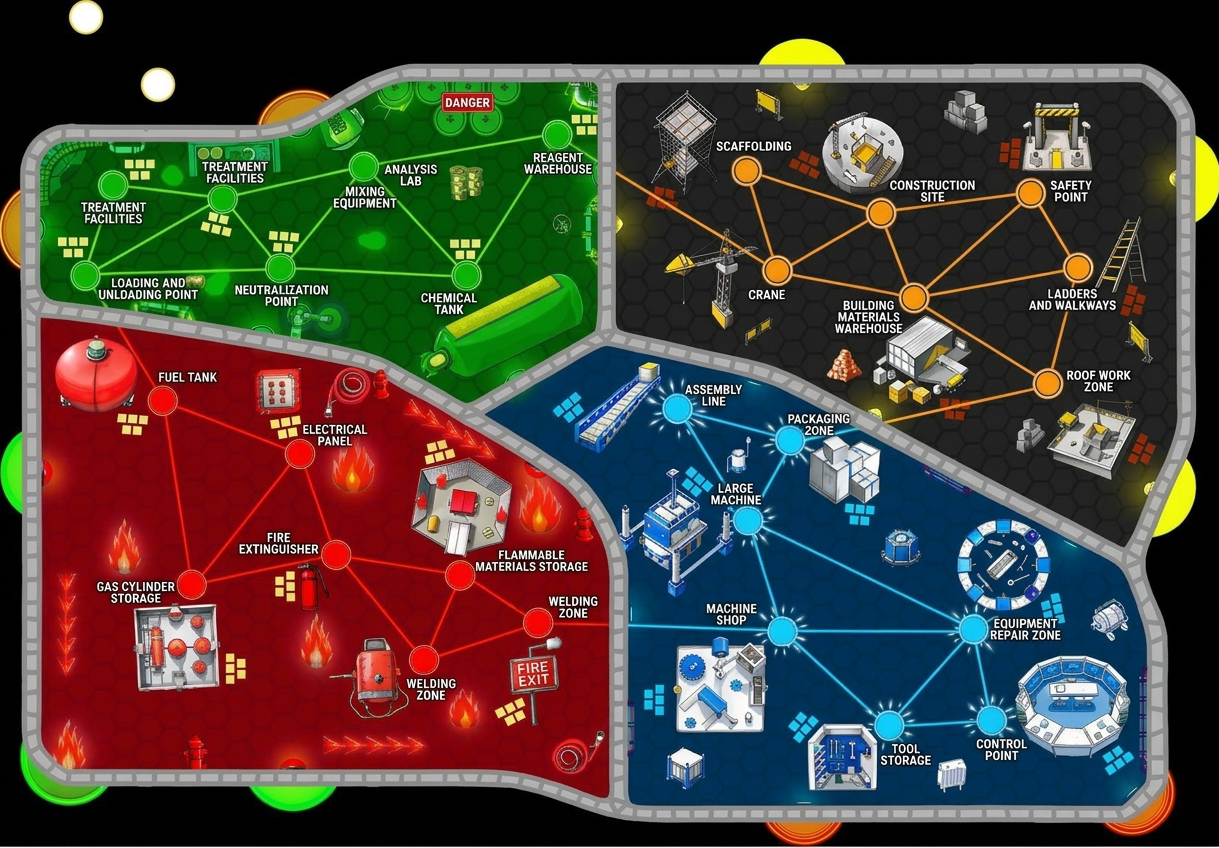
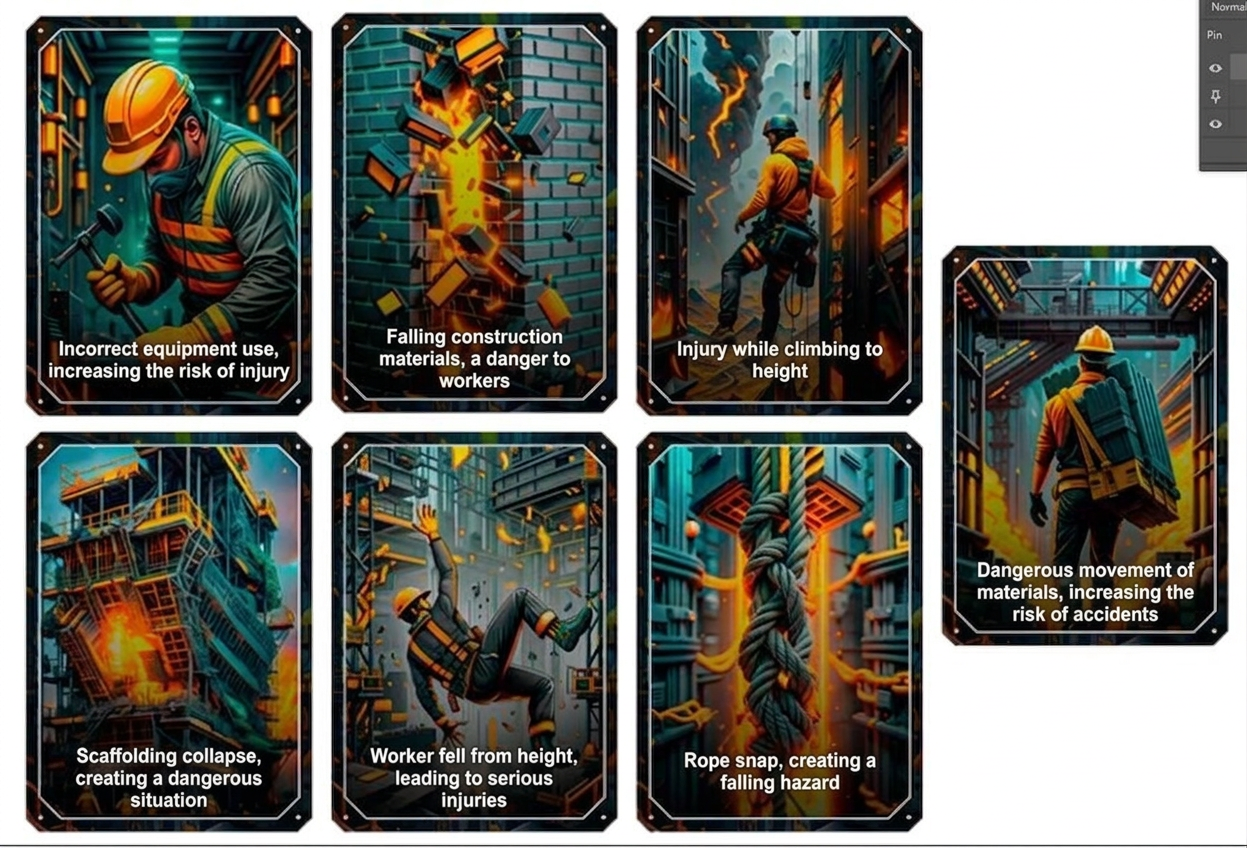
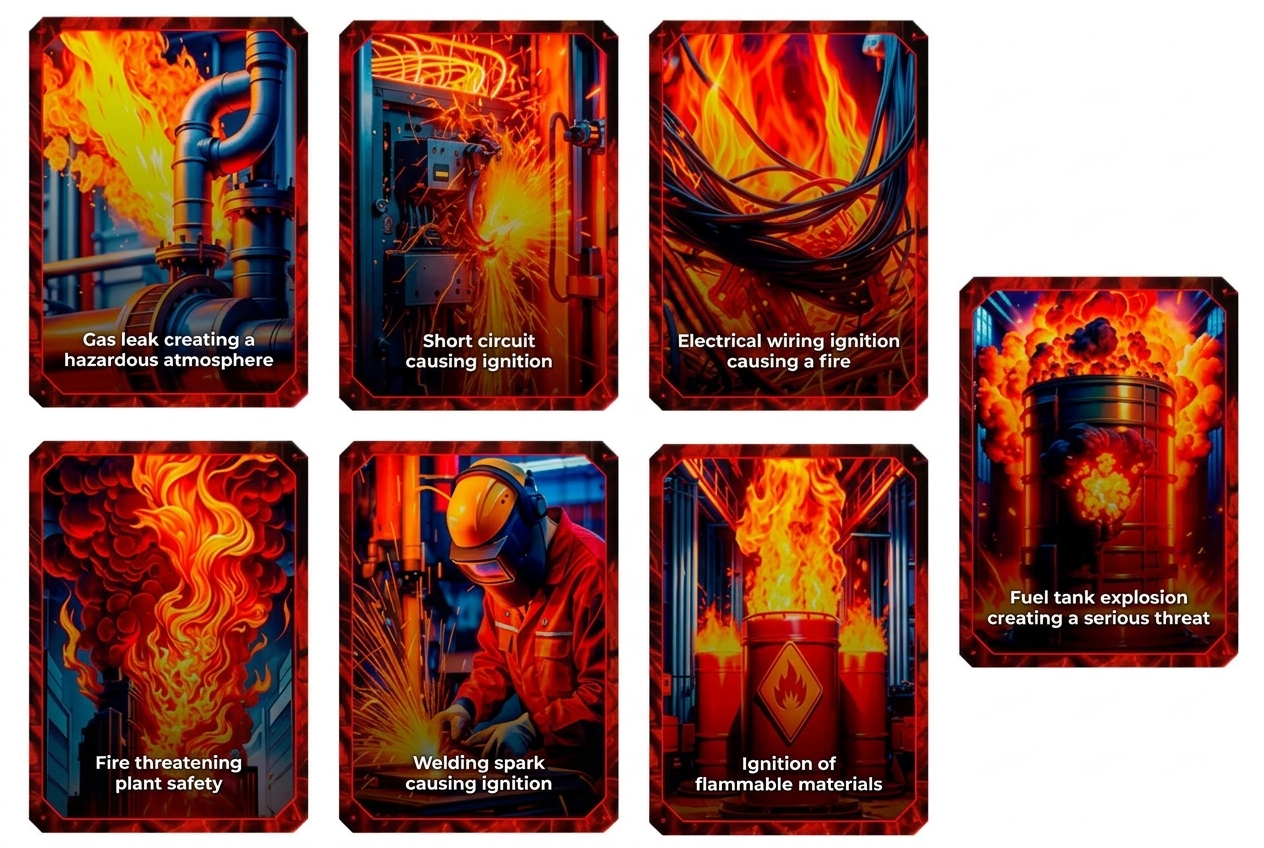
- Visualization and Prototyping (1 – 2 days). AI helps quickly create prototypes of visual elements: illustrations for cards, images of protective equipment, diagrams of production areas, and even game board layouts. This allows you to "feel" the game and evaluate its clarity in a matter of hours.
- Balancing and Simulation (1 day). Adjusting the game balance is the most difficult stage. AI is capable of simulating thousands of virtual game sessions to identify non-working rules, dominant strategies, or logical errors. A process that previously took weeks of manual testing is now completed in a day.
I am attaching several final images.
Section 5. What Do the Expert and the Company Get? The symbiosis of specialist expertise and AI speed gives three key advantages:
- Time and Resources. Freeing up the expert's time from routine for truly important work: interacting with people, analyzing real risks, and being present "in the field."
- Efficiency. Instead of formal training, the company receives a tool that actually develops employee skills, reduces human factor risks, and improves the overall safety culture.
- Professional Growth. A specialist who applies modern tools stops being just a "controller." They become an innovation leader and strategist whose authority in the eyes of management increases many times over.
The future of HSE is not in the "human vs. machine" confrontation, but in effective symbiosis. Deep knowledge and expert experience, multiplied by the speed and power of technology, set a new standard of efficiency. Artificial intelligence will not take away the professional's job, but a professional using AI will become significantly more effective than one who ignores it. The opportunity to become an architect of a safe production environment is no longer a fantasy, but a reality available today.