A Real Case of Implementing "Curatorship" and Combating System Stagnation
1. The Problem of System Stagnation
After conducting a comprehensive transformation of the occupational safety system, we, like many others, "planted a tree" – we laid the foundation. However, any system, even the most well-tuned one, will stagnate and regress without constant support.
We faced a real risk: department heads began to drown in a growing volume of requirements. They were simultaneously receiving tasks related to HSE, environmental protection, and transport safety, all against the backdrop of implementing a new industrial safety philosophy (line walks, investigations, training).
What is the cost of this problem? The inevitable burnout of managers, an increase in paperwork, the imitation of activity, and, as a result, a probable rise in injury rates, despite all the regulations.
To prevent this, the "Curatorship" project was created. We needed a "gardener" who would help the system grow.
2. Why Not Immediately? The Synchronization Problem
It would have been a mistake to launch the curatorship immediately. The project was implemented entirely by the internal forces of the Safety Directorate, without involving HR or external consultants. At the same time, our team consisted of 80% "old guard" employees. They were undoubtedly excellent specialists, but they were used to working differently.
First, we needed to reformat our own Directorate. If we had sent unprepared curators to the departments who did not understand the new philosophy, we would have faced complete desynchronization and discredited the idea right from the start.
3. Mechanics: Who is a Curator (and Who is Not)
The key thesis of our philosophy: The Safety Leader is the Manager. They are the role model.
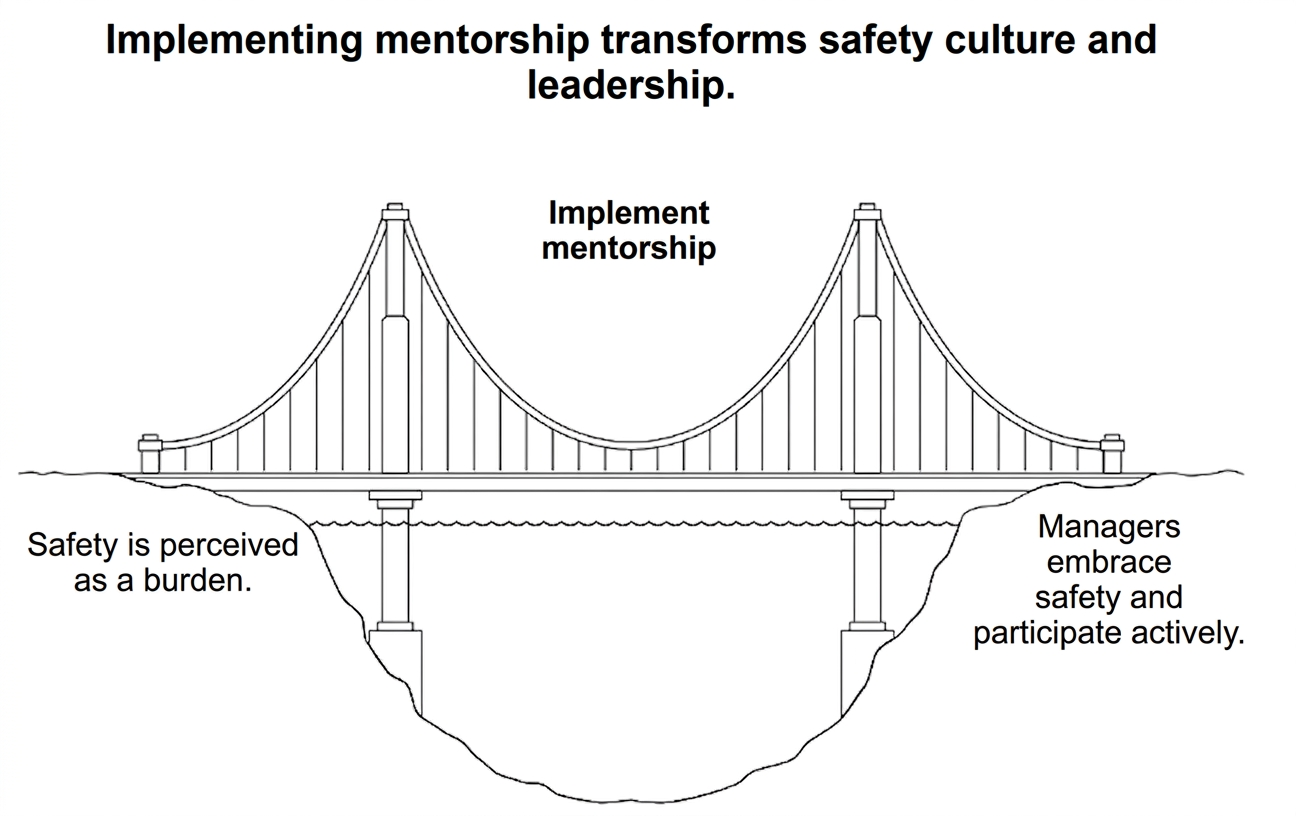
The role of the Curator is not to lead, but to be a "grey cardinal, mentor, teacher, and coach." Their task is to develop the manager, steering them away from the stereotype of an "HSE overseer."
Curatorship is about live communication and support. The mentor's arsenal includes:
- Line walks: not as an audit, but as a joint search for risks.
- Continuous feedback: a dialogue where the manager can ask any question.
- Education and training: The Curator helps analyze real cases rather than just giving lectures.
- Safety conversations: helping to find root causes, not culprits.
And perhaps the most striking example is the manager's conversations with employees before their vacations.
How did we select the curators? They are our in-house specialists. We assigned them based on the anchor principle (core competence): an industrial safety specialist to hazardous production facilities, and an occupational safety specialist to departments with different specifics.
We encountered a problem: not all of our experts possessed "soft skills" – simply put, not everyone knew how to speak publicly and conduct a dialogue. We used "Safety Days" as internal public speaking training to prepare them for the role of mentors.
Yes, the Curator encourages the manager to talk to people not only about occupational injuries but also about off-the-job injuries. Why? Because a safety culture is not something you can "leave at the checkpoint." It is a mindset. The Curator, as a mentor, helps the manager convey this idea to everyone.
4. The Real Struggle: "You Are My Secretary"
Implementing curatorship (the experience has been ongoing since 2024), we see the main result: this system develops the leadership qualities of the managers themselves.
The Curator helps the manager engage with safety and start talking about it confidently and meaningfully. Safety ceases to be a burden imposed by the HSE department and becomes a personal management quality.
Curatorship is our key tool in instilling culture. It is our way of telling the manager: "We are here. We will help. Let's do this together."
Initially, we expected skepticism, but there was almost none – the managers were already waiting for an assistant. The problem turned out to be different: about 40% of managers perceived the curator as a secretary or deputy who would now do all the paperwork for them.
We managed to overcome this not through orders, but through live dialogues and building a system of trust. The key turning point came when managers realized in practice: they are not punished for identified violations; instead, the root cause is sought together with them.
5. Proof No. 1: Two Real Cases
Personnel decide everything. And a lot depends on the individual on the job.
- A Case of Success: There was a manager who "threw dust in people's eyes" and was an absolute outsider in the safety rating. A curator was assigned to him, who methodically worked with him using all our tools (walks, feedback, dialogues). By the end of 2024, to our own surprise, this department became Leader No. 1. This is the direct merit of the curator.
- A Case of a Lesson Learned: There was also an opposite example. The leader of the 2023 rating became an outsider by the end of 2024. The reasons? The manager reduced his personal involvement, enjoying the success achieved. And the assigned curator, in turn, "passed the buck" and agreed to the role of a secretary, which instantly led to a drop in quality. The conclusion: "Even the strongest metal needs constant maintenance."
6. Proof No. 2: Real Figures and Facts
Our philosophy is to "teach how to learn safety." And this philosophy is proven by the numbers. Compared to last year (before the active phase of curatorship):
- We improved overall safety culture indicators by 30%.
- We recorded a 27% reduction in occupational injuries.
- We achieved a reduction in off-the-job injuries (largely thanks to pre-vacation conversations) by 50 cases.
The effect is best described by an anonymous direct quote from one of the managers: "Honestly, I didn't believe in this story. I thought you were just regular HSE guys... But now I see that the benefits are enormous. I've changed my attitude."
7. Proof No. 3: The "Moscow Handrails" Case
We saw a striking example of the difference in culture at a strategic session involving key company executives. We noticed that colleagues from the Taman site (where curators work closely) instinctively hold onto the handrails on the stairs – always. Meanwhile, colleagues from the Moscow office (where there is no curatorship yet) do not, taking remarks as a joke.
This made us want to give up; it felt like so much work had been in vain.
But ultimately, according to the latest data, even in the outsider department, 90% of colleagues now hold onto the handrails. This proves that "water wears away the stone," and curatorship is exactly that drop of water.
8. The Future: Rotation, Growth, and AI
The project does not stand still.
- Mechanics: we regularly rotate curators – transferring them to other facilities. This provides a fresh perspective and prevents the curator from settling into the role of a shop floor worker.
- Growth of Curators: this role forces the specialists themselves to grow. They awaken a "professional greed" for knowledge. An ecologist starts to understand hard hats, and an industrial safety specialist learns about fire extinguishers. They become conductors of the safety culture and our main talent pool.
- Vision (Scale): our next step is the development of the system. We see two key directions here using AI. First, relieving curators of routine and paperwork to free up their time for what is most valuable – live communication. Second, creating a safety track for managers, where the system itself will select and plan personalized training materials and focus tasks for them.
9. Our Meaning of the Word "Curator"
We deliberately gave the word "Curator" our own meaning, rather than the one found in dictionaries. For us, it is not a job description.
It is our philosophy of a "gardener" who tends to the system, preventing it from "drying out." It is a "compass" for the manager-"captain." It is a coach and mentor who stands beside, not above. And, as the numbers show, this approach is not just humane; it is effective.