🛡️ Safety: Unpacking the System
It's no secret that many industrial safety systems in real-world production operate in vain:
- Some generate mountains of useless reports
- Others skid in place with a screech and smoke
- Third ones are so clunky they can only tip over
- Fourth ones blare with victory fanfares but exist only on corporate TV.
In my 30+ years in HSE, I have seen many different ways of "assembling" industrial safety systems. As practice shows, a failure of a single element can seriously damage such a mechanism, and sometimes completely disable it.
How is an effective safety management system structured? Let's step closer and look under its "hood."
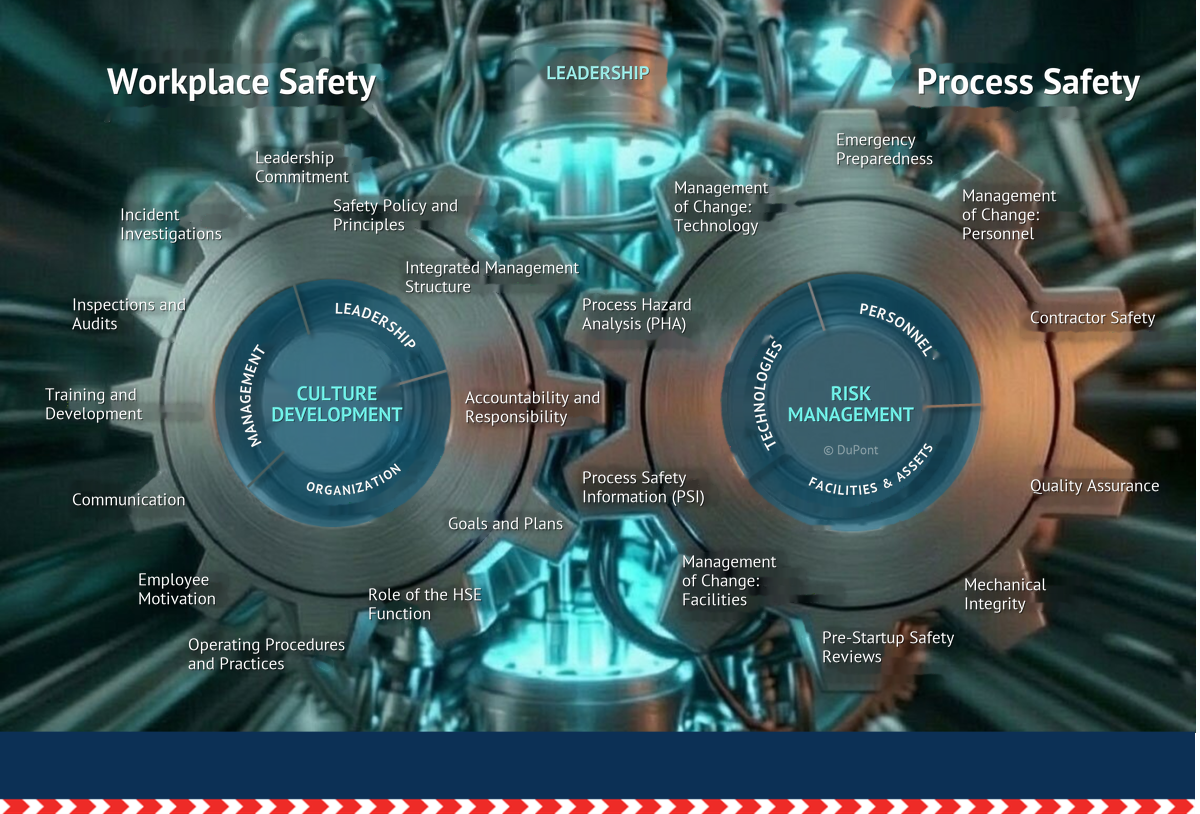
NOTE: I hope that in the figure below I managed to clearly depict all the most important "internals." The design is based on the DuPont / DSS+ concept, proven by years of practice.
1. THE ENGINE 🚀
Like any functioning mechanism, industrial safety has its own power plant. Some CEOs and business owners still evaluate its power solely in monetary terms.
While finances are important, they do not determine success. What starts and maintains the entire process is something more valuable than money — commitment, leadership, and the will of managers, each in their place: from the head of the holding to the shift supervisor and foreman. 👥
2. THE SAFETY DIFFERENTIAL 🎛️
It distributes energy between two gears, ensuring the reliable operation of the safety mechanism even on sharp "turns" and "slippery roads."
⚙️ 2.1. Left Gear — Workplace Safety
It ensures the work of occupational health and safety. Our international colleagues call it Workplace Safety.
The serviceability and quality of this gear's operation determine the actual state of the corporate safety culture, which is so widely discussed in our professional environment.
Here are its 12 key elements:
- Management Commitment
- Policy and Principles
- Integrated Management Structure
- Accountability and Responsibility
- Goals and Plans
- Role of the HSE Department
- Operating Procedures and Practices
- Personnel Motivation
- Communication
- Personnel Training and Development
- Inspections and Audits
- Incident Investigations
The operation of the left gear is very important. It drives the right gear. Or it doesn't...
⚙️ 2.2. Right Gear — Process Safety
In our usual terminology, it is responsible for industrial and fire safety. As you understand, this is especially important for Class I and II hazardous production facilities.
Here are its 10 key elements:
- Management of Change: Personnel
- Contractor Safety
- Quality Assurance
- Mechanical Integrity
- Pre-startup Safety Reviews
- Management of Change: Facilities
- Process Safety Information (PSI)
- Process Hazard Analysis (PHA)
- Management of Change: Technology
- Emergency Preparedness
📌 CONCLUSION
As Sherlock Holmes used to say: "It's elementary!" However, if you have any extra parts left after assembling the mechanism, don't throw them away! 😉
Maximum reliability and efficiency of your industrial safety system are achieved only when each of its 22 elements is in its place, operating normally and in interaction with other elements. 👍
When your system is skidding, wasting budget and creating a bureaucratic burden, it's high time to think about its diagnostics and maintenance. 🛠️
________________________________________
💬 Colleagues, are all 22 elements implemented in your system? Which one "malfunctions" most often and requires special attention? Share your thoughts in the comments. 👇