
🛡️ Safety: Safety Observation Program (UC RUSAL) | Part 3
“It is all an insoluble mystery to me,” said I, “and it grows darker instead of clearer.” — “On the contrary,” answered Holmes, “it clears every instant.” — Arthur Conan Doyle, The Sign of the Four
1. A Word on the Mechanics, or the “Gears” of a Systems Approach
The term “Quick Wins” is widely recognized among HSE professionals. However, far from everyone knows how this tool works in practice—real-world case studies, unfortunately, are rarely shared. In the previous part of this article (https://hsedays.com/insights/safety-observations-rusal-part-2), I sought to fill this gap.
As you saw, quick wins provide the change team with their initial momentum and confidence in success. This is crucial during the early stages. Yet any start is meaningful only when followed by systematic change and planned task execution. And that requires ongoing effort: a management program.
A clarification is needed here: many people associate the word “program” exclusively with computers, smartphones, and software applications. In this context, however, we are talking about something entirely different.
💡 A management program is a distinct operational building block within the HSE management system that integrates all the elements required to effectively address a specific set of practical tasks: rules and procedures, methods and tools, solutions and action plans.
I am referring to governance processes that drive the performance of a specific activity in a changing environment. This is achieved through a systems approach—Plan, Do, Check, Act—as defined by W. Edwards Deming’s classic PDCA cycle.
You can find an overview of key foundational management programs in the article “Safety: Unpacking the System” (https://hsedays.com/insights/safety-management-system-unpacking).
Naturally, for any management program to work, you need leadership commitment, a dedicated team of like-minded colleagues, and adequate resources.
Time and again, I have seen that any truly effective program must comprise eight essential elements:
- Governing document: a policy, regulation, or standard.
- Organizational structure: participants and the allocation of their roles, authority, responsibilities, and resources.
- Training: workforce onboarding and skill development.
- IT tools: digital solutions to support processes.
- Communications: information sharing and feedback across all levels.
- Motivation: a system for employee engagement and incentives.
- Goal setting: KPI definition and performance monitoring.
- Audits: regular effectiveness assessments.
These are the primary “gears” of the “Look Around” program. Let us take a closer look at them.
2. Designing the Evolution: Expanding the Circle
To give “Look Around” a solid foundation and a clear structure, our first step had to be developing a governing document: a corporate policy defining the program.
In drafting it, we sought to incorporate all the core principles of proactive safety (https://hsedays.com/insights/safety-observations-rusal-part-1).
💡 Where there is no standard, there can be no improvement. Standards are the foundation for both maintenance and improvement. — Masaaki Imai, founder of the Kaizen concept
The greatest challenge lay in their adaptation and fine-tuning.
We chose to strike the right balance: examine the practices across our operational sites, identify the best approach, and pursue gradual evolution, improving quality step by step.
This evolutionary approach became the cornerstone of our document.
Through vigorous debates and hands-on discussions, my colleagues and I did not merely conceptualize, but engineered an entirely new safety control system.
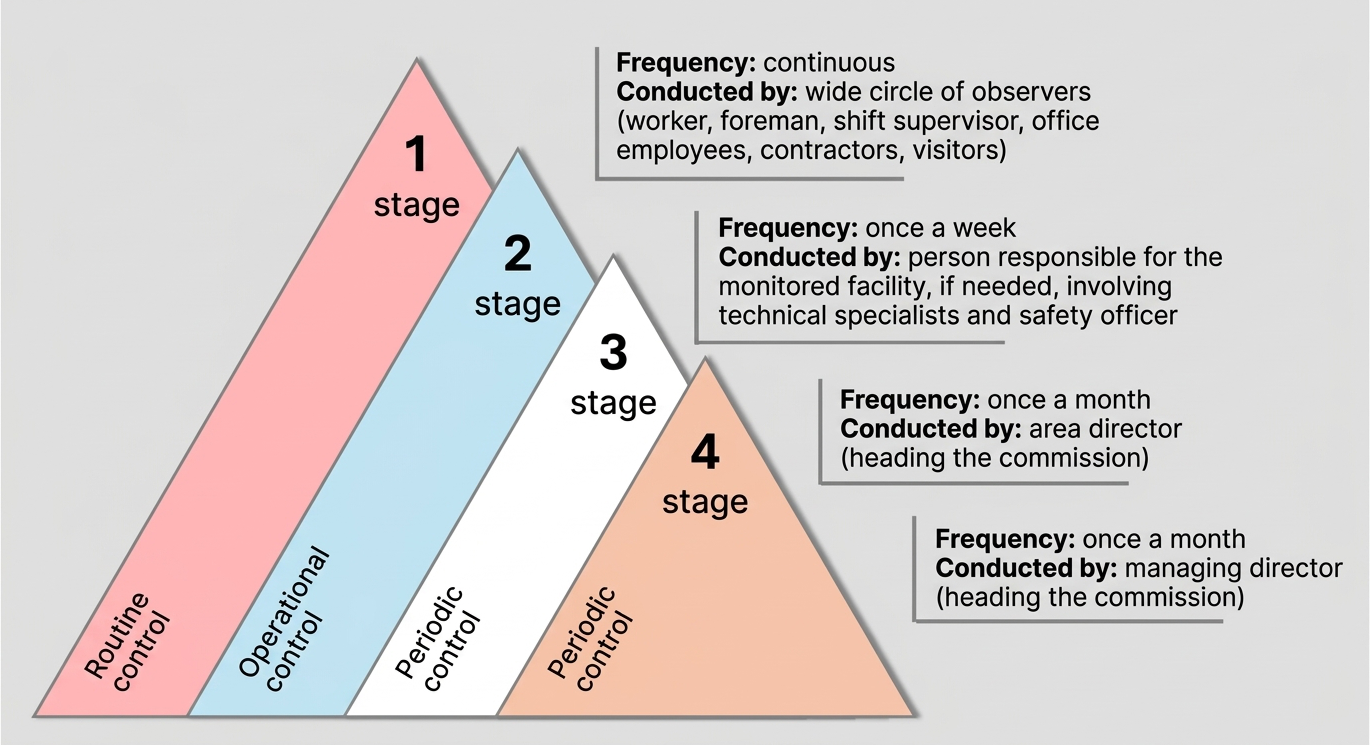
We recognized the four-tier control scheme as optimal, upgraded it to deliver a fundamentally new level of quality, and rolled it out across all company sites.
The fourth tier closed the management loop at the highest level. The plant managing director now personally participates in safety observations, serving as the leader and primary champion of the entire system.
This decision directly brought to life the concept of HSE Line Ownership: operational safety is the direct responsibility of line managers, starting from executive leadership.
💡 When I say commitment, I mean that the chief executive gets in there and makes things happen, not just saying: “Yes, I bless it, here is some money.” — Philip Crosby, pioneer of preventive management and the Zero Defects methodology
The second pivotal innovation was maximizing the circle of participants—“there are never too many eyes!”
While line managers retained their existing duties, we brought “volunteers” into the observation process—all proactive and engaged site employees, contractors, and even visitors.
Zero coercion—relying strictly on their genuine desire to help.
As a result, our safety observation framework took on its complete form (Figure 1).
We aimed to formulate the core message of the “Look Around” program as simply as possible—so that every participant would instantly remember the essentials:
- Do not walk past. Daily hazard identification and elimination is everyone’s responsibility.
- See a mess? Clean it up immediately.
- Spotted a hazard? Make it visible to others, warn those nearby, and notify your manager.
- Remember the golden rule: do not start work if it cannot be carried out safely.
💡 The role of management is to change the process, not to badger people into doing better. — W. Edwards Deming, father of modern quality management
Our new governing document defined key organizational processes:
- Roles of participants and scope of their responsibilities.
- Action protocols upon identifying unsafe acts, unsafe conditions, and safe work best practices.
- Mandatory training: initial and refresher courses for all personnel.
- Organization of safety observations across all management levels.
- Application criteria for individual and team KPIs.
- Support from HSE specialists.
- Monitoring and performance reviews at the plant leadership level.
- Motivation and engagement mechanisms to encourage active participation.
In addition, we established a dedicated rollout framework for expanding the “Look Around” program to other company sites.
If you are familiar with the Vision Zero concept, you can see how it translates into tangible business processes.
3. Roles and Key Players
The logic of “Look Around” is defined by three key participant roles and a closed feedback loop of their interactions: from hazard detection to its elimination.
Every participant must know their role inside out…
Observer
Anyone can act in this role: a front-line worker, a contractor, an administrative employee, a visitor, a visiting corporate headquarters specialist, or even a state labor inspector. The observer’s role is straightforward—they are the eyes and ears of our system.
Manager
This refers to a workshop head, department manager, or senior site foreman. These individuals are the linchpin of safety control. And no deputies!
Such a manager is the risk owner and holds personal accountability for everything in their unit, down to the behavior of employees and contractors.
Their duty is to respond immediately. That is why hazard reports are routed directly to them. They verify the reports and swiftly organize the implementation of corrective actions.
We granted the manager maximum autonomy. They can reject an unsubstantiated report, sign off on a completed corrective action, or send it back for revision.
We paid special attention to empowering managers to motivate personnel toward safe behaviors. Historically, at some sites, foremen and even workshop heads lacked sufficient authority. Yet even where such authority existed, managers were extremely reluctant to exercise it, either because they lacked a clear action protocol or found the procedures overly cumbersome.
To overcome this barrier and equip managers with effective direct levers of influence, we overhauled procedures across the entire RUSAL Group. The outcome was a new corporate standard for UC RUSAL, grounded in the principles of progressive motivation toward safe work.
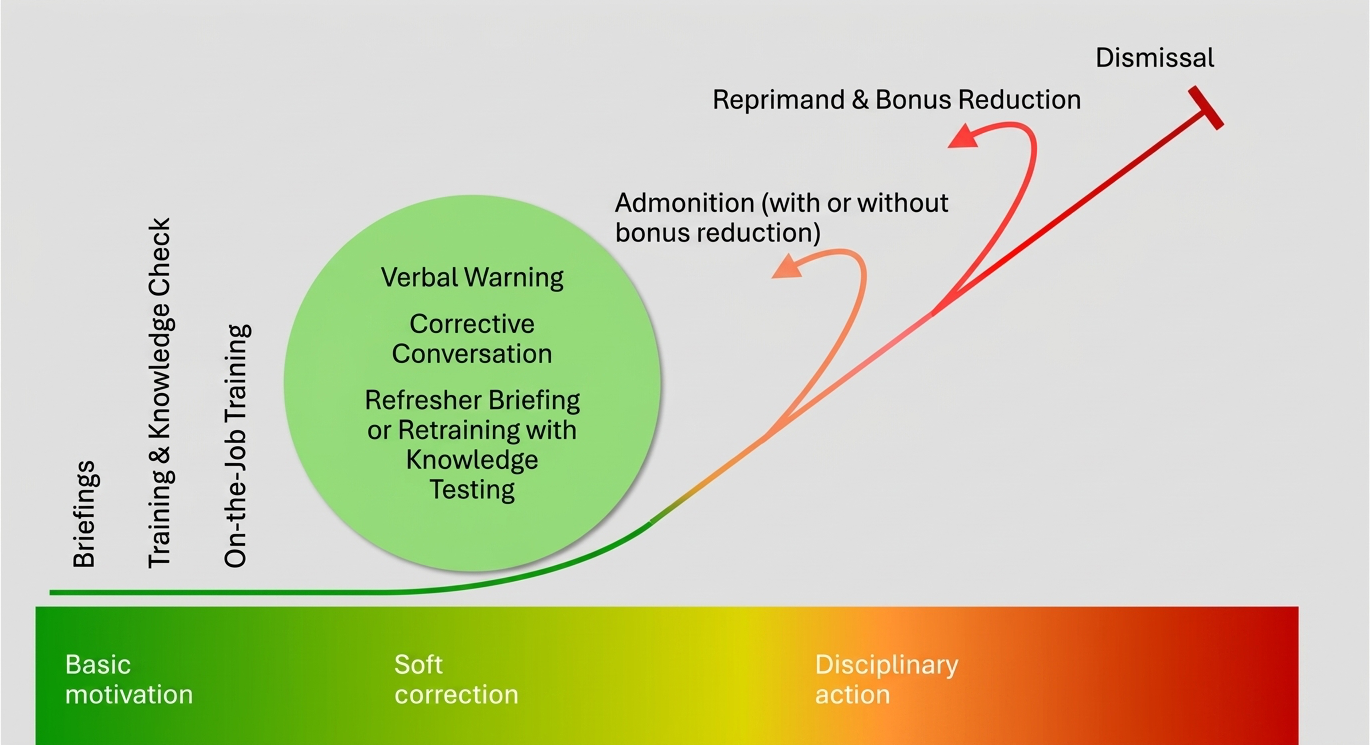
In our context, this motivation represents a system of progressively escalating interventions. Its goal is not punishment, but behavior modification and the prevention of recurring infractions and unsafe acts.
The principle of progressive corrective interventions warrants a dedicated discussion of its own, which is why only its general schematic is shown below (Figure 2).
💡 The fundamental law of progressive motivation is fairness, transparency, and inevitable consequences.
However, “negative reinforcement” alone is insufficient to build a sustainable, collective habit of safety.
Since our overarching goal was the transformation of corporate culture, we also introduced “positive” motivational incentives to balance the system.
We placed these levers directly in the hands of line managers—even though corporate HR found this approach unfamiliar and even risky.
This was one of those cases where innovation clashes with established internal conventions and requires executive backing at the highest level of company leadership.
Controller
This role is assigned to HSE specialists. Controllers do not deal with localized fixes—they must see the big picture. They have full access to all observation data. If necessary, a controller can intervene at any stage of the observation lifecycle: correct errors, and even step in to back up a manager facing difficulties.
The HSE department ensures:
- Expert support for participants.
- Overall quality control of their work.
- Regular performance analysis.
- Actionable feedback to the managing director and division heads.
💡 Work should be organized around roles, not job titles. — Akio Toyoda, longtime leader of Toyota Motor Corporation
In engaging a large number of people in the observation process, we aimed to make it simple and frictionless for every participant.
Picture a typical situation: a newly hired employee spots a hazard somewhere in a vast industrial plant. Can they pinpoint the exact location every time? Do they even know the name of the section or who manages it?
If not, what are they most likely to do? Spend time hunting down someone who knows, or simply walk past? What would you do in their shoes?
In such situations, people quickly become indifferent.
Therefore, instead of confusing acronyms or convoluted division names that change frequently anyway, we created an exhaustive list of distinct, easily recognizable monitored areas at every facility: workshops, bays, laboratories, cafeterias, security gates, parking lots, and even leased premises.
We assigned personal accountability for each monitored area to a specific line manager—strictly one area, one owner. Now, when an observer detects a hazard, their report goes directly to the “owner” of that area.
We eliminated the “no man’s land” across the plant map and handed control over to those who truly run the operations.
Clarifying roles, responsibilities, and operational ownership helped us understand exactly what tools were needed for safety observation participants. These insights later served as the foundation for developing the corporate “Look Around” IT system.
Coming up in the next part:
- How we trained observers to master their roles.
- Why you cannot get anywhere without feedback.
- What fertile ground is needed for BBS audits to thrive.
- How much money is required to sustain participant enthusiasm.
- Can KPIs evolve alongside the system?
To be continued.