Workplace Inspections: What to Check and How to Miss Nothing? The Safe Work Model and Its Practical Application
To organize safety at a production site, the most important element is involving all participants of the production process in improving the safety culture. Compliance with HSE requirements, identification, and elimination of hazards and risks at work is a collective effort and is by no means the sole prerogative of the HSE engineer and the workers themselves. In this mission, we also need to involve line managers.
The HSE engineer is assigned a very important mission – to teach personnel how to identify and manage risks in the workplace.
To teach line managers how to conduct high-quality workplace inspections.
Practice shows that real HSE inspections are often chaotic; that is, the inspecting person, whether a production foreman (line manager) or a site supervisor responsible for monitoring safe working conditions, checks "whatever catches the eye and seems suspicious" when visiting a workplace. The inspector may also be guided by current instructions describing safe actions for personnel. There are examples of inspection organization where we can clearly see the inspector using pre-developed checklists describing standard criteria for organizing safe working conditions.
Methods of checking for compliance with instructions and criteria given in checklists have their place and reasons for use, but today I want to share with you the experience of using a universal approach that will be very useful both at the initial stage of safety culture formation and in existing HSE management systems.
This approach is based on the safe work model used in international practices.
The model consists of four fundamental elements necessary for organizing safe working conditions at the workplace:
- Element No. 1. Competent personnel.
- Element No. 2. Proper procedures.
- Element No. 3. Sound equipment and tools.
- Element No. 4. Environment.
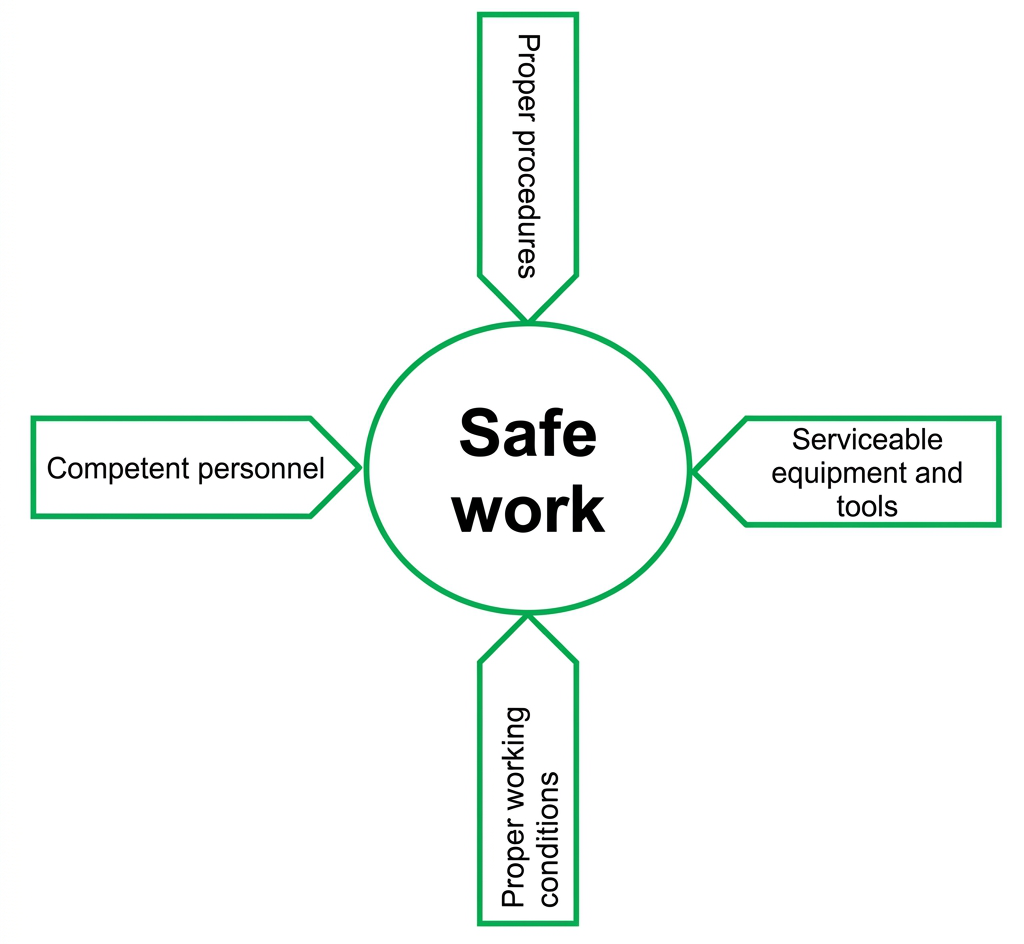
In practical application, it looks like this:
You are the "Inspector".
You come to any workplace for an inspection (specifically any workplace, because the method is universal) with the aim of checking the safety of the work being performed.
For example, let's take a non-standard and non-monotonous task, such as welding on a pipeline section inside a workshop (outside a stationary station).
Check in order:
- "Competent Personnel":
The workers performing the task must have the necessary qualifications for this type of work;
The worker must be trained in safe work practices, know the risks at their workplace, and know measures to prevent these risks from affecting them during the work process.
- "Proper Procedures":
The worker performs only the work assigned to them by the work order;
Before starting work, the worker conducted a risk assessment. Be sure to ask the worker what risks they saw and what they are doing to reduce (eliminate) these risks. Evaluate whether everything has been taken into account. If not, then further explain to the worker which risks they missed and how they can be managed (preventing their impact on the worker being interviewed).
Is the worker using PPE correctly? Are all necessary PPE available, and are they in good condition or not?
- "Sound Equipment and Tools":
Inspect the equipment and tools being used.
Equipment and tools must be in full working order.
Equipped with necessary guards and interlocks.
If you are unsure about the condition of the equipment or the tools being used, stop their use and operation and, together with the worker being inspected, study the product's technical data sheet.
- "Proper Working Conditions"
Access paths to the workplace must be clear and unobstructed.
Check for sufficient lighting and ventilation.
Height differences must be fenced off (covered).
No people should be in the equipment's operating zones.
Working conditions are inspected from a 360° perspective from the work site.
If risks are identified that cannot be eliminated safely and without the help of additional forces and resources, work is IMMEDIATELY suspended until the issues are resolved.
By applying this universal inspection method, you are guaranteed to increase the level of safety in the workplace because this method allows you to see risks and miss nothing in the process.
It also permanently solves the question of what to look for when conducting workplace inspections.