ECOSPACE (Impact on the Planet's Climate, Greenhouse Gases)
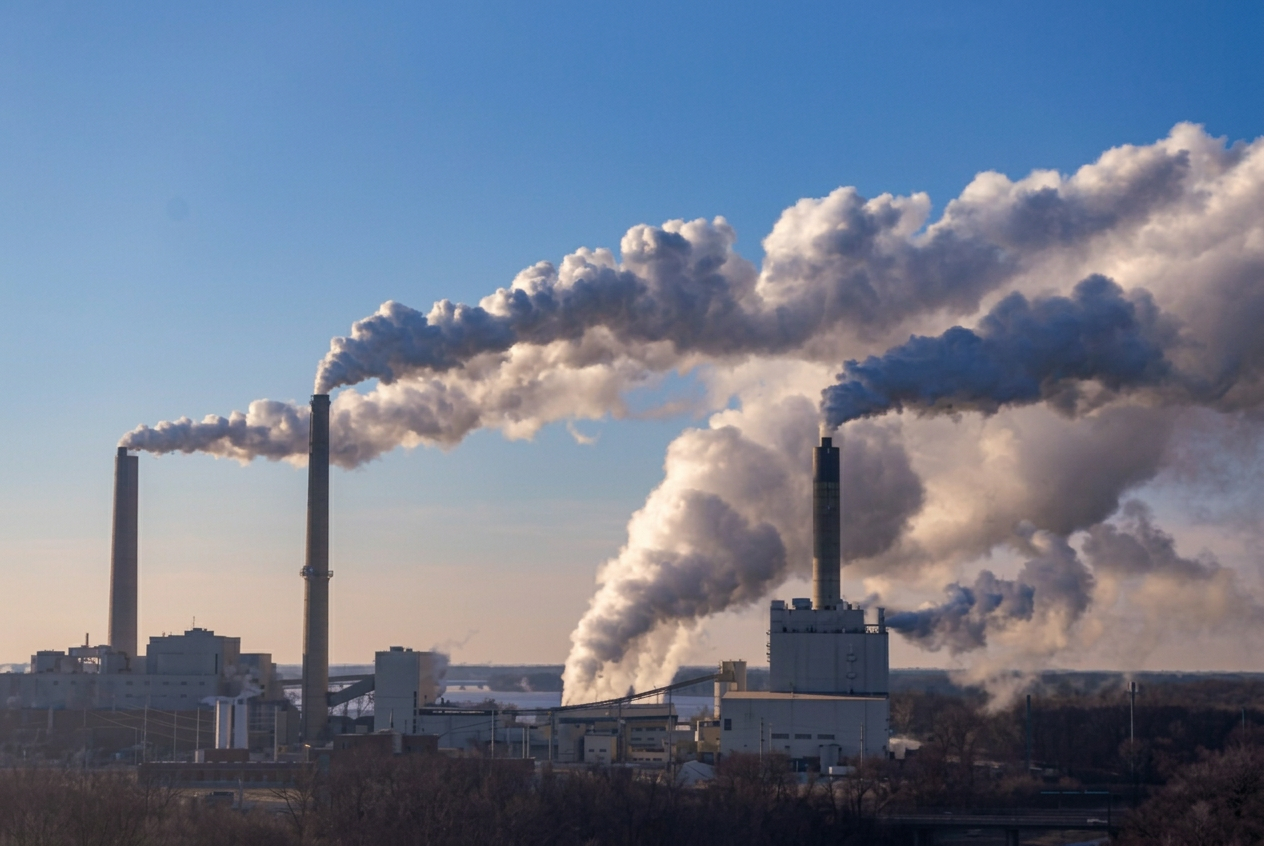
By covering the Earth, greenhouse gas emissions trap solar heat. This leads to global warming and climate change.
Greenhouse gases – are gaseous substances of natural or anthropogenic origin that absorb and re-emit infrared radiation (Article 2 of Federal Law No. 296-FZ dated July 2, 2021, "On Limiting Greenhouse Gas Emissions").
Currently, the planet is warming faster than ever before in human history. Over time, rising temperatures change weather patterns and disrupt the usual natural balance. This creates numerous risks for humans and all other forms of life on Earth.
⸎ In 2019, Russia joined the Paris Agreement — an international treaty within the United Nations framework. The goal of the treaty is to slow down global climate change.
⸎ The Russian Federation has committed to reducing greenhouse gas emissions to 70% of 1990 levels by 2030 and achieving a carbon-neutral development path by 2060 (Government Decree of the Government of the Russian Federation No. 1228 dated September 21, 2019, "On the Adoption of the Paris Agreement" and Presidential Decree No. 666 dated November 4, 2020, "On the Reduction of Greenhouse Gas Emissions").
Carbon-neutral development path - this is when greenhouse gas emissions are equal to their absorption.
The greenhouse effect refers to the atmosphere's absorption of thermal radiation from the Earth's surface and the re-emission of part of this absorption back to the Earth's surface, thereby preventing the loss of this radiation flow into outer space.
The main greenhouse gases present in the atmosphere are:
- carbon dioxide (CO2);
- nitrous oxide (N2O);
- methane (CH4);
- sulfur hexafluoride (SF6);
- organohalogen compounds (e.g., chlorofluorocarbons or CFC).
Quantitatively, greenhouse gas emissions are measured in conventional units — CO2 equivalent (carbon dioxide equivalent, CDE, CO2e). CO2 equivalent is a unit used to compare the radiative forcing of greenhouse gases with carbon dioxide.
The Russian Federation has been conducting GHG inventories, assessments, and calculations of emission and absorption volumes at the national level since 2006 (Order of the Government of the Russian Federation No. 278-r dated March 1, 2006). The main goal of the order is to create a national inventory of greenhouse gas emissions and absorption volumes.
The state-level GHG report is compiled by Roshydromet and the Yu.A. Izrael Institute of Global Climate and Ecology based on state statistical reporting data. It is submitted annually in accordance with international requirements and the 2006 IPCC (Intergovernmental Panel on Climate Change) guidelines to the UN Framework Convention on Climate Change committee as confirmation of the state's commitments to regulating GHG emissions and for assessing domestic climate policy.
The statistical data available at the state level is insufficient to fully assess the national economy's impact on the climate, establish appropriate targets for economic sectors, and form a list of measures to achieve them. This requires refined data at the level of federal subjects and individual organizations.
Individual companies play the main role in providing greenhouse gas data — these are the major emitters upon whose activities the success of Russia's entire climate doctrine depends.
Specifically for the purpose of updating the Russian Federation's greenhouse gas inventory and creating a unified information system, starting from 2023, organizations will report annually on the volumes of GHG released into the atmosphere as a result of their activities.
Reports must be submitted by legal entities and individual entrepreneurs if they are classified as regulated organizations and their activities result in greenhouse gas emissions equivalent to 150,000 tons or more of carbon dioxide per year for the period until January 1, 2024, or 50,000 tons or more of carbon dioxide per year for the period starting from January 1, 2024 (Paragraph 1 of the criteria for classification as regulated organizations and Paragraph 1 of Article 7 of Federal Law No. 296-FZ dated July 2, 2021).
It is important to note that different production processes lead to the formation of various greenhouse gases. Examples of such production processes include the production of lime, cement, pig iron, steel, the combustion of fossil fuels, etc.
The reporting form was approved by Government Decree No. 707 dated April 20, 2022.
The following data will be required to complete the report:
- basic organization information card;
- information on economic and other activities accompanied by greenhouse gas emissions (list of applicable production processes and types of activities, codes of objects of negative environmental impact, and information on the capacity of equipment used (if any));
- data on the inventory of sources of pollutant emissions into the atmosphere;
- information on the instrumental and calculation methods used to determine the volume of greenhouse gas emissions, conversion factors for economic and other activity indicators established by the Ministry of Natural Resources of Russia, and justification for their choice.
The greenhouse gas emissions report is submitted by the organization by July 1 of the current year for the previous reporting year.
On June 1, 2023, the Greenhouse Gas Emissions Registry was launched in Russia. The Registry will allow for the automated collection of reports from industrial enterprises emitting more than 150,000 tons of CO2 per year. Carbon reporting will help understand Russia's progress toward carbon neutrality by 2060, as outlined by the President of the Russian Federation, and take additional state regulatory measures if necessary.
It is worth noting that the calculation of greenhouse gases according to the methodological guidelines of Order No. 300 of the Ministry of Natural Resources of the Russian Federation dated June 30, 2015, contains information on the company's direct GHG emissions from its own sources.
In reality, an organization's actual emission volume is much larger: in addition to direct emissions, a company has indirect emissions related to product creation stages and supply chains.
To designate the range of processes included in the assessment and calculation of greenhouse gas emissions, the concept of "scope" is used.
- Direct GHG emissions (Scope 1) — GHG emissions from the organization's own sources (i.e., from sources owned or controlled by the organization);
- Indirect energy GHG emissions (Scope 2) — GHG emissions associated with the organization's consumption of energy from external sources;
- Other indirect GHG emissions (Scope 3) — all other GHG emissions that are in one way or another related to the organization's economic and other activities.
Methodological guidelines for the quantitative determination of indirect energy GHG emissions are contained in Order No. 330 of the Ministry of Natural Resources of the Russian Federation dated June 29, 2017.
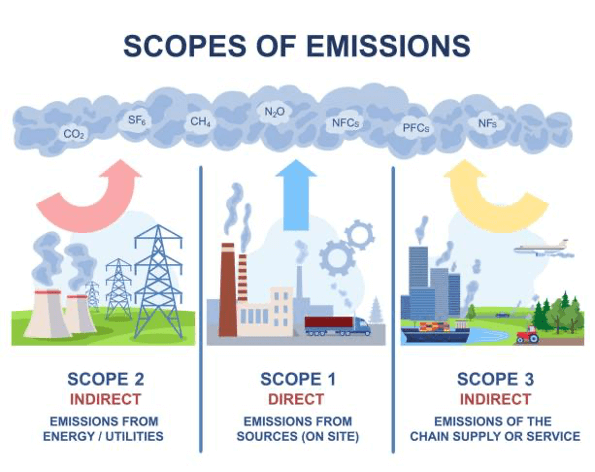
For large companies, especially those exporting their products to foreign markets, it is **important to account for and publicly disclose** their climate impact by calculating direct and indirect emissions.
Expanded voluntary carbon reporting is a strategically important step when interacting with stakeholders:
- investors;
- the public;
- government authorities.
This is part of the company's environmental policy within its sustainable development and ESG transformation.