ECO-SPACE (Staff Training, Environmental Competence)
Staff training is a purposeful, systematic process through which an individual acquires knowledge, skills, abilities, and communication methods under the guidance of experienced teachers, mentors, specialists, and managers.
A systematic approach to staff training involves the use of specific types, forms, and methods of instruction. The preference for a particular method or form is determined by several factors. The main ones include:
- organizational goals;
- HR policy;
- characteristics of the staff being trained;
- the company's budget for professional development.
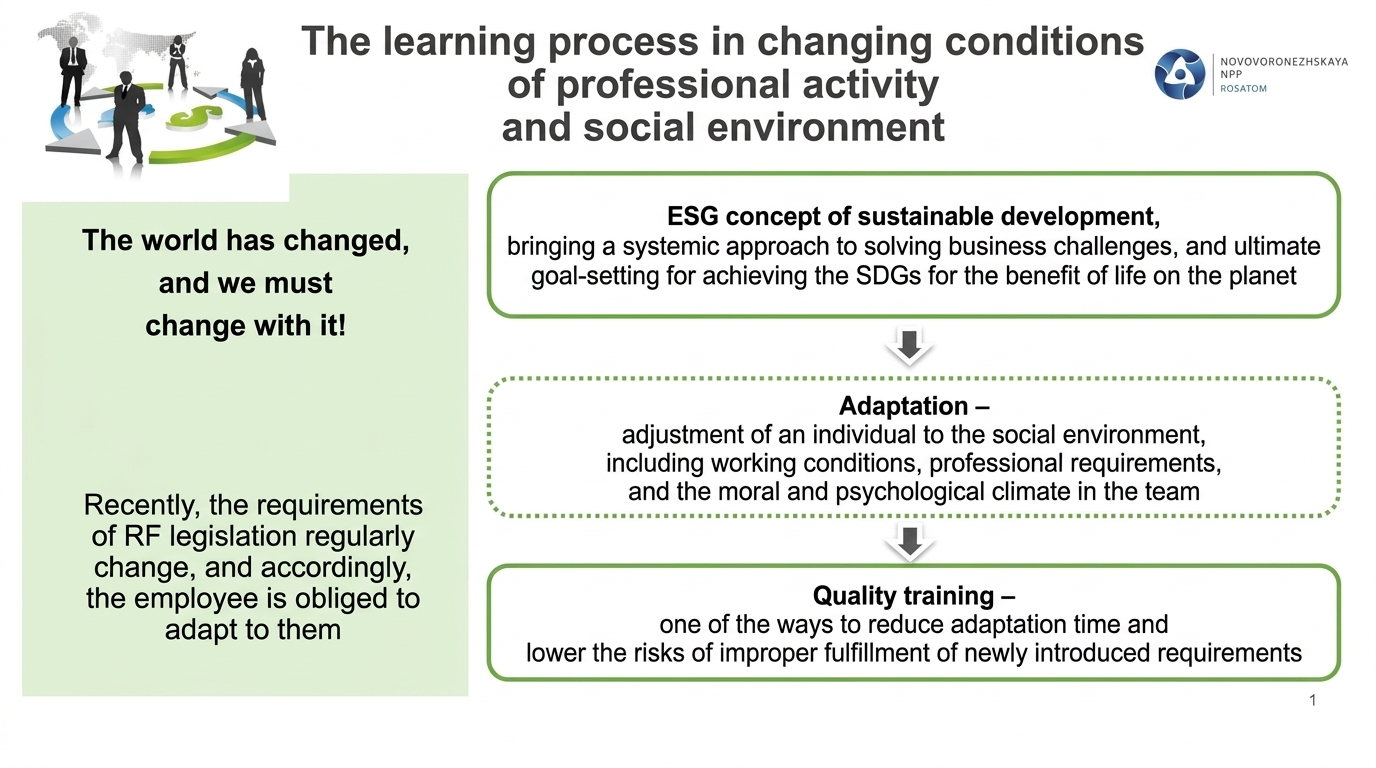
There are three types of staff training: vocational training, professional development, and retraining:
- vocational training involves the planned, organized instruction and graduation of qualified personnel for all areas of professional activity. As a result, trained staff acquire a set of specialized knowledge, skills, abilities, and communication techniques;
- professional development involves training staff to improve knowledge, skills, and abilities in relation to professional needs or career advancement;
- retraining is driven by training personnel to master new knowledge, skills, and abilities in connection with learning a new profession or changing requirements for the content and consequences of labor.
According to Clause 7.2 of GOST R ISO 14004-2017 "Environmental management systems — General guidelines on implementation," knowledge, understanding, and skills allow an individual to achieve the necessary competence regarding environmental performance. All persons working under the organization's control who affect or could affect environmental performance, including the organization's ability to fulfill its compliance obligations, must be competent based on education, training, experience, or a combination thereof. These persons include the organization's own employees, as well as others working under its control, performing work on-site and in departments on a contractual basis.
Environmental competence is defined as an employee's mastery of a system of knowledge, views, and beliefs of the corresponding competence, including their personal attitude toward it and aimed at realizing their moral responsibility for the state of the environment in all types of professional activities.
In accordance with Clause 7.2 of GOST R ISO 14001-2016, the national standard of the Russian Federation "Environmental management systems — Requirements with guidance for use," the organization shall:
- determine the necessary competence of person(s) doing work under its control that affects its environmental performance and its ability to fulfill its compliance obligations;
- ensure that these persons are competent on the basis of appropriate education, training, or experience;
- determine training needs associated with its environmental aspects and its environmental management system;
- where applicable, take actions to acquire the necessary competence, and evaluate the effectiveness of the actions taken.
Applicable actions can include, for example, the provision of training, mentoring, or the reassignment of currently employed persons; or the hiring of competent persons.
The organization shall retain appropriate documented information as evidence of competence.