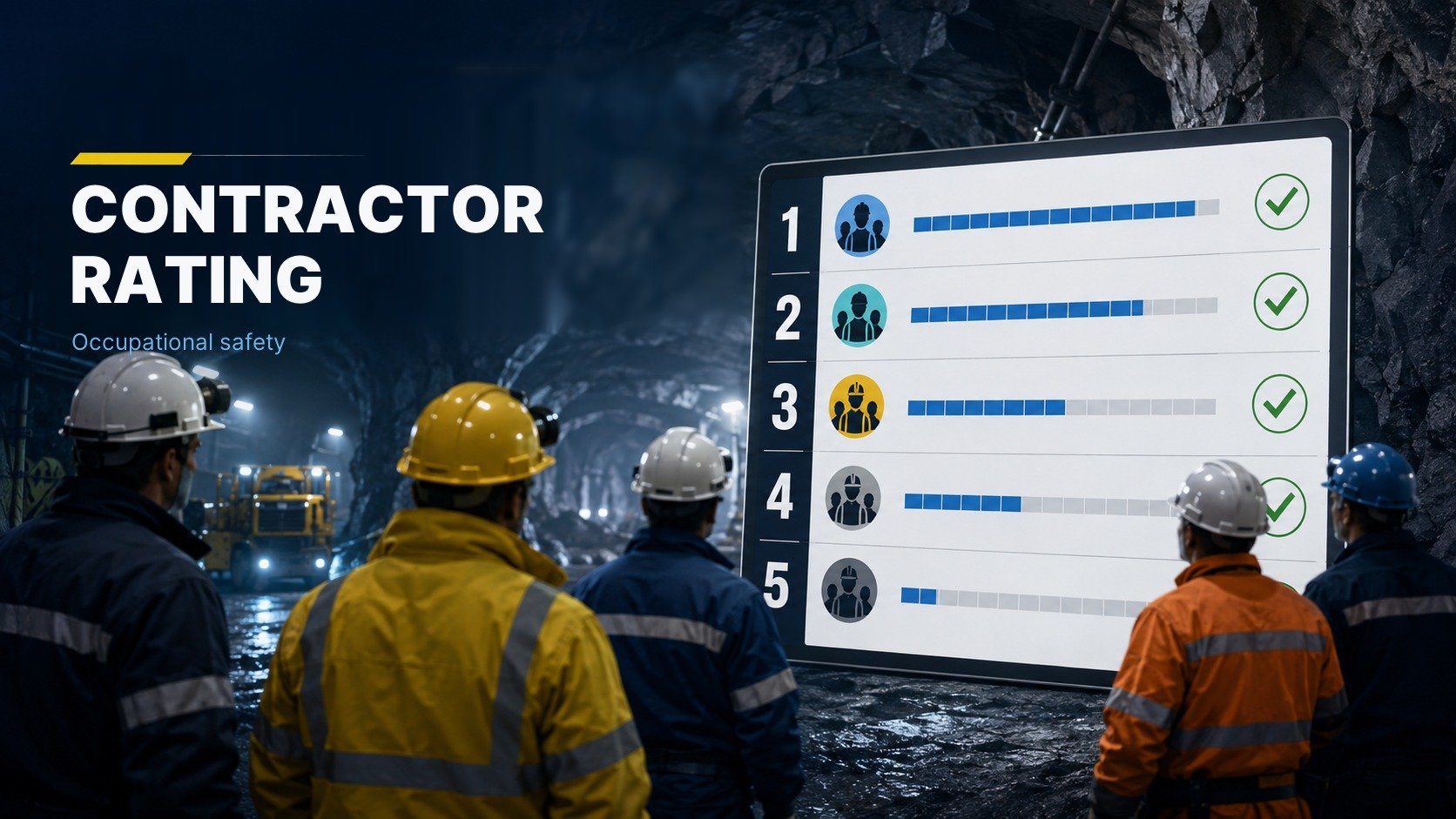
How to turn contractor control into a development system: creating an occupational safety rating
Dozens of contractor organisations can work at a large industrial site at the same time. Each of them has its own managers, internal procedures, experience and level of safety culture maturity. Yet for the client the boundary between “own” and contractor employees is a convention: an incident on site becomes a shared risk — human, operational, financial and reputational.
That is why handing work over to a contractor does not mean handing over responsibility for safety. But control alone is not enough either. Inspections often record individual violations without allowing anyone to see the trend, to compare organisations with one another and to understand whether corrective measures really change people's behaviour on site.
We tried to solve this problem through a contractor rating — a single assessment system that combines observations at the workplace, compliance inspections and an audit of the occupational safety management system. In the summer of 2026 the model went through a pre-pilot at a mine of PJSC MMC Norilsk Nickel: 23 contractor organisations under 36 contracts were brought into the scope.
Why routine inspections are not enough
The traditional control model has several limitations.
First, one-off inspections give a snapshot of the situation but do not show the trajectory. A contractor can close a specific finding without changing the process that led to the violation.
Second, assessments made by different inspectors are hard to compare. One specialist records every deviation, another only those they consider material. As a result, the outcome depends not only on the state of the works, but also on the inspector's approach.
Third, control often ends with a report. If its results are not linked to an improvement plan, to feedback for the contractor's manager and to a follow-up inspection, the data never becomes a management decision.
Finally, without a single system it is difficult to use safety indicators in contractor motivation and in procurement procedures. For that, the assessment has to be regular, transparent and equally clear to everyone involved.
How the rating model works
The rating is built on three complementary sources of data.
1. Works supervisor assessment — a weekly check of the foreman directly at the work site against a single checklist.
2. Preventive compliance check — a situational inspection of the contractor's employees carried out once every two weeks.
3. Occupational safety management system audit — a quarterly assessment of how the contractor has organised management, control and the completion of corrective actions.
The point of the model is not to add up scores mechanically and build a league table. The rating starts a repeating management cycle:
observation → recording the result → discussion with the contractor → corrective action plan → follow-up inspection → rating update.
This approach makes it possible to see not only the contractor's current position, but also its ability to change. For risk management the trend is sometimes more important than the absolute score: a low starting assessment combined with consistent improvement points to a working change system, while a stably high result calls for a check on objectivity and sustainability.
What the pre-pilot showed
During the pre-pilot 372 works supervisor assessments were planned and 324 were carried out — 87% of the plan. In 238 cases the work received a satisfactory assessment, in 17 an unsatisfactory one. Excluding the cases where the contractor was in fact not performing work at the time of the inspection, the share of satisfactory assessments was 93%.
For the system audits, 39 out of 43 planned inspections were completed, or 91%. Of these, 30 ended with a satisfactory result and nine with an unsatisfactory one. It was the audits that helped to see that individual violations on site are often linked to deeper management gaps: insufficient internal control, weak motivation of managers, the absence of employee statistics and of analysis of recurring violations.
The most telling result was the trend in repeat audits. Among the 12 contractors for which comparable results were available, 11 improved their assessment. The median score rose from 73 to 91. For one organisation the trajectory was 0 → 26 → 60 → 89 points. These data do not yet prove a direct cause-and-effect relationship, but they give a strong signal: regular feedback, a corrective action plan and a repeat assessment are able to sustain visible change.
The preventive compliance checks showed that the system is not limited to observation. Against a plan of 104 inspections, 19 violations were recorded, nine reports were issued and in four cases the work was stopped. This is an important principle: the rating does not replace the right to intervene immediately when the risk is serious.
The recurring topics were quite practical: issuing permits to work, following the safe sequence of operations, using certified tools and gas detectors, wearing personal protective equipment, safety of work at height and knowledge of the key safety rules.
The main effect does not appear in the table
I consider the most significant result of the pre-pilot to be not the rating itself, but the change in the quality of dialogue. Regular contact with the top managers of the contractor organisations and with the foremen made it faster to discuss violations, agree on corrective measures and return to them at the follow-up inspection.
The contractor gets a clear picture: which criteria are applied, where exactly the deviation occurred, what needs to be changed and how the result will be assessed. The client, in turn, sees not a set of unrelated findings, but the history of how the organisation works with risks.
This moves the relationship from the logic of “inspector — inspected” to a more mature model of shared responsibility. The level of demand does not fall, but it becomes predictable and evidence-based.
Three conditions for scaling up
The pre-pilot also revealed limitations that are important to remove before the system is expanded.
First — calibration of the inspectors. A low share of detected violations does not always mean a high level of safety. In one set of data five inspectors carried out 93 checks and did not record a single deviation, whereas across the whole sample violations were noted in roughly 14% of inspections. This is not proof that specific employees did poor work, but it is a solid signal to check that approaches are uniform. Training, joint site visits and regular comparison of assessments are needed.
Second — automation. Manual data collection is fine for a pre-pilot, but when scaled up it creates unnecessary workload and a risk of errors. The digital environment should provide common reference data, capture of primary data, deadline control, calculation of the rating and transparent analytics on trends and repeat violations.
Third — engagement. 72 people completed the training against a plan of 95, and attendance at the nine regular meetings with contractors was 79%. Even a good methodology does not work without discipline of participation. That is why the presence of managers, training and the completion of corrective action plans have to become part of management responsibility.
What conclusions can be applied in other companies
The pre-pilot experience allows several practical principles to be formulated.
1. Start not with an aggregate score, but with a common dictionary of criteria and a clear purpose for the assessment.
2. Combine the check of behaviour on site with an audit of the contractor's management system.
3. Assess not only the current state, but also the trend after corrective actions.
4. Calibrate those who carry out the inspections: comparability of data matters more than the number of checklists filled in.
5. Do not turn the rating into a purely punitive tool. It should show the contractor a path of improvement and recognise sustained progress.
6. Link the results to real decisions — development plans, motivation, terms of further cooperation and procurement procedures.
A contractor rating is not one more form of control and not a competition for a place in the table. Its value appears when the data helps to see the risk earlier, to discuss it concretely with the contractor, to verify the result of the changes and to take a well-founded decision.
Ultimately, the maturity of such a system is measured neither by the number of inspections nor even by the average score. The main criterion is whether safe performance of work becomes a shared and sustainable practice for everyone who is on the production site.
Comments 1
However, as with any tool for occupational health and safety and industrial safety, there is a danger of slipping into formalism.
Very often, "box-ticking" inspections, reports, and ratings are direct symptoms of resistance and sabotage. Such behavior on the part of the client company is usually instantly read by contractors and orients them towards similar actions.
In this case, you can forget about the self-assessment of contractors and other highly useful things you are talking about. And the responsibility for the effectiveness of the program will completely fall on the shoulders of the Department of Occupational Health and Safety and Industrial Safety.
After some time, complaints will inevitably follow:
As a result, an excellent idea and a carefully thought-out tool risk remaining only on paper. Constant "calibration" of the process or staff training will not suffice here.
The good news: we have a proven cure for this affliction.
The contractor safety management program (like any other management program) must be implemented at the right time: upon readiness and as part of a single, consistently implemented strategy for occupational health and safety and industrial safety.