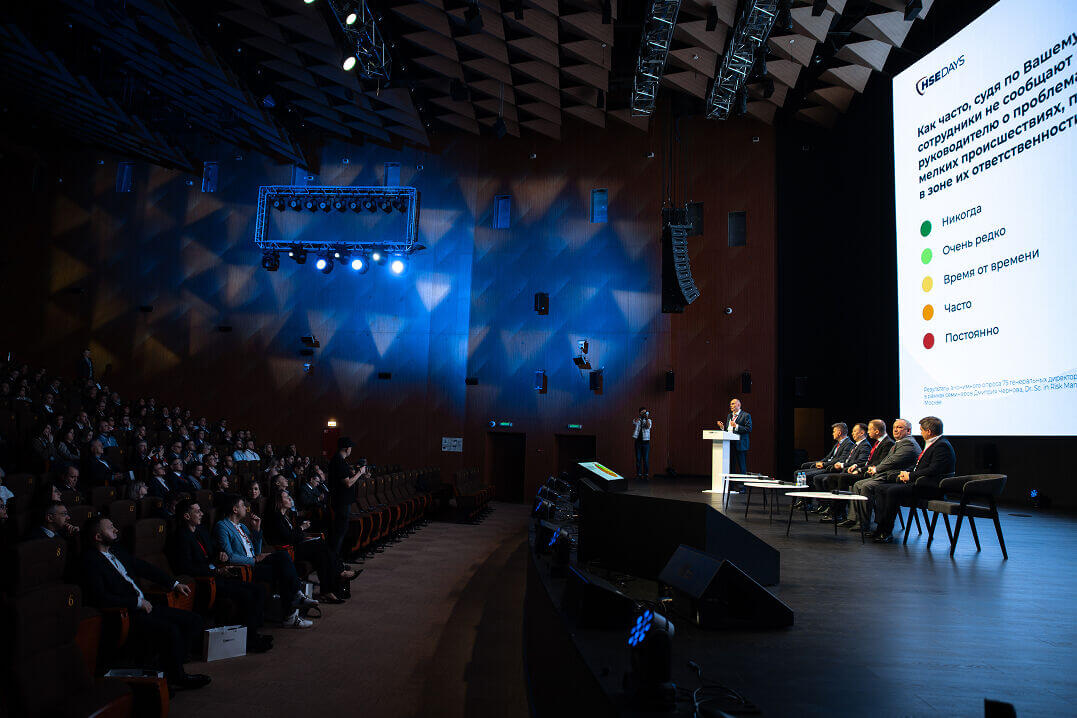
Frontline Leaders: Absolute Honesty Standard and HSE AI Revolution Launched at HSE DAYS Forum
The VI Annual HSE DAYS Forum has concluded in Moscow — an event that divides the history of the domestic safety industry into "before" and "after". Over 350 delegates from the country's largest industrial holdings, two days of intellectual brainstorming, and an unprecedentedly intense competition in the HSE TOP 100 rating confirmed: this platform does not follow trends, it creates them.
This year, the HSE DAYS forum became a territory of open dialogues and high technologies. The event's agenda reached a strategic level, uniting issues of personal responsibility of top executives, the psychology of leadership, and the large-scale implementation of artificial intelligence.
The tone for the entire forum was set by the plenary session "Frontline Leaders", moderated by Dmitry Chernov (ETH Zurich), an international expert in technological risk management. The focus was on an acute problem of corporate governance: the "filtering" of bad news on its way to the top.
The session speakers — Denis Paramoshin (Salym Petroleum Development), Stanislav Polshakov (Zarubezhneft Group), Vladimir Varlamov and Konstantin Rubin (SUEK), Mikhail Zhiganov (Nornickel) — openly discussed how to build an honest and constructive dialogue between top management and owners regarding existing critical technical and production risks.
Deep industry expertise was brought to the forum program by industry leaders who headed their own sessions. The SUEK team, led by Vladimir Varlamov, held a session for mining enterprises, presenting the concept of balancing three cultures: production, corporate, and safety culture. Participants analyzed how to synchronize these areas so that safety becomes not a limitation, but the foundation of business efficiency.
In turn, Zarubezhneft JSC organized a strategic session on health protection. Curated by Elena Kompasenko, the focus of the discussion shifted to employee health as a key factor in business sustainability. Experts discussed real risk management tools — from the prevention of cardiovascular diseases to combating burnout, proving that caring for people directly affects operational performance.
The next vector of the forum was a technological breakthrough. HSE DAYS solidified its status as the main innovation laboratory: while the industry is taking its first steps in using neural networks, here they demonstrate how to implement AI at a systemic level and create working tools in-house.
Rinat Fatkhutdinov, PhD in Engineering, moderated the AI session and held his own master classes for the forum participants. He summarized the results of the technological track as follows:
"Today, a strict rule works in business: the fast beats anyone. This is the law of evolution, where it is not the strongest who survives, but the one who adapts to changes the fastest. Artificial intelligence is exactly the tool that provides this speed and adaptability. It seemed to many that implementing neural networks in HSE is difficult and time-consuming. The main insight the participants took away: everything is easy when you know how. Now industry leaders have this knowledge to be faster than their competitors."
The culmination of the business program was the awarding of the leaders of the HSE TOP 100 rating. This year, the competition was the fiercest in the history of the project. The gap between the finalists was measured in tenths of a point, which indicates a colossal growth in the level and competencies of participants from domestic companies.
Summarizing the results of the forum, the organizer emphasized the transformation of meanings that occurred over these two days: "HSE DAYS has ceased to be a forum 'only about safety'. It is a forum about business efficiency and human-centricity. We saw hundreds of leaders who understand: it is impossible to build a safe company on the fear of punishment. It can be built on trust, technologies, and the synergy of three cultures — safety, production, and corporate culture," summarized HSE DAYS founder Andrey Prokopenko.