12 Life-Saving Rules: Why They Are Enforced and How to Properly Document a Violation
Introduction
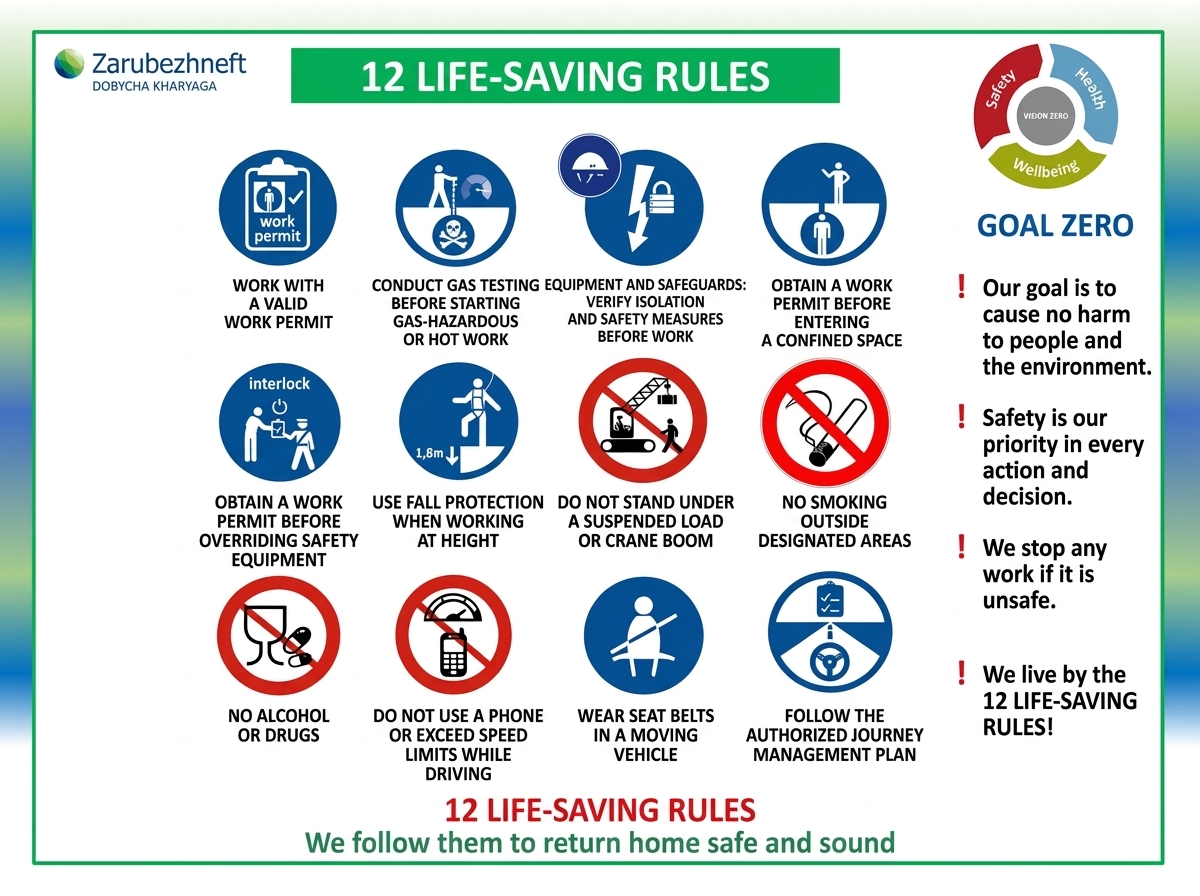
At ZARUBEZHNEFT-Dobycha Kharyaga LLC, the Life-Saving Rules (LSR) are core safety rules designed to establish barriers against incidents that could cause harm to people, the environment, and property during the performance of work and delivery of services.
That is why these rules are strictly followed by everyone without exception: from frontline workers to senior managers, and from Company employees to contractor personnel. The standard containing these rules is incorporated into contracts with contractors as an integral part—the requirements are mandatory for anyone entering a site. There are 12 rules in total.
However, following the rules is only half the battle. You also need to know how to properly record a violation. An LSR Violation Report is not a mere formality, but a document with real legal force: how competently it is drafted determines whether the company can impose disciplinary action on an employee or issue financial penalties to a contractor. Practice shows that courts often side with employees if a report is drawn up with procedural flaws. Therefore, the documentation procedure must be approached just as thoroughly as the safety requirements themselves.
Why an LSR Violation Report Is Needed in the First Place
An LSR Violation Report confirms the fact that an employee breached workplace discipline or occupational safety requirements, and serves as the basis for disciplinary action up to and including dismissal. Without a properly executed report, a penalty simply will not hold up on appeal.
It is important to distinguish between two scenarios:
- A report on a Company employee serves as the basis for disciplinary action, which the employee can challenge in a court of general jurisdiction. Here, the cost of an error is at its highest.
- A report on a Contractor employee shifts the dispute into the realm of B2B legal relations, and the penalties fall on the contracting company.
This distinction dictates different procedural requirements.
Rule One: Committee Only
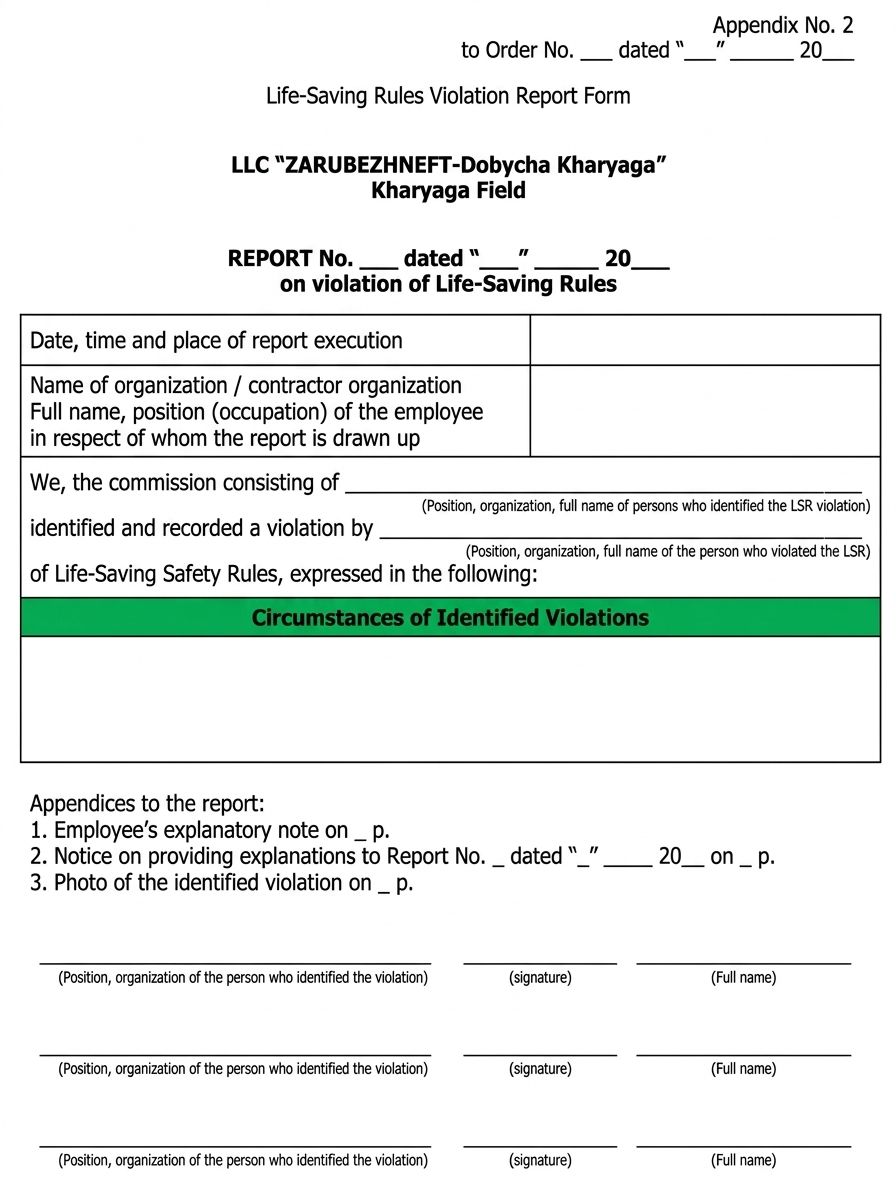
An LSR Violation Report must be drawn up by a committee of at least three people. A single-person report has no legal standing. For Company employees, the committee is formed exclusively of the company's own staff.
If a violation is committed by a contractor's employee, an authorized representative of the Contractor—such as a foreman, site supervisor, or HSE specialist—must be involved in drafting the report. Skipping this step deprives the company of the ability to hold the contractor accountable.
Rule Two: Exact Location of the Violation
The location of the violation must be described in a way that rules out any ambiguity. Writing "on the oilfield premises" is not enough. You must specify the names, addresses, inventory numbers, or other identifying coordinates of facilities, as well as specific terrain features.
A good example of wording: "Employee A.B. Ivanov was smoking 50 meters north of the Administrative and Amenity Building of the Central Processing Facility at the Kharyaga field, i.e., outside a designated smoking area." This level of detail immediately eliminates any questions about where and what exactly happened.
Rule Three: Date and Time Are Not Minor Details
The date the report is drafted is of fundamental importance: from the standpoint of civil and labor law, it determines the legal consequences of the violation. A report without a date makes it impossible to apply enforcement measures to either an employee or a contractor.
The date and time are indicated in the upper right corner of the report or within the narrative text.
Rule Four: Full Names and Job Titles Without Abbreviations
In a report concerning a Company employee, the job titles and full names of all participants must be written out in full: both those drafting the report and the person who committed the violation. Commonly used abbreviations are not permitted in order to avoid ambiguous interpretation. "PTO Engineer I.V. Smirnov" can turn into a problem in court; "Production and Technical Department Engineer Ivan Vladimirovich Smirnov" will not.
Rule Five: Consistent Description of the Violation and Regulatory References
The violation must be described sequentially: when, where, by whom, and under what circumstances it was committed, and what exactly was violated. A mandatory element is referencing the regulatory documents that govern proper conduct: the contract, job description, internal labor regulations, standard HSE requirements, laws, and company policies. You must specify the exact clauses and articles that were breached.
Requirements for handwritten text are strict: write legibly, and avoid corrections or strikethroughs in the body of the text. If a correction is necessary, a note referencing it is placed at the bottom of the page, and the corrections themselves must be certified by the signatures of all committee members.
Rule Six: Written Explanations—Without Them, Disciplinary Action Will Fail
This is where the procedures for Company employees and contractors diverge most noticeably.
For a Company employee, written explanations are mandatory:
- If the employee provides a written explanation immediately after the violation is recorded, a formal notice is not required.
- If the employee refuses to provide an explanation on the spot, a formal notice requesting a written explanation must be handed to them on the same day—deviations from this rule are unacceptable, as this is a requirement under Article 193 of the Labor Code of the Russian Federation.
- If no explanation is provided after one work shift has elapsed from the moment the notice was served, the committee draws up a Report of Refusal to Provide an Explanation and attaches it to the violation report.
Failing to follow the procedure for requesting explanations makes it impossible to impose disciplinary action—this is a direct consequence of Article 193 of the Labor Code of the Russian Federation.
For a Contractor employee, the rules are more flexible:
- The absence of a written explanation does not block the preparation of a formal claim against the contractor.
- A formal notice requesting an explanation is not drafted; if the worker refuses to provide an explanation, it is sufficient to state this in the body of the report above the committee's signatures.
- If the worker refuses to sign the report, the committee draws up a separate Report of Refusal to Sign, and its date and location must match the date and location of the violation report itself.
Rule Seven: Photographic Evidence as Proof
Photographic documentation strengthens the evidence base and details the circumstances of the violation—especially when an employee or contractor representative refuses to provide a written explanation. Combining two types of photography is recommended.
Panoramic Photography
Panoramic photography captures the surroundings across large areas of terrain or major facilities with a wide field of view. The essence of the method is taking a sequence of shots and subsequently merging them into a single panorama. This technique is particularly useful when a site or facility cannot be captured in a single frame.
Detailed Photography
Detailed photography involves capturing specific objects in a single shot or multiple shots from different angles (cross-angle photography). The key is to take a position that allows you to most fully capture the circumstances of the violation, shooting from multiple angles whenever possible.
To link the photographs to the report, annotations are made on the images in the following format: "Appendix to the LSR Violation Report dated ___ ________ 20__"—signed by the employee against whom the report was drawn up and by the committee members.
Checklist: What Must Be Included in the Report
Before signing the document, verify that:
- the location of the violation is described with exact coordinates and reference points;
- the date and time of the report are stated;
- full names and job titles of all committee members and the violator are written out without abbreviations;
- there is a consistent description of the circumstances with references to specific clauses of regulatory documents;
- for a Company employee: a written explanation or a properly executed notice (and, if applicable, a report of refusal) is attached;
- for a contractor: their representative was involved, and any refusals to explain or sign are documented;
- photographic evidence: panoramic and detailed photos with annotations and signatures are included.
Conclusion
Life-Saving Rules do not exist for the sake of writing reports—they exist so that everyone returns home alive and well. However, when a violation does occur, a properly drafted report serves as the company's insurance policy: without it, disciplinary action will fall apart in court, and a claim against a contractor will lose its legal force. Three core principles—acting as a committee, describing facts with precision, and following the procedure for requesting explanations—cover the majority of risks. Meanwhile, high-quality photographic evidence turns a disputed situation into a documented fact that is difficult to challenge.