Five Key Safety Rules
Five Key Safety Rules: Visual Prompts for Mindful Action
On the shop floor, it is crucial for workers to understand how safety requirements relate to their daily tasks. Before starting a shift, while preparing a workstation, and during task execution, the right rule needs to come to mind at the right moment and guide a safe decision. Statistically, only 10–20% of text-based information is retained in memory after three days, compared to 80–90% for visual information.
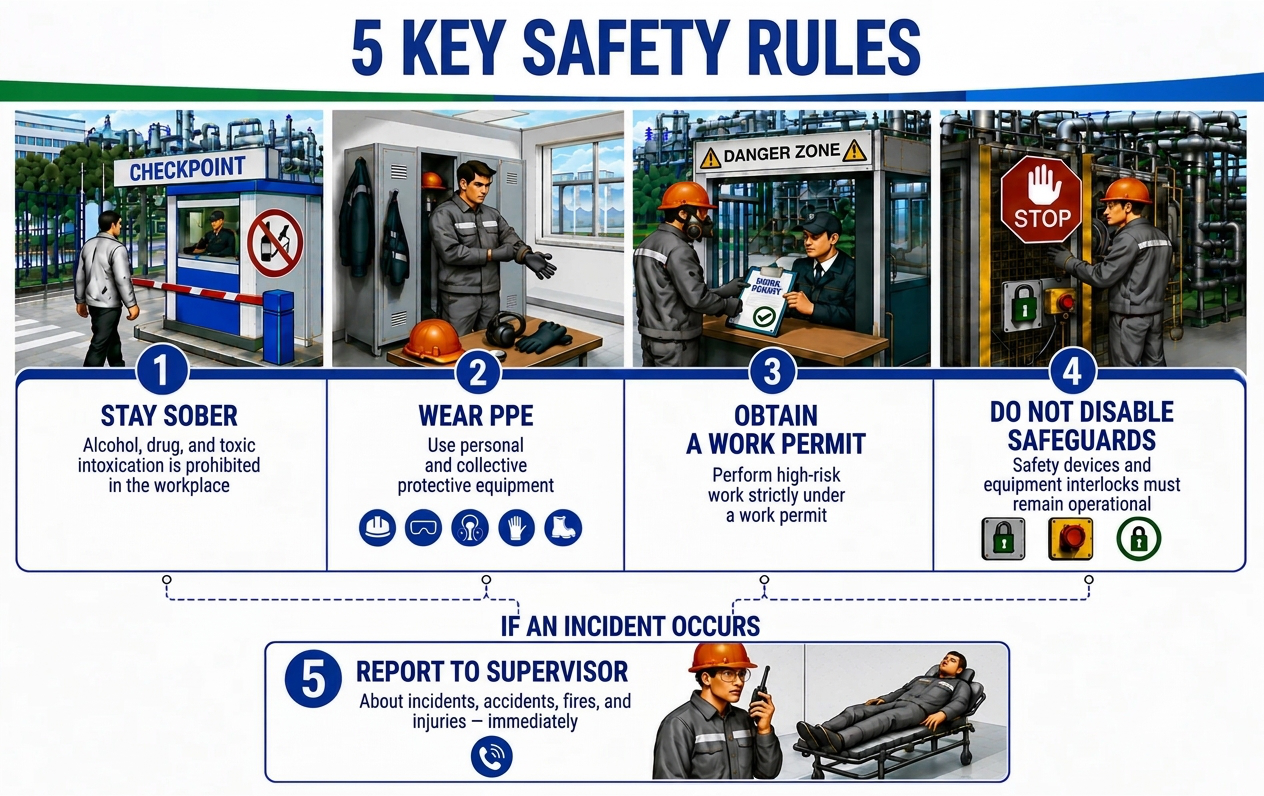
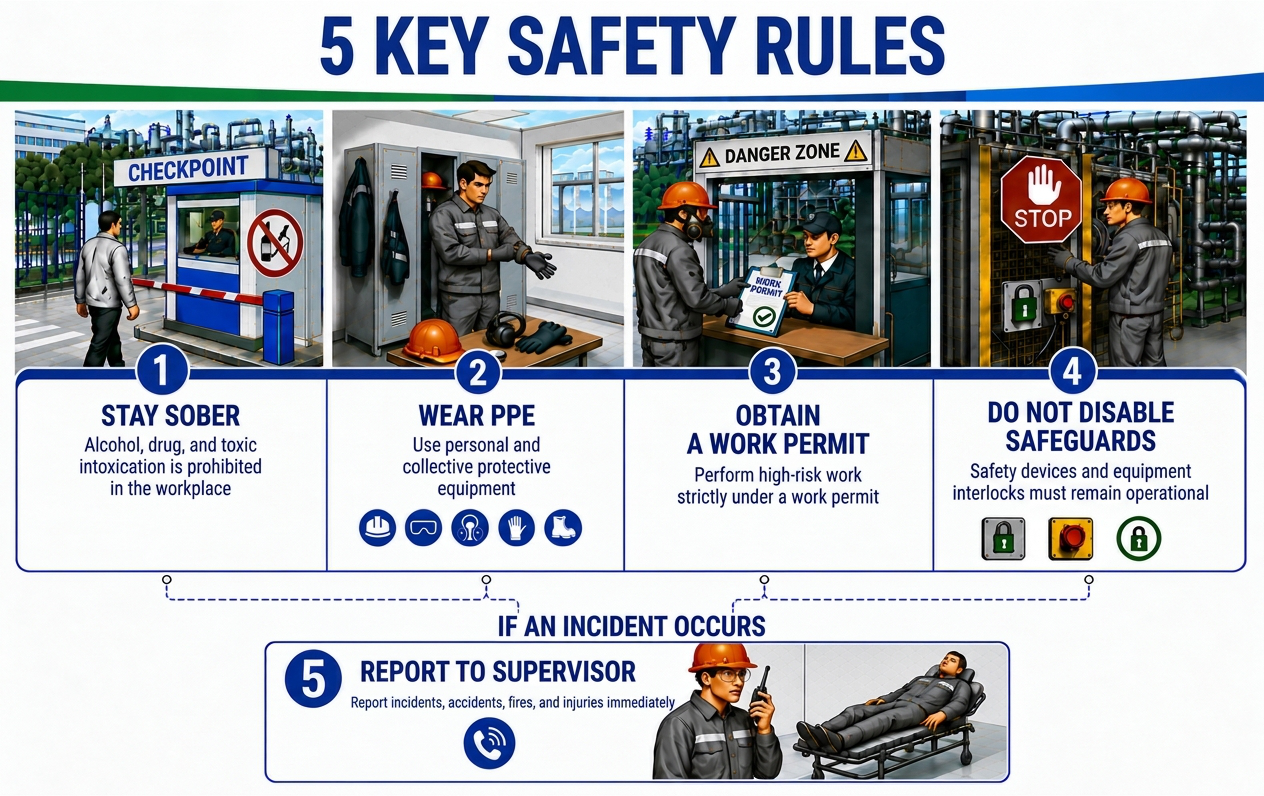
With this in mind, I designed the "5 Key Safety Rules" poster. It is built around familiar workplace scenarios: passing through the plant gate, preparing workwear and protective equipment, obtaining a work permit, and working around machinery.
Each rule is paired with a distinct image and a concise call to action:
Stay sober. Safe work begins with a person's own fitness for duty.
Wear your PPE. Task preparation includes putting on all required personal protective equipment.
Get a work permit. When performing tasks that require a permit to work, follow the established authorization procedure.
Never bypass safety guards. Safety devices and equipment interlocks must remain functional at all times.
Report to your supervisor. Incidents, accidents, fires, and injuries must be reported immediately.
I paid special attention to the placement of the fifth rule. It is set apart in a dedicated block under the condition "If an event occurs." This layout emphasizes that reporting an incident is a reactive step taken when a situation arises, whereas the four primary rules focus on preventing hazardous events in the first place.
When designing the poster, I aimed to link the text to a recognizable scene. Workers see a familiar setting, relate it to their own work area, and receive a quick prompt. Large captions and a consistent visual style make the poster suitable both for safety bulletin boards and for toolbox talks.
I also see practical value in using the poster as a conversation starter. A supervisor or foreman can invite workers to walk through the illustrated scenarios: what PPE is needed for a specific task, when a work permit is required, what consequences bypassing an interlock could trigger, and whom to notify in case of an emergency.
A great way to check comprehension is to ask workers to explain their own actions—for example, having them describe how they prepare for a job or analyze a scenario at their workstation. This reveals how well the requirement is understood and where further clarification is needed.
To me, visual communication is one of the tools for building a strong safety culture. Its purpose is to make requirements easy to grasp, encourage open dialogue about risks, and help people recall the right rule at the critical moment. Based on this poster, a short video was also generated for contractor onboarding and briefings.