SPAS Card: Saving Lives and Preventing Violations
Workplace incidents can be represented as a pyramid. Its peak is an emergency event. However, its base consists of small and, at first glance, insignificant cases that, by accumulating, can lead to serious consequences. Trying to prevent only major incidents is like fighting a tsunami. You need to start small.
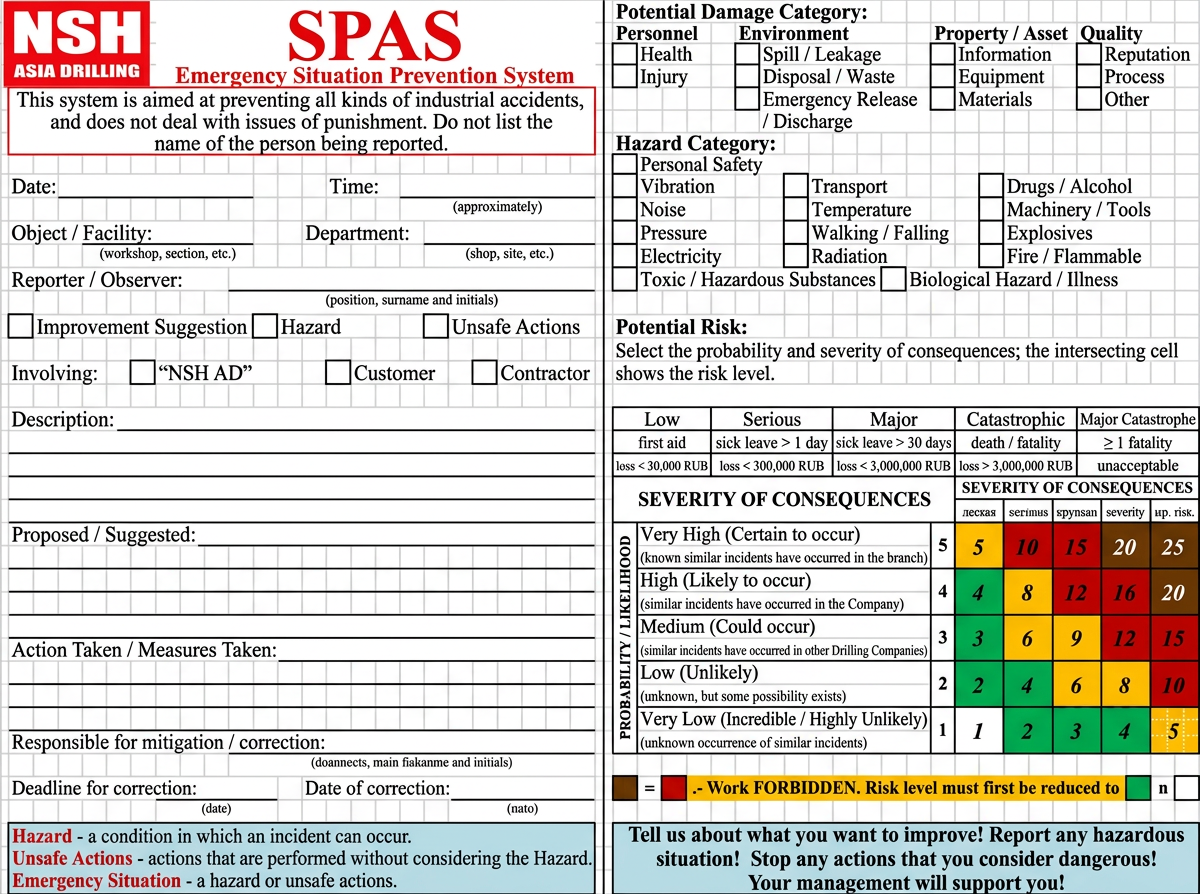
ASIA DRILLING has developed a special system for preventing incidents during work processes. It is familiar to everyone – the Emergency Prevention System, or SPAS. This is a specific regulation that allows for the timely detection and elimination of minor deviations from safety regulations. Any dangerous actions noticed by an employee are recorded in the SPAS card. What does a dangerous action mean? It is any violation of HSE requirements (occupational health, industrial, environmental, and fire safety) that may threaten the health and lives of workers. It also includes human actions that could cause damage to equipment, technical devices, and structures.
Why is the SPAS card needed and how does it help every employee?
Such a document acts as a protective barrier in the path of an incident. If an employee is proactive and pays attention even to minor violations, they help their colleagues and consciously avoid committing dangerous actions themselves. This culture of intervention helps foster mindfulness and care for others and oneself. After all, as has been said many times, safety rules are written in blood. In the field of safety, every word spoken in time can save a person's life. And ASIA DRILLING consciously develops and supports this dialogue with employees, in drilling crews, and in teams united by a single goal – the construction of oil and gas wells. However, one should not forget that safety is also the personal responsibility of everyone!
How does the SPAS card work?
The SPAS card itself is a regulation for observing the nature of work in which every company employee participates. If your colleague commits a reckless action or you yourself have allowed a dangerous situation that violates safety regulations, you can demand that work be suspended using the SPAS card.
Regulation for using SPAS cards
If an employee discovers a violation that threatens people's lives and health or could lead to an accident or emergency, they must demand that work be stopped. The worker who committed or provoked the dangerous action is obliged to:
- stop work;
- take all measures to eliminate the dangerous action;
- immediately inform the supervisor that an observation card has been issued regarding their actions.
Sometimes an employee cannot independently eliminate the danger that has arisen; in that case, they are obliged to report this to their supervisor, as the supervisor bears the responsibility to eliminate the dangerous action.
The observer who first saw the unsafe actions must record them in the SPAS card and present it to the site manager, the head of the structural unit, or the HSE engineer.
Every identified violation is entered into a special register and analyzed. In this way, problem points in work processes are identified in time and refined to ensure maximum safety.
ASIA DRILLING encourages the use of SPAS cards
Sometimes we hear arguments that recording violations in SPAS cards becomes an obstacle to the successful completion of tasks, but this is not the case. With the implementation of this mechanism, crews record a decrease in NPT and a high level of safety, which positively affects the efficiency of the work process. To develop the culture of those employees who were attentive and recorded safety-violating events in SPAS cards, ASIA DRILLING provides incentives. Currently, financial and non-financial rewards are paid for identifying violations. They are awarded to the employee who took measures to prevent an emergency situation and completed the best SPAS card.
Comments 1
Thank you for sharing an excellent practice that is applicable to various enterprises. A very useful article