Robotic Fire Suppression Systems Under UAV Threat: Standards and Practice
Introduction: Why Robots Have Become a Necessity
Unmanned aerial vehicle (UAV) strikes on industrial and infrastructure facilities are no longer rare incidents; they have become a systemic risk factor that both fire protection system designers and incident commanders must account for. A fire following a UAV strike is a distinct operational scenario: the seat of the fire may lie within a repeat-strike zone, unexploded ordnance and debris may be scattered nearby, the area may be mined, and radio communications may be jammed by electronic warfare (EW) systems.
Under these conditions, a stark operational paradox arises. On one hand, the first few minutes are critical for fire containment—they determine whether the fire escalates into a cascading blaze or a vapor cloud explosion across tank farms and process units. On the other hand, the incident commander is prohibited from deploying personnel into an area that has not been cleared by military engineers and explosive ordnance disposal (EOD) teams: until EOD specialists inspect the site and confirm the absence of explosive hazards, any hose team effectively becomes a target. While EOD teams work, the fire grows, and passive waiting leads to the loss of the facility.
The only viable engineering solution to this paradox is remote and automatic fire suppression: fixed robotic fire suppression systems, mobile robotic firefighting systems, and ballistic protection for personnel. These solutions make it possible to deliver extinguishing agents into the "gray zone"—areas where humans cannot enter without risking their lives—and to conduct fire reconnaissance using video and thermal imaging before EOD clearance is completed.
Regulatory Framework
The deployment of robotics in fire protection is backed by an established regulatory framework:
- Federal Law No. 123-FZ dated July 22, 2008, "Technical Regulations on Fire Safety Requirements" — Article 45 establishes the classification of fire suppression systems, subdividing them by degree of automation into automatic, semi-automatic (automated), standalone, and manual systems, while Article 83 sets requirements for automatic fire suppression systems (AFSS): calculated extinguishing agent supply, operational health monitoring, and fire location alerting for on-duty facility staff and fire response units.
- SP 485.1311500.2020 (approved by Order No. 628 of EMERCOM of Russia dated August 31, 2020) — the foundational code of practice for designing automatic fire suppression systems. Section 8 is dedicated entirely to robotic fire suppression systems (RFSS): an RFSS is defined as an automatic system comprising multiple fixed robotic fire monitors integrated into a common fire detection and control network, while a fixed robotic fire monitor is defined as a programmable, multi-axis nozzle assembly designed to extinguish or contain fires or cool process equipment and structural elements.
- GOST R 59636-2021 "Automatic Fire Suppression Systems. Guidelines for Design, Installation, Maintenance, and Repair" — governs installation, commissioning, and performance testing procedures for AFSS, including operational safety requirements.
- GOST 35035-2023 "Firefighting Equipment. Mobile Robotic Fire Suppression Systems" — standardized mobile firefighting robots for the first time, defining weight classes (ultralight: up to 100 kg; light: up to 1 t; medium: up to 18 t; heavy: over 18 t), all-terrain mobility, endurance, operation in radioactively contaminated environments, and test methods.
- Firefighting Operations Regulations (Order No. 777 of EMERCOM of Russia dated September 16, 2024) — establishes procedures for organizing fire suppression and emergency rescue operations, fire reconnaissance, selecting the primary tactical sector, ensuring responder safety, and issuing withdrawal signals when personnel face imminent danger. It is precisely these reconnaissance and HSE provisions that establish the rule—"no personnel entry prior to EOD clearance"—which robotic systems make it possible to navigate without violating safety regulations.
Fixed Robotic Fire Suppression Systems: Protecting Static High-Risk Zones
Fixed RFSS installations are engineered to protect tank farms, pump stations, flare stacks, and other capital-intensive assets where delays in applying extinguishing agents are measured in minutes and rapidly escalate into disasters.
Their core strengths are speed and autonomy. Activation takes just 20–30 seconds, with monitors operating automatically from detector signals without human intervention. This eliminates human-response delays—a decisive factor when facing repeat UAV strikes. A distributed network architecture ensures that if a drone destroys a single monitor, the overall system does not fail: autonomous control algorithms continue cooling adjacent process vessels, preventing cascading fire spread.
Compressed air foam (low- or medium-expansion) deserves special mention: the durable film it forms prevents vapor reignition from a second drone strike—and follow-up strikes on an already burning facility have unfortunately become standard tactics.
There is one major limitation: fixed RFSS installations require redundant, protected firewater ring mains and sectionalized piping. Consequently, they represent a capital investment made during greenfield design or major facility upgrades rather than an ad-hoc retrofit.
Rusak Mobile Robotic System: Agile Reserve in the "Gray Zone"
The Rusak mobile robotic fire suppression unit addresses operations in the "gray zone" during the critical first 5–7 minutes after a strike, when personnel cannot enter the site due to the risk of secondary detonations or follow-up drone attacks.
Key machine specifications:
- 4×4 chassis capable of negotiating debris, snow cover up to 200 mm deep, and damaged roads;
- LSD-C40 fire monitor with a flow rate of 40 L/s and a throw range of up to 65 m, operated remotely from a safe standoff distance;
- protected remote operation from cover; if radio channels are jammed by EW systems, control automatically switches to a reinforced fiber-optic tether up to 350 m long, guaranteeing uninterrupted command links under active jamming;
- auxiliary capabilities including gas hazard reconnaissance, debris wetting, and cooling of process equipment.
Its limitations match its vehicle class: tether/link range is capped at 350 m, a top speed of 15 km/h does not allow it to evade a diving FPV or attack drone, and extinguishing agent delivery relies on an external water supply—either a firewater ring main or a pumper tender. Thus, the Rusak is not a replacement for fixed RFSS installations, but an agile tactical complement to them.
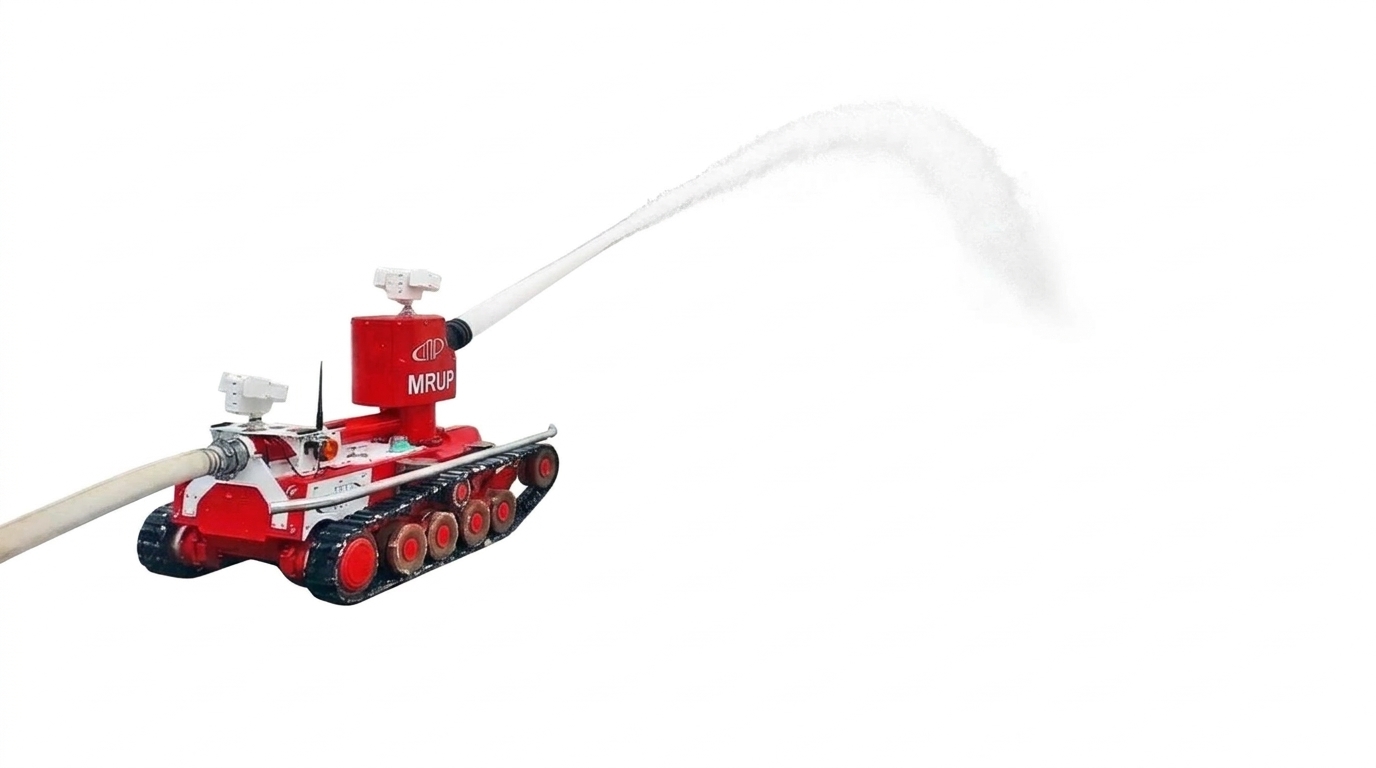
YEL-4 and YEL-10: Heavy Engineering Assets from VNIIPO of EMERCOM of Russia
Tracked robotic firefighting systems developed by VNIIPO (All-Russian Research Institute for Fire Protection of EMERCOM of Russia, Balashikha) handle severe operational scenarios beyond the reach of wheeled vehicles or dismounted reconnaissance teams.
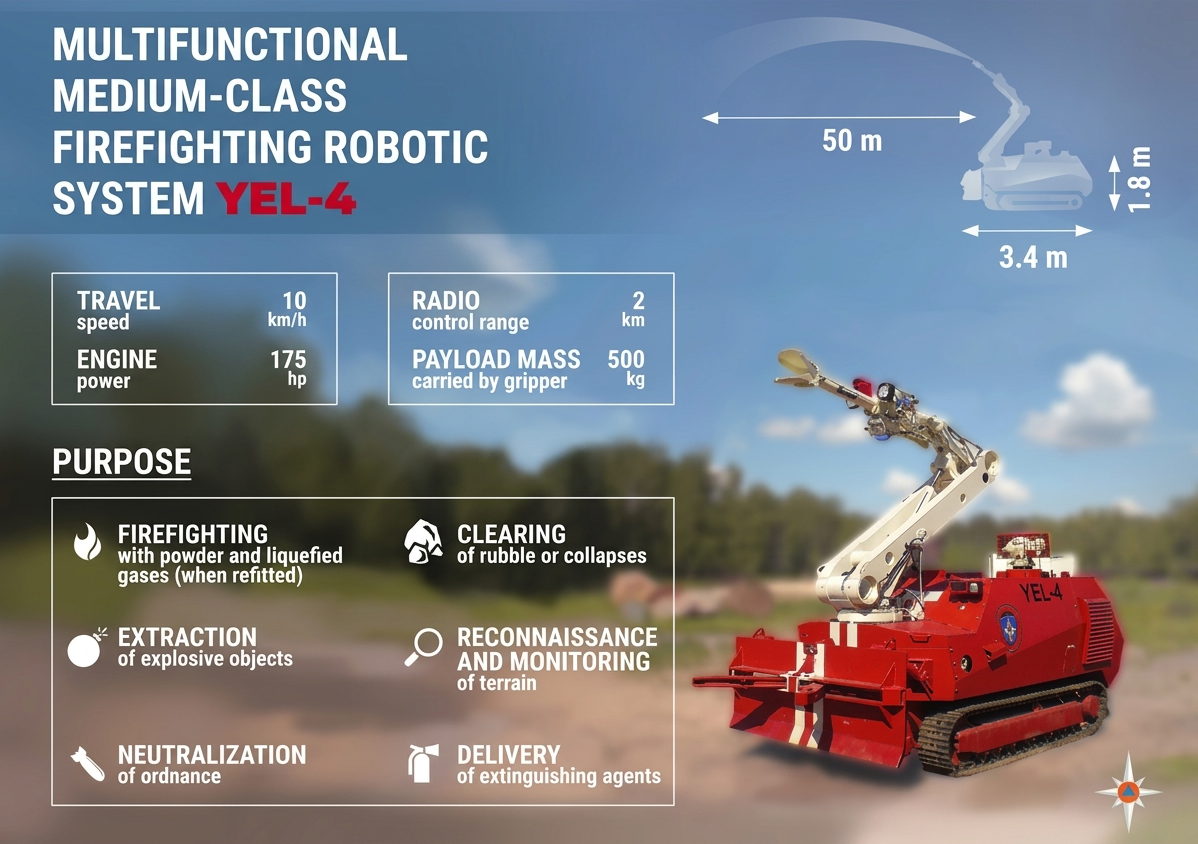
| Parameter | YEL-4 | YEL-10 |
|---|---|---|
| Curb weight | 9.2 t | 19.0 t |
| Engine | Perkins 1106C-E60TA, 170 hp | Perkins 1106D-E66TA, 234 hp |
| Onboard water / foam concentrate capacity | 1.4 t / 0.5 t | 2.5 t / 0.8 t |
| Water / foam throw range | up to 70 m / 50 m | up to 80 m / 50 m |
| Monitor flow rate | 1,200 L/min | up to 2,400 L/min |
| Grapple lifting capacity | up to 500 kg | up to 1,000 kg (at 2.5 m reach) |
| Remote control range | up to 2,000 m | up to 2,000 m |
| Speed | up to 10 km/h | up to 10 km/h |
The YEL-4 is built for industrial emergencies at chemical plants, nuclear power stations, and storage depots, operating in radiologically and chemically contaminated zones, clearing rubble with a dozer blade and hydraulic grapple, and delivering water and foam over obstacles via a manipulator arm.
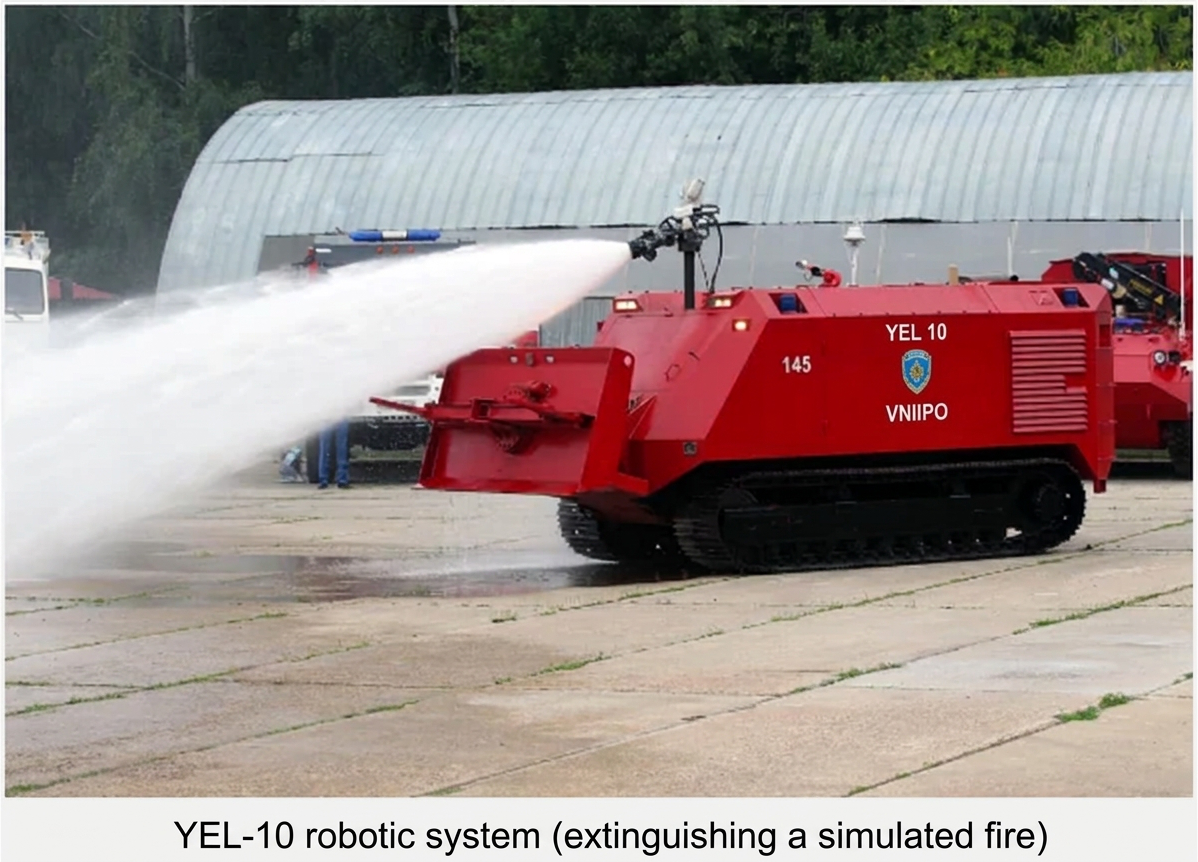
The YEL-10 is a heavy-class platform engineered for extreme-hazard environments: ammunition depots, oil terminals, and nuclear or chemical facilities amidst heavy rubble and ongoing explosions. Its standout advantages are onboard autonomy (self-contained water and foam tanks), thermal survivability via self-cooling water drencher curtains, and blast/fragmentation protection provided by 8 mm armor plating. For a facility under ongoing drone attack while already on fire, this exact capability set is indispensable.
Uran-14: A Robot Built for Explosive-Hazard Zones
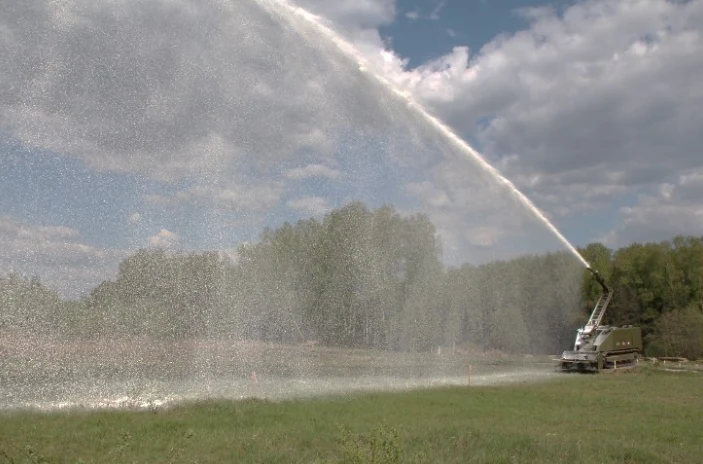
Manufactured by JSC 766 UPTK (Nakhabino, part of JSC Kalashnikov Concern within Rostec State Corporation), the Uran-14 system was purpose-built from the outset for remote firefighting at high-hazard and inaccessible sites.
Key specifications include a 14 t curb weight, a 240 hp powertrain, a 2,000 L/min fire pump, a 50 m stream range, onboard tanks holding 2,000 L of water and 600 L of foam concentrate, and radio remote control at distances of at least 1,000 m. Its fire monitor features continuous 360-degree rotation—an important advantage when defending an asset against multi-directional threats.
The Uran-14's distinct operational value lies in combining fire suppression with combat engineering tasks: optical and thermal reconnaissance of concealed fire seats, breaching paths through debris, lifting and relocating hazardous or explosive loads up to 1.5 t with its hydraulic gripper, and pushing obstacles weighing up to 4 t. The manufacturer's documentation explicitly specifies the armored hull for "fighting fires in areas containing explosive ordnance"—making it ideal for operating ahead of and alongside EOD teams rather than merely waiting for them.
Other Robotic Systems on the Market: Overview
Over recent years, a comprehensive lineup of robotic firefighting equipment has emerged on the Russian market—spanning ultralight platforms to 20-ton tracked machines. Measured by the number of commercial models available, Russia and China lead the global mobile firefighting robot segment: a recent industry study cataloged 69 models across 22 countries. Crucially, the technology now rests on dedicated technical standards: GOST 35035-2023 formalized weight classes, mobility metrics, endurance, radiation-zone performance, and test protocols. This milestone shifted firefighting robotics from experimental prototypes to regulated, certified industrial equipment.
ANT-1000PM and Pioner: Production Systems from Rostec
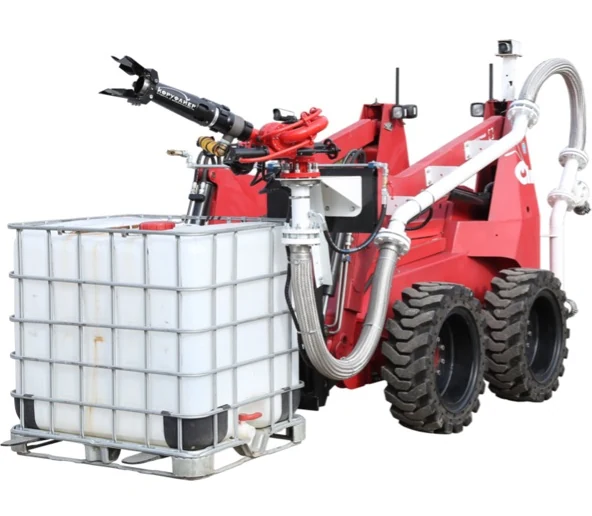
Developed by the Kovrov Electromechanical Plant and VNII Signal (part of the High-Precision Systems holding of Rostec State Corporation), the ANT-1000PM robotic system is based on the commercial production ANT-1000 diesel skid-steer loader. A firefighting module equipped with a monitor and water-foam eductor nozzle is mounted on a remotely operated boom, projecting extinguishing agents up to 65 m horizontally and 35 m vertically. Operators control the unit from up to 1 km away via the Prometey control link, engineered to resist heavy smoke attenuation and electromagnetic interference. Its reliability has been validated through testing at VNIIPO of EMERCOM of Russia, and in 2026 the holding delivered its first commercial production batch to a major Russian fuel and energy company.
Built on the same technological architecture is the Pioner system—a remotely operated PM-160 firefighting vehicle on a tracked chassis built by Kurganmashzavod. Designed for hard-to-reach fires and fuel-and-energy asset protection, comparable units are already in service at the Kalinin and Rostov nuclear power plants, performing reconnaissance and fire suppression in radiation-hazard zones.
VARAN PL-30: A 2026 Newcomer
At the Integrated Safety and Security Exhibition in 2026, KAMAZ, jointly with JSC Monolit and with participation from the EMERCOM Academy, unveiled the VARAN PL-30 tracked robotic system: 440 kg weight, a 30 L/s fire monitor with a 50 m range, at least 24 hours of continuous operation, and an integrated thermal imager and gas analyzer. The unit has already seen field deployment at oil and gas facilities—making it directly applicable to post-UAV-strike fire scenarios.
Light Class: Reconnaissance and Pinpoint Suppression
The MRUP-112 VR from the Vargashi Plant of Fire-Fighting and Special Equipment (Kurgan Region) is a production radio-controlled mobile fire suppression unit built under a state contract for EMERCOM of Russia. It features onboard remote control and radio telemetry, dual waterproof IR-illuminated cameras, a remote fire monitor, and a control radius exceeding 200 m. Units are deployed with fire and rescue garrisons in Moscow, Saint Petersburg, Nizhny Novgorod, Yekaterinburg, and Volgograd.
Alongside it are several other light and ultralight designs: the Prometey mobile robotic unit (CJSC NPO KZST, Kurgan), the remotely operated ~2-ton LUF-60 turbine-assisted firefighting unit, the MUPR mobile robotic suppression unit featuring a 200 m control range and camera scanning, the electric tracked MRK-RP designed for smoke-filled indoor spaces (jointly developed by VNIIPO and Bauman Moscow State Technical University), and OJSC Reduktor's compact 250 kg electric Tropa-3 system capable of riding along rail tracks—making it invaluable in subway tunnels.
Fixed Solutions: Competing in the Russian AFSS Market
Alongside EFER robotic fire suppression systems (featuring automatic IR and optical flame tracking, explosion-proof enclosures, response times under 20 seconds from alarm to discharge, and widespread deployment in aircraft hangars, tank farms, loading racks, and offshore platforms), several other domestic manufacturers compete in this space:
- Pozhtekhspas system — an integrated array of ten robotic monitors tailored for wide-span buildings and high atriums; each monitor aims via thermal and optical cameras, every hazard point is covered by at least two monitors (as mandated by SP 485.1311500.2020), and battery backup keeps the system operational during power outages;
- Uralspetsavtomatika solutions — industrial robotic monitors rated at 10, 20, and 30 L/s alongside compact mini-monitors for offices and shopping centers; according to the manufacturer, robotic monitors eliminate 70–80% of conventional branch piping, making total installed costs competitive with traditional sprinkler/deluge AFSS;
- Strazh robotic system (Sistemservis Association and Konstanta Group) — engineered for permanent installation at sports arenas, petrochemical plants, helipads, and aviation hangars.
International Counterparts
Internationally, the mobile firefighting robot market features Croatia's DOK-ING MVF-5 tracked system, U.S. machines from Howe & Howe, Magirus robotic units, and a broad lineup from Chinese manufacturers (Guoxing Intelligent, Kaicheng Intelligence)—the latter competing with Russian designs primarily in the light and medium weight classes. Industry analysts note that Russia has historically led the heavy armored class, whereas international manufacturers focus predominantly on lighter reconnaissance and support robots.
Mobile Ballistic Shields: When Human Entry Cannot Be Avoided
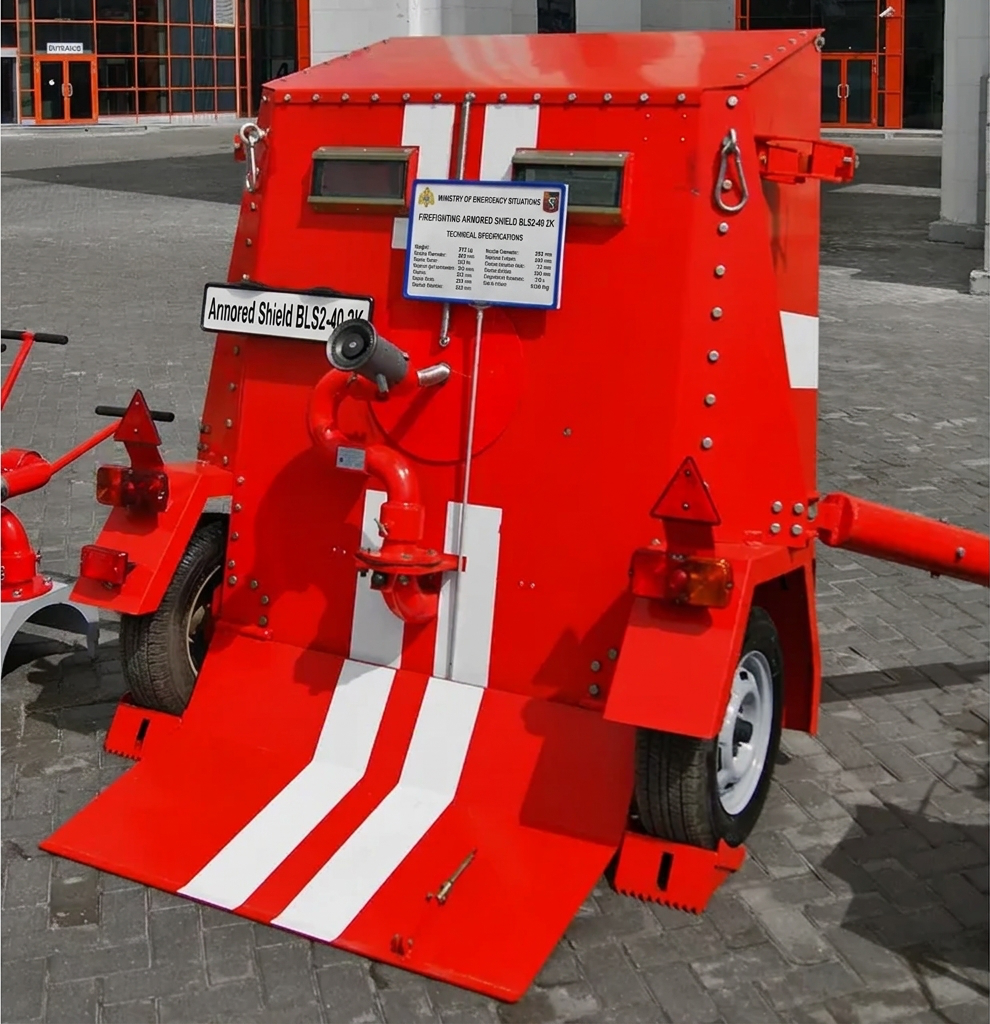
Armored shields for hose teams are not an alternative to robots, but a last-resort protective measure. Designed for emergency protection of municipal firefighters and facility emergency response teams (NASF) during manual hose advancement under subsiding UAV threat, they provide localized protection against blast overpressure, shrapnel, and thermal radiation. They allow crews to approach within 10–15 meters of the fire seat and are repositioned either manually by at least two firefighters or towed by light utility vehicles.
Their core limitation is obvious and fundamental: deploying shields still places personnel inside hazard zones that robotic systems can cover far more safely. Tactically, ballistic shields should only be used to advance crews after robots have contained the fire and EOD teams have cleared the area.
Key Takeaways
- Robotics bridges the critical time gap between a UAV strike and EOD clearance. Before fixed RFSS and mobile firefighting robots, the first 5–10 minutes after a drone strike were lost: the fire burned unchecked while crews were barred from entering uninspected terrain. Fixed robotic monitors begin discharging extinguishing agent within 20–30 seconds of sensor detection, while mobile units operate remotely inside the "gray zone"—resolving the "burning, yet off-limits" dilemma through engineering rather than risking human lives.
- Russia has one of the world's most comprehensive firefighting robotics markets. Domestic offerings span every weight tier: from ultralight platforms (Tropa-3, MRK-RP) through light and medium units (Rusak, MRUP-112 VR, VARAN PL-30, ANT-1000PM) to heavy armored systems (YEL-10, Uran-14), complemented by a mature fixed RFSS sector (EFER, Strazh, Pozhtekhspas, Uralspetsavtomatika). Together, Russia and China lead the global market in mobile firefighting robot model diversity.
- Regulations have caught up with engineering. SP 485.1311500.2020 and GOST R 59636-2021 codified fixed robotic system design, while GOST 35035-2023 standardized mobile firefighting robots—covering weight classifications, terrain mobility, autonomy, and testing. Procuring and deploying fixed and mobile robotic units is no longer an experimental workaround, but a compliant practice grounded in formal safety and performance standards.
- EW resilience and blast survivability are decisive selection criteria under UAV threat. Fiber-optic tether backup (Rusak), distributed fixed monitor networks, self-contained agent tanks, armor plating, and water-curtain self-cooling (YEL-10, Uran-14) are not optional extras—they directly address battlefield-like site conditions: jammed radio spectrums, flying shrapnel, and ruptured firewater mains. High-risk facilities must evaluate systems against these survivability metrics, not merely nominal flow rate and stream throw.
- Only a layered defense-in-depth architecture works—not standalone machines. Fixed RFSS units protect static high-risk process zones during the opening seconds; light/medium mobile robots suppress residual fires in the "gray zone"; heavy tracked robots handle reconnaissance, obstacle breaching, and firefighting amid rubble, explosions, and contamination; and ballistic shields serve as the final fallback for manual hose teams. No single platform solves every challenge alone; fire protection engineering for threatened facilities must integrate all tiers simultaneously, or the defense chain will break at its weakest link.
Conclusion
UAV strikes have fundamentally reshaped industrial and infrastructure firefighting. The traditional response sequence—"alarm received, crews deploy to positions, hose teams attack the fire seat"—is no longer safe or viable under drone threat: personnel cannot enter before EOD clearance, yet waiting until clearance is complete allows the fire to spiral out of control. Robotics has emerged as the definitive answer—no longer a conceptual novelty, but a mature market backed by dozens of commercial production models, dedicated national standards, and real-world deployment across EMERCOM garrisons and fuel-and-energy facilities.
For facility executives and fire safety directors, the practical takeaway is clear: robotic firefighting systems should be treated not as an expensive add-on, but as an essential pillar of fire protection plans at threatened sites—on par with conventional AFSS and fire alarm networks. Capital expenditure on fixed RFSS and mobile robots represents a small fraction of protected asset value, whereas a single cascading tank-farm fire costs billions of rubles and, far more importantly, human lives. Recent years have taught a straightforward lesson: where robots meet the flames first, a fire remains a manageable incident; where the opening minutes are lost, it becomes a catastrophe.