Pre-Job Safety Briefing: From Legal Requirement to a Quality Control System
Introduction: Task-Specific Safety Briefing as a Legal Requirement
The foundation of an occupational health and safety management system is consistently informing employees about working conditions, workplace hazards, harmful production factors, and safe work methods. Article 214 of the Labor Code of the Russian Federation directly obliges the employer to inform workers about working conditions and occupational safety, while Article 225 mandates training in safe work methods and techniques as well as safety briefings for all newly hired and existing employees. Thus, a safety briefing is not a voluntary initiative by management, but a statutory duty whose fulfillment is verified during incident investigations and regulatory inspections.
The types and procedures for conducting safety briefings are defined by the Rules on Occupational Safety Training and Knowledge Assessment, approved by Decree No. 2464 of the Government of the Russian Federation dated December 24, 2021. Alongside induction, on-the-job, and refresher briefings, this document establishes the task-specific safety briefing. According to Clause 19, a task-specific safety briefing is conducted for workers:
- prior to performing work that is only permitted under continuous supervision by the employer, as well as high-risk work, including tasks that require a Permit to Work (PTW) and other authorization documents;
- prior to performing work directly on active roadways or railway tracks related to the employee's direct duties, where compliance with additional occupational safety requirements is needed;
- prior to performing work that is not part of the main technological process and not covered by job (operating) instructions, including tasks outside the workshop or site, loading and unloading operations, site cleanup, and work on roadways and railway tracks;
- prior to performing emergency response and recovery operations;
- in other cases established by the employer.
A task-specific safety briefing is conducted within the scope of occupational safety requirements applicable to the planned work (activities), as specified in the employer's internal policies. The mandatory nature of task-specific briefings for high-risk work is also confirmed by industry regulations: for example, the Occupational Safety Rules for Working at Heights (Order No. 782n of the Ministry of Labor of Russia dated November 16, 2020) require conducting a task-specific briefing for crew members with their signature in the Permit to Work, explaining the work execution procedure and emergency response actions.
Practice shows, however, that the main problem lies not in the existence of the requirement, but in how it is executed. A briefing conducted merely as a "tick-the-box" exercise—formally, without the active participation of workers, and without discussing the specific hazards of a particular site—neither protects people nor reduces the risk of an incident. That is precisely why employers are required to take into account the employee's actual working conditions established through workplace environment assessments and occupational risk assessments.
With this in mind, ZARUBEZHNEFT-Dobycha Kharyaga LLC introduced an additional layer of control, namely the "Pre-Job Safety Briefing Standard," which supplements labor law requirements and establishes a unified briefing algorithm for all employees of the Company, as well as contractors and subcontractors. A key element of the system is additional oversight by specialists from the Health, Safety, and Environment (HSE) department: they visit production sites directly, attend safety briefings, verify their quality using a checklist, interview workers, and provide feedback to the persons in charge of safe work execution.
| PROMPT QUESTIONS FOR CHECKING THE QUALITY OF A PRE-JOB SAFETY BRIEFING |
|---|
| Is everyone present at the briefing (including contractors and subcontractors)? |
| Is the briefing conducted directly at the worksite? |
| Are PTWs, JSAs, Method Statements, or other supporting tools used during the briefing? |
| Does every attendee understand the nature and stages of the upcoming work and the proper methods for executing it, know how to use the equipment they will operate, and know their exact location during work execution? |
| Have all primary risks inherent to the task been identified and discussed? |
| Have additional risks related to simultaneous operations (SIMOPS) and their corresponding control measures been discussed? |
| Have all Life-Saving Rules applicable to this type of work been discussed? |
| Have real examples of lessons learned from past incidents applicable to this type of work been discussed? |
| Have the availability and serviceability of required personal and collective protective equipment been checked? |
| Have the availability and serviceability of communication devices and the procedures for using them been checked? |
| Does every attendee understand all safety measures for each identified risk and hazard? |
| Is the worker's (or crew's) knowledge verified regarding actions to take during a break or when working conditions and task scope change? (e.g., the "Stop! Think! Act!" methodology) |
| Have procedures for employee actions during emergencies and unforeseen situations been discussed? Do workers understand how to act in an emergency? |
| Does the person conducting the briefing ask, "Is everyone clear on what we need to do and how to do it?" Does the line supervisor ask open-ended questions and participate in the group discussion? |
| What is your impression? Based on the conducted briefing, does the crew know what to do and how to do it safely? |
Based on the observations, provide feedback to the person in charge of safe work execution:
|
The completion of a briefing is documented and confirmed by photographic evidence: photos of the briefing in progress, the crew lineup, and the condition of the work area record the actual, rather than paper-based, fact that it took place. Such oversight solves two problems. First, it eliminates formalism: the person in charge of safe work execution understands that the outcome will be verified not by a signature in a logbook, but by the actual substance of the discussion. Second, it builds a cumulative evidence base demonstrating the employer's due diligence—during an incident investigation, it is possible to reliably establish what information was communicated to which workers prior to starting a specific task.
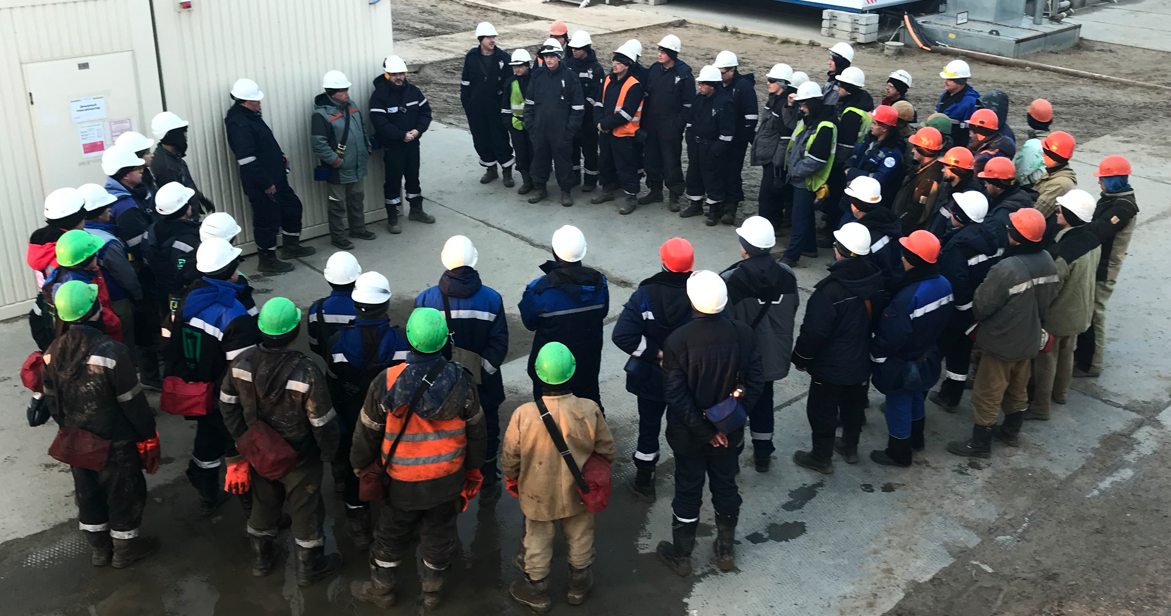
Importantly, this monitoring is not punitive. Based on the observations, the person who conducted the briefing receives feedback: positive feedback involves public recognition in front of the entire crew while highlighting the most engaged workers; constructive feedback involves a one-on-one discussion about what was done well and what could be done better. Every morning at the production sites before the shift begins, a brief yet crucial process takes place: the person in charge of safe work execution and the crew discuss what they will do today, how they will do it—and what could go wrong. The Standard cements this process as a mandatory algorithm: a daily, open, two-way dialogue rather than reading off a piece of paper just to tick a box.
Purpose of the Standard and Roles of Responsible Persons
The Standard defines the algorithm for conducting safety briefings before starting any work, including high-risk work, and serves as an internal regulatory document of the Company. It does not replace the requirements of current legislation or internal corporate policies, but acts as an additional tool to ensure safe work execution. The requirements apply to all structural divisions of the Company and are also included in the list of documents appended to service contracts, making them mandatory for contractors and subcontractors.
The two main roles in conducting the briefing lie with the person in charge of safe work execution and the HSE specialist.
- The person in charge of safe work execution ensures site preparation, conducts the briefing, controls risks, supervises workers, and authorizes the start of work only after all safety measures have been implemented.
- Specialists of the HSE department are responsible for methodological support, monitoring and evaluating the proper application of the methodology across the Company's perimeter (including contractors), training the persons in charge of safe work execution, and verifying the quality of briefings while providing feedback.
Briefing Structure: Six Mandatory Steps
As part of the briefing, the person in charge of safe work execution sequentially performs the following steps.
Step 1. Preparation for the Briefing
The person in charge:
- obtains authorization to perform the work (verbal permission is acceptable, except for high-risk work (HRW) performed under a Permit to Work);
- verifies the availability of required documentation: safe work instructions, JSA (Job Safety Analysis), Method Statement, and Permit to Work;
- checks the availability of resources—materials, personnel, and equipment;
- verifies that all workers and vehicles have valid access passes (including color-coded inspection tags on special machinery) and valid safety training certificates;
- ensures that the site is ready for work, including barriers and warning signs that prevent unauthorized access by third parties;
- ensures that workers are in an appropriate physical and emotional state;
- checks the availability and serviceability of collective and personal protective equipment beyond the minimum standard issue (respiratory protection, fall protection equipment, self-rescuers, etc.), as well as tools and machinery.
Step 2. Discussing the Nature of the Upcoming Work
The worker (or crew) is briefed on the nature and sequence of operations, crew positioning and individual roles, and the tools and equipment to be used; knowledge of proper communication signals is verified; when performing HRW, the requirements of the Permit to Work are discussed with each crew member.
Step 3. Discussing Hazards and Risks
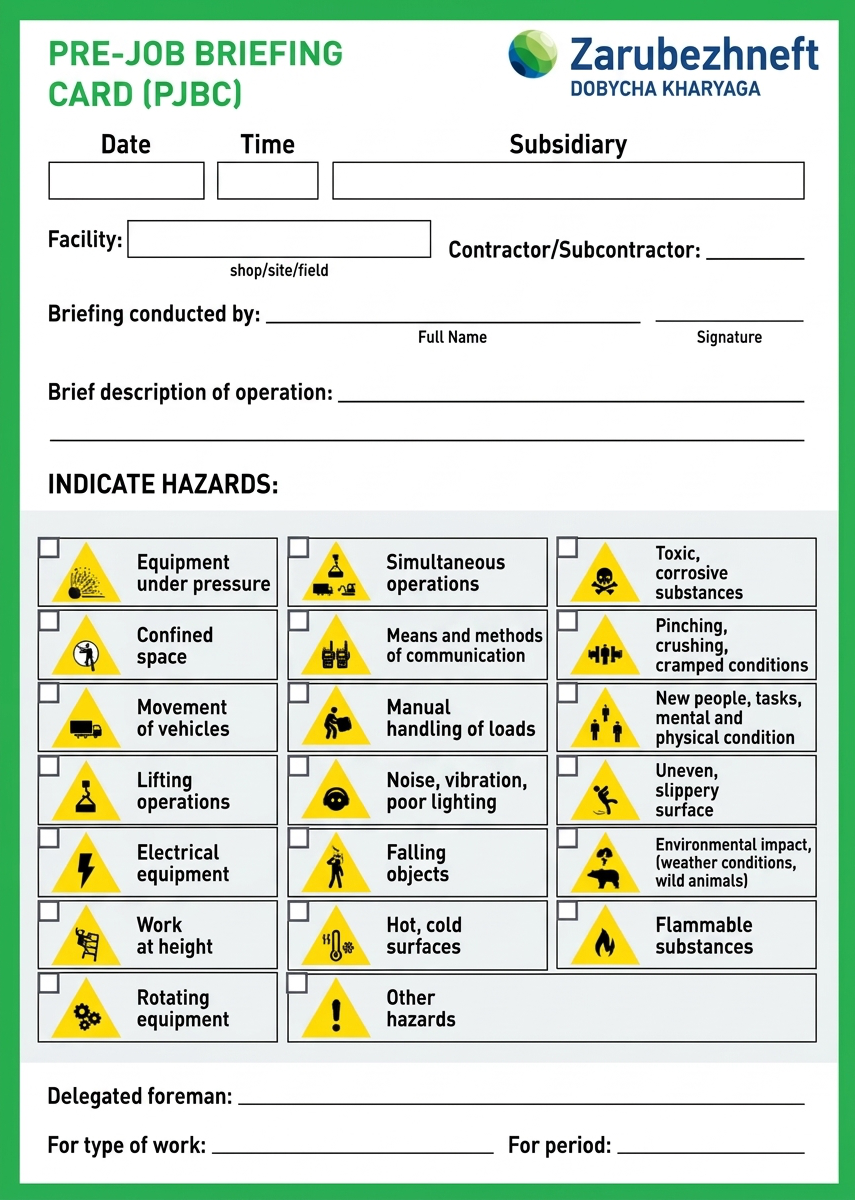
Together with the crew, the primary hazards and risks of each stage are identified (using visual prompt icons and, if necessary, the JSA), along with additional risks related to simultaneous operations by other crews, and hidden hazards (lighting, weather conditions, fatigue, new workers). Prior to HRW, special emphasis is placed on the specific risks of those tasks. Identified hazards are ticked off on the "Safety Briefing Card." Each worker discusses how their actions might affect other crew members.
 |  |
Step 4. Discussing Risk Mitigation Measures
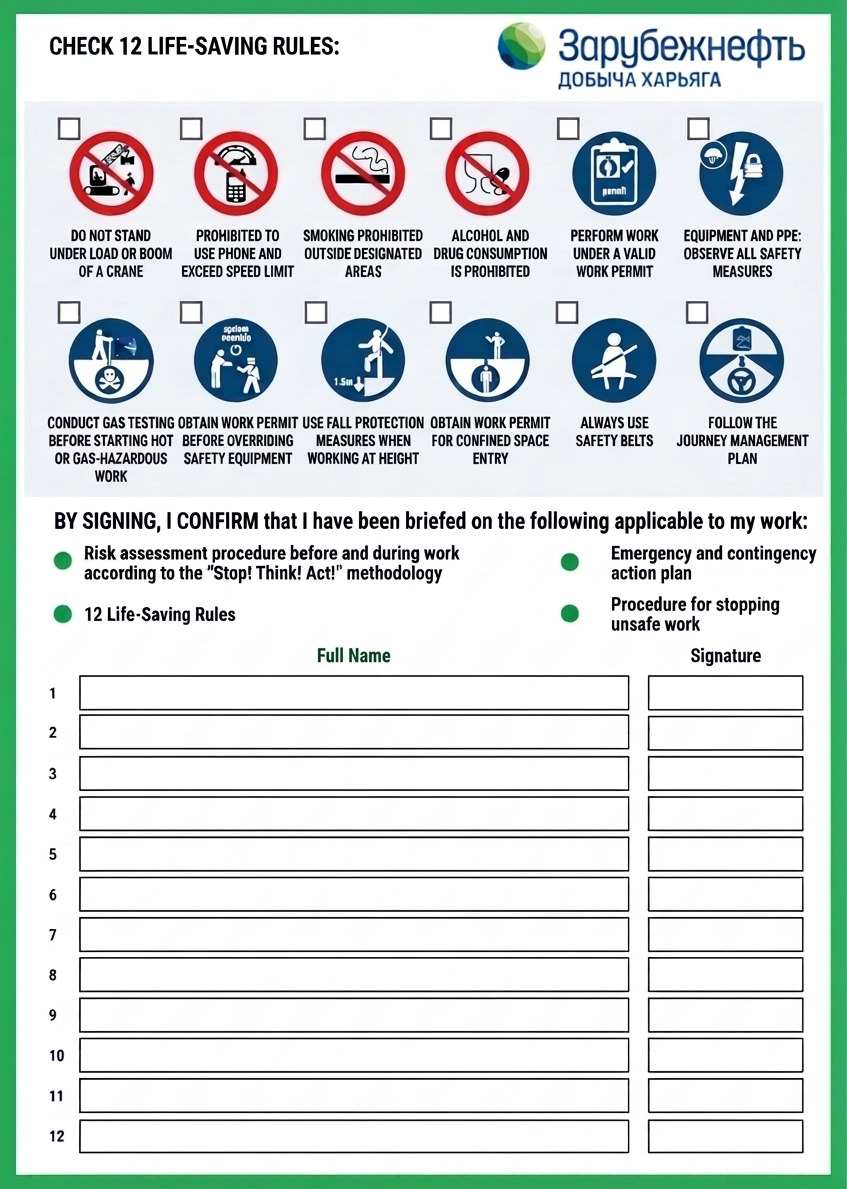
Control measures are defined for each identified risk; the "12 Life-Saving Rules" applicable to the specific task and real examples of lessons learned from past incidents are discussed; the availability and serviceability of personal and collective protective equipment are verified; workers are reminded of their right to refuse unsafe work (stop work authority) if safety requirements cannot be met.
Step 5. Discussing Emergency Response Procedures, Changing Conditions, and First Aid
Potential emergencies and contingency procedures are discussed, along with first aid response, the availability and serviceability of communication devices, emergency phone numbers, procedures during breaks, changing conditions, and work completion, as well as ongoing risk assessment during work execution.
Step 6. Readiness Verification and Documentation
The person in charge re-verifies that workers are fit for duty and conducts a brief check to ensure every worker understands what, how, and when they need to do, and that they have no remaining questions. The briefing process is documented with the workers' signatures: all sections of the "Safety Briefing Card" are completed.
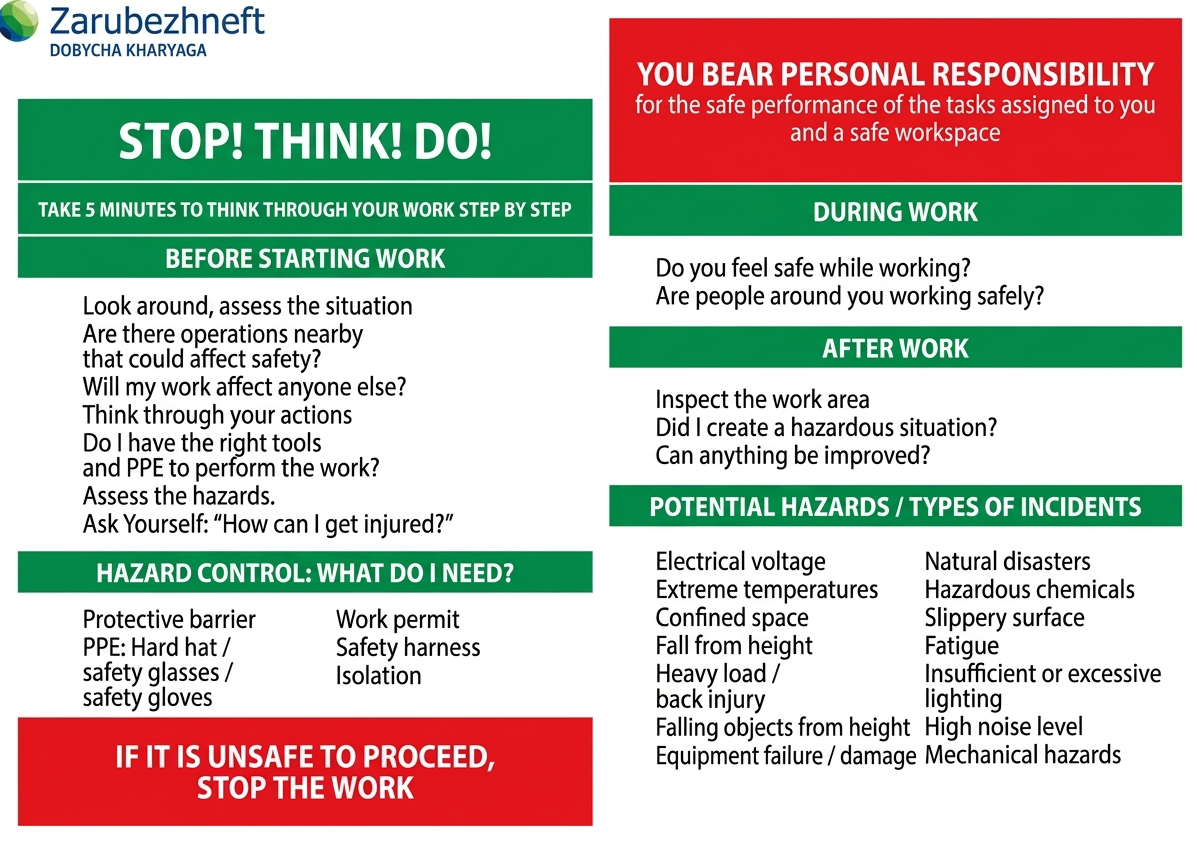
If the briefing confirms that the task can be performed safely, the crew proceeds with the work in compliance with all necessary safety measures. If safe execution is impossible, the person in charge of safe work execution ensures that the root causes of non-compliance are eliminated before work can begin. During breaks (such as lunch) and upon completion of work, the employee ensures the worksite is left in a safe condition, and at the end of the job, cleans the area and disposes of waste in designated temporary waste storage locations. Before starting and throughout the work, employees apply the "Stop! Think! Act!" methodology whenever unsafe acts or conditions are identified.
Conclusion
A task-specific safety briefing before starting work is a direct requirement of the Labor Code of the Russian Federation and the Occupational Safety Training Rules (Government Decree No. 2464 dated December 24, 2021), as well as industry-specific regulations for high-risk work. However, a regulatory obligation turns into genuine protection of life and health only when the briefing is conducted meaningfully rather than as a formality. The experience of ZARUBEZHNEFT-Dobycha Kharyaga LLC demonstrates a working model for such a transformation: a clear six-step briefing algorithm, practical support tools (briefing card, pocket guide, quality check prompt questions), clear role allocation, and two-tier oversight—site managers attend briefings at their facilities, while HSE specialists go out to the field, verify quality against a checklist, interview workers, and confirm actual completion with photo evidence. Feedback, coaching, and incentive programs close the loop, turning the daily safety briefing from a formality into a living risk management tool. It is precisely this combination of a rigorous algorithm and active field oversight that makes the pre-job safety briefing an effective barrier between the worker and workplace hazards.