Not a Day Without a Safety Briefing
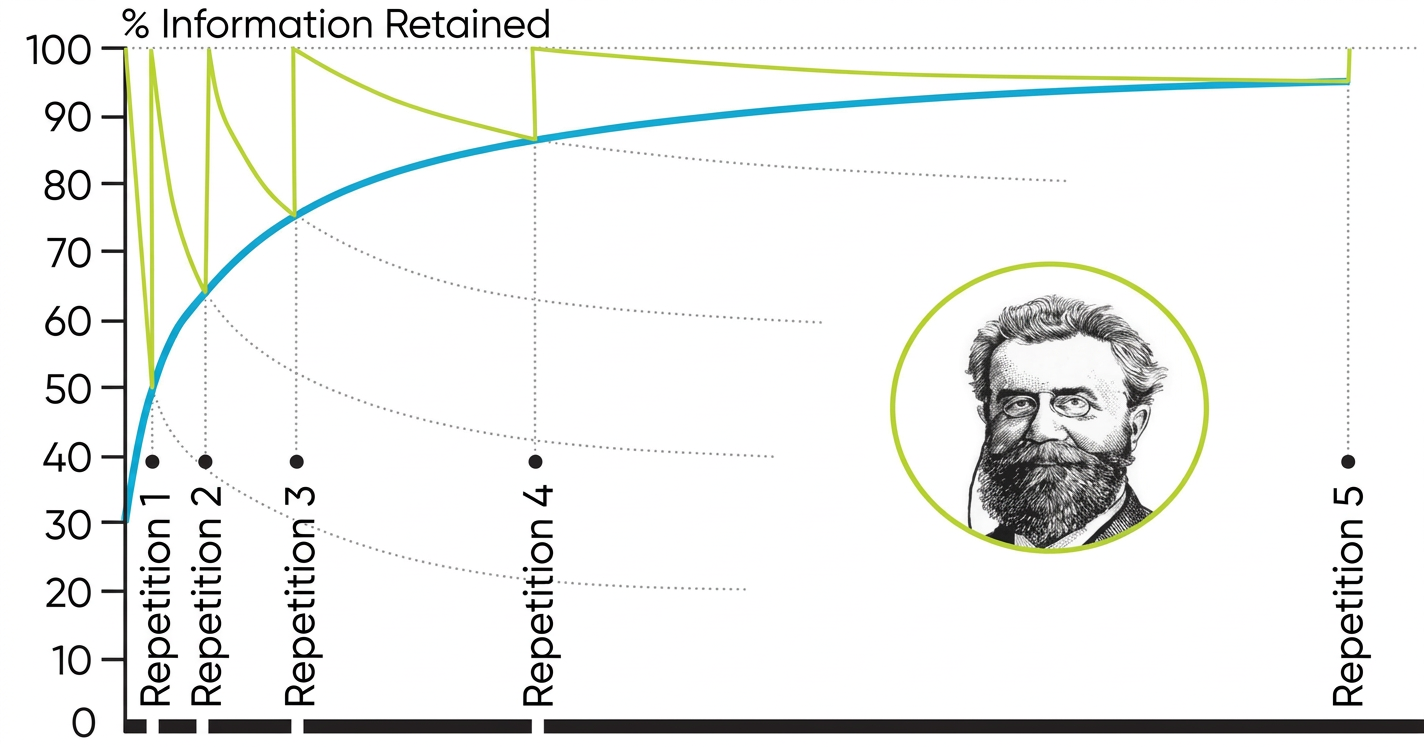
Back in the 1880s, German scientist Hermann Ebbinghaus conducted experiments on his own memory for many years — for example, memorizing nonsense syllables — and concluded that after the first error-free repetition of a series of such syllables, forgetting occurs very rapidly at first. Within the first hour, up to 60% of all information received is forgotten; 10 hours after memorization, only 35% of what was learned remains in the memory. Subsequently, the forgetting process slows down, and after six days, about 20% of the total number of originally learned syllables remains, with the same amount remaining after a month. Ebbinghaus recorded the results of his observations on a graph, which became known as the "forgetting curve." Later, George Miller, one of the founders of cognitive psychology, described a pattern in his 1956 scientific paper "The Magical Number Seven, Plus or Minus Two," according to which a person holds an average of seven blocks (plus or minus two) of information elements in their memory simultaneously. These works became the first precursors of the now-popular trend – microlearning.
Microlearning is an approach where a learner receives new information in small portions and then repeats it regularly. The main goal of microlearning is to continuously keep knowledge of safe work methods up to date. At our enterprise, this approach is implemented through daily pre-shift briefings, which represent the concept of studying knowledge in small "portions" over a short period of time. This approach allows us to constantly remind employees about safety rules and the fact that their work involves hazardous production facilities, as well as to build a solid foundation of knowledge day by day, which is continuously updated and reinforced. The briefing procedure is one of the tools for improving the safety culture at the enterprise.
Currently, the enterprise's employees undergo an electronic pre-shift briefing every shift in the form of a short test. The test includes five questions generated automatically by the program. The questions are developed based on work instructions. It takes an employee about 10 minutes to complete the briefing. Upon completion, the employee sees the test result. After correctly answering five questions, the system records the completed briefing; after incorrect answers, it suggests reading a short tip and repeating the briefing. Having studied the instruction requirements for the incorrect answer, the employee takes the test on that question again. The briefing ends automatically when no questions with incorrect answers remain. Based on the test results, the system generates statistical data on employees, which can be tracked by the employee's supervisor or an HSE specialist.
We consider the main results of implementing pre-shift briefings to be the maintenance of employees' knowledge in an up-to-date state through periodic repetition of material in small portions and an increase in the effectiveness of employee training in the field of industrial safety and HSE.