Do You Know What Rail Flaw Detection Is?
Several years ago, we faced a serious issue when freight cars loaded with ore derailed on a long railway stretch during the Arctic winter.
An investigation and technical inspection revealed that the metal in one of the rails, which had served reliably for decades, had fractured in the so-called "rail head" due to rolling contact fatigue cracks. To minimize the risk of future derailments across the Company's operations, a comprehensive set of measures was implemented to conduct regular inspections of rails and turnout components using flaw detection equipment capable of identifying defects in both running rails along the entire length and cross-section during continuous testing at speeds of up to 4 km/h.
What exactly is rail flaw detection? It is a set of non-destructive testing (NDT) methods used to detect rail defects in time and prevent railway accidents. Flaw detection helps to:
- detect cracks, delaminations, lack of fusion, corrosion, and other metal discontinuities;
- assess the remaining service life of rails and welded joints;
- plan rail repairs and replacements rather than dealing with the aftermath of accidents;
- ensure traffic safety, including during the transport of hazardous materials.
There are several primary methods of rail flaw detection:
- Ultrasonic Testing (UT) — the most common method, and the one we use ourselves. Ultrasonic waves (typically at a frequency of 2.5 MHz) are transmitted into the metal, and reflected signals are analyzed to identify internal defects: cracks, delaminations, and flaws in the head, web, and base of the rail. The pulse-echo, tandem, and through-transmission techniques are most frequently used.
- Magnetic and Magnetic Particle Testing (MPT) — effective for surface and near-surface cracks. Magnetic powder is applied to a magnetized rail; it accumulates at defect sites where the magnetic field is distorted. This is particularly useful for inspecting welded joints and areas with poor acoustic coupling.
- Eddy Current Testing (ECT) — operates using an electromagnetic field and the currents induced within the metal. It effectively detects microcracks, including those in aluminothermic welds. As a non-contact method, it is easy to automate.
- Visual-Dimensional Inspection — the baseline stage: examining and measuring rail geometry, and identifying spalling, shelling, corrosion, and shape deviations. It is performed in the field and always complements other methods.
- Radiographic Testing (RT) — used to a limited extent on critical sections where maximum detail of the metal structure is required.
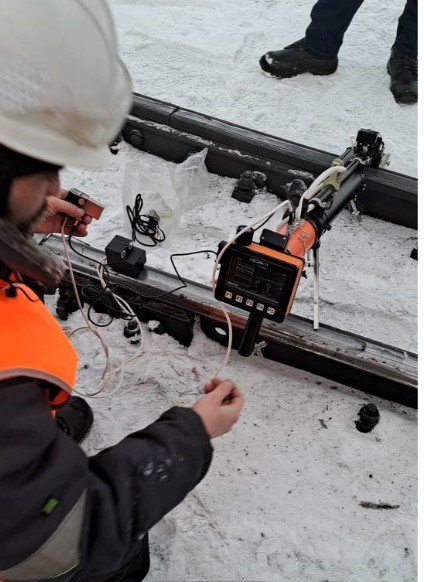
After a pass with a dual-rail flaw detection trolley, if defects are suspected in rails, turnouts, or welded joints, we primarily use the RDM-11 single-rail flaw detector, whose software displays inspection results on the screen in real time, as well as saves and reviews B-scan recordings.
Naturally, inspections of rails and turnout components are strictly regulated and conducted according to annually approved schedules. Moreover, for tracks used to transport hazardous materials, tracks with a traffic density of 25 million gross tons per year or more, or tracks with operating speeds of 40 km/h and above, inspections are carried out more frequently—at least twice a year.
The interpreted ultrasonic inspection records for rails and metal turnout components are stored in both electronic and paper formats for at least one year.
Do you use flaw detection at your facility?