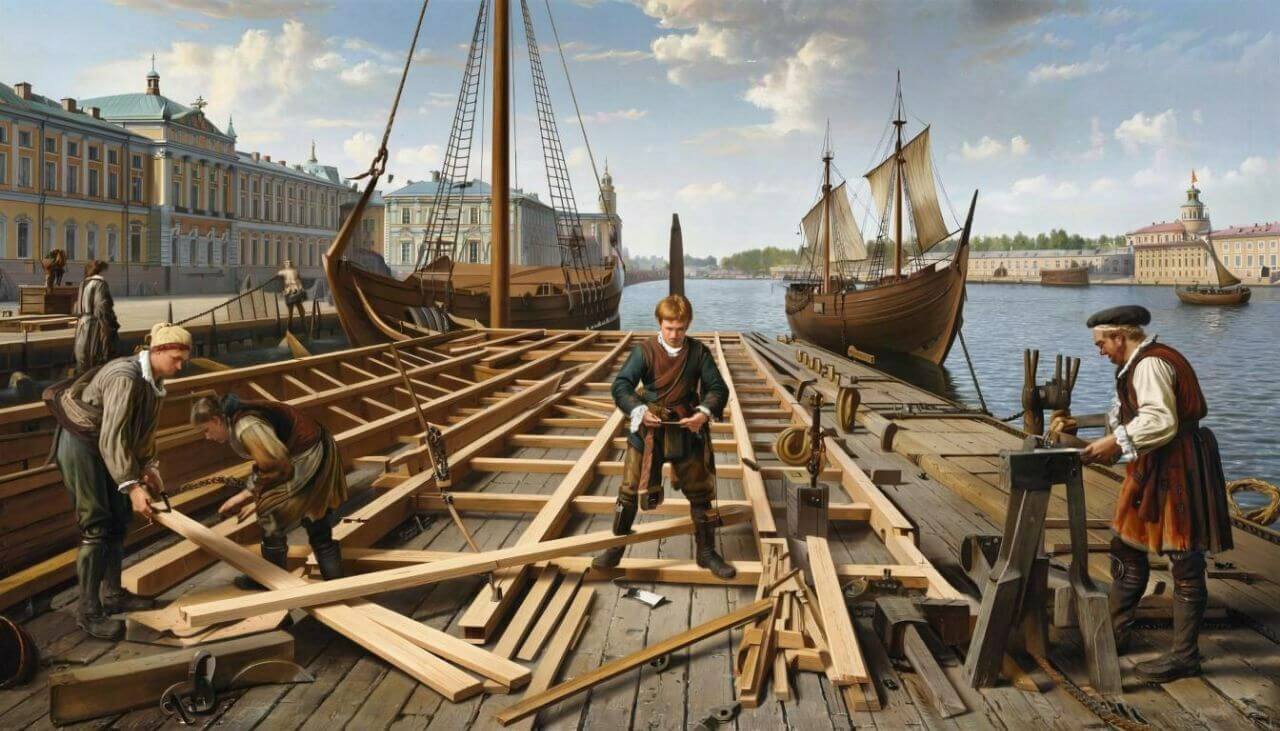
Safety Culture, Peter the Great Style: How an 18th-Century Shipyard Fostered Order, Responsibility, and Mentorship
Three hundred years ago, thousands of people worked at the Admiralty shipyards — from carpenters and blacksmiths to healers and ropemakers. The "Regulations on the Management of the Admiralty and Shipyard" (St. Petersburg, 1722) does not use the words "HSE" or "occupational safety," but it reveals the setup of a system where safety is a part of craftsmanship and honor. Here, safety requirements are hardwired into the duties of every position: the boatswain at the cranes, the rope-making commissioner, the mast master, the ober-sarver (chief surveyor) of timber, and others.
The Regulations are structured by job title. Each chapter represents an area of responsibility and specific rules for safe work. For example, for the boatswain assigned to the cranes: to keep the cranes "in readiness and cleanliness"; when lifting heavy loads, to limit the number of people "at each" (not to overload the crew) — essentially, early control over the organization of lifting operations and load distribution.
For the commissioner assigned to rope making: receiving and inspecting hemp, sample strands, weighing, drying ropes, boiling them in tar, marking the ends, and personal presence during the lowering of heavy ropes. This is simultaneously material quality control, fire and industrial safety, as well as a permit for high-risk work.
For the mast master: incoming inspection of materials (quality and "youth" of the wood), strength of the nodes ("crosstrees"), acceptance and supervision of the manufacture and assembly of masts — effectively managing the risks of working at heights and load-bearing structures.
For the ober-sarver (timber): receiving and laying out timber, immediate unloading by cranes, bringing in additional people "under the direction of the office" to unload "without delay." This is already about safe logistics, synchronizing cranes and workers, and unloading heavy cargo.
Below are seven clusters of hazardous work described in the Admiralty Regulations.
Rigging and Rope Production
Hazards: breaking of heavy ropes, tar burns, injuries during lowering.
Regulations: receiving hemp, sample strands, weighing, drying and boiling in tar, marking ends, supervision during the lowering of heavy ropes.
– Inspection of hemp/strands/scales
– Drying/boiling/marking
– Presence during the "lowering of heavy ropes"
Modern parallel: traceability of slings and ropes, permit-to-work for rigging operations, control of flammable liquids during tarring.
Lifting Devices and Cranes
Hazards: overloading, dropped objects, lack of synchronization.
Regulations: readiness/cleanliness of cranes, limit on the number of people "at each" when lifting heavy loads.
– Standard for people/load and crane readiness
Modern parallel: method statements for lifting operations, appointing a person in charge, calculating crew composition.
Working at Heights – Mast/Spar Making
Hazards: falls, collapse, non-compliant materials.
Regulations: acceptance of masts, wood quality, assembly from multiple parts, strength of crosstrees, covering the tops.
Modern parallel: inspection of load-bearing elements, training for working at heights, regulations for scaffolding/mast assembly.
Fire-Hazardous Work – Tar and "Fireships"
Hazards: ignition during tar boiling/storage, explosions of fireship munitions.
Regulations: store tar in "lyres lined with lead, with copper valves" (requirement for containers/tanks); place fireship magazines "in convenient locations to prevent the danger of fire."
– Regarding tar/measurement/weight:
– Storing tar in lyres with valves:
– Regarding "fireship" magazines and placement:
Modern parallel: storage of flammable/combustible liquids, zoning, localization of fire-hazardous areas.
Ship Launching
Hazards: slipway collapse, uneven movement, injuries in the launch zone.
Regulations: planning of warehouses and work areas so that "ships could be launched into the water without fear."
– Regarding "without fear" during launching and proximity of logistics
Modern parallel: method statements for launching, calculation of stability/friction forces, exclusion zones.
Moving Timber and Heavy Loads
Hazards: falling logs, jamming, injuries during unloading.
Regulations: immediate unloading of timber by cranes, assistance from "people under the direction of the office" to unload without delay.
Modern parallel: signalmen/banksmen, layout of unloading areas, synchronization of cranes/crews.
Working with Heavy Materials and Metal
Hazards: structural failures during forging/assembly, injuries from debris.
Regulations: "iron tests" — testing with a "best/average" classification; essentially, incoming inspection of strength/quality.
– Reference to the "iron test"
Modern parallel: material certification, laboratory tests, batch traceability.
Three Pillars of Peter the Great's Safety Culture
- Order as a risk barrier. Requirements for warehouses, routes, sequencing, and working "without delay" are not bureaucracy, but flow engineering that reduces the likelihood of failures and injuries (timber/cranes/launches).
- Responsible persons "at the point of danger." The rope-making commissioner is personally present during the lowering of heavy ropes; the boatswain at the cranes controls readiness and headcount — this is about mentorship, supervision, and immediate correction of actions.
- Materials as a safety factor. From hemp and tar to mast timber and iron — incoming inspection, storage, marking, and "tests" turn quality into a manageable parameter rather than a matter of chance.
What does this offer today's HSE professional?
- Roles instead of slogans. The Regulations show that a safety culture grows from clear roles and authorities, not from generic appeals.
- Marking → traceability → responsibility. Tags on ropes, logbooks for timber and tar are the ancestors of modern registers, ERP traceability, and permits-to-work.
- Engineering logistics. The layout of warehouses and unloading schedules serve as a method statement for workflow: personnel placement, sequencing, and the elimination of bottlenecks.
"Order Saves Lives"
Peter the Great's Regulations are not a museum rarity. They are a living prototype of an HSE system where "safety" is built into craftsmanship, duties, and mentorship.
When we create digital risk maps today, introduce permits for lifting and rigging, or approve method statements for launching, we are actually continuing a practice polished three centuries ago: order, material control, and responsibility at the worksite.