The HSE Officer's Code through Company Values: Results
Victim or Winner?
By how a person understands the word "responsibility," you can tell who is in front of you: a victim of circumstances or a winner capable of overcoming any difficulties.
To develop the value of "Results," we decided to use the proven "Oz Principle" methodology by world-renowned authors R. Connors and T. Smith.
Why Do We Need Wizards?
In today's world, a culture of victimization (victim) has become widespread: instead of taking responsibility for results, people look for ways to justify their mistakes, miscalculations, and wrong actions. The principle of finding someone to blame is also reflected in modern psychology, where we search for the roots of our problems in early childhood.
Sometimes these complaints are justified: life is not always kind to us, and we are not to blame for all the trials sent our way. Nevertheless, to overcome negative circumstances, it is necessary to take responsibility for the result. Only with this approach are development and success possible.
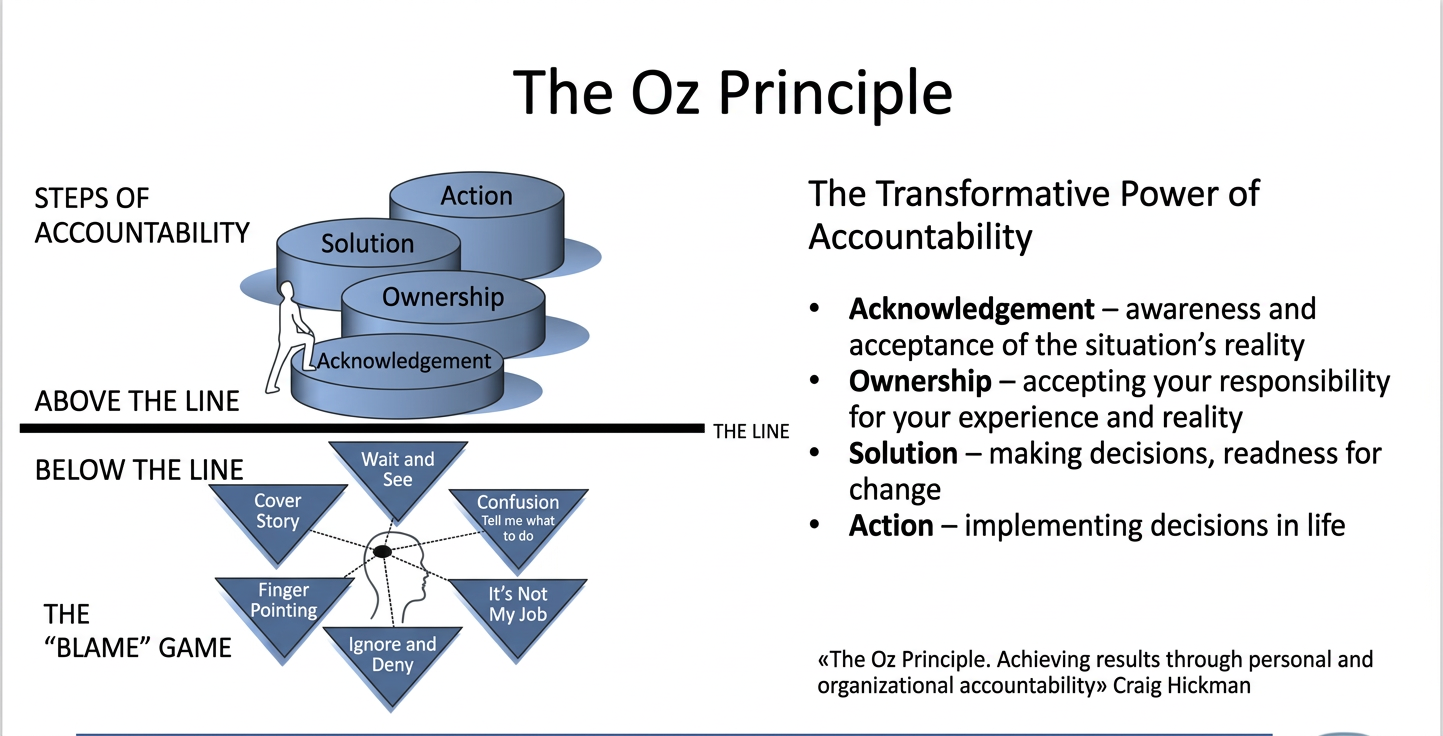
"Below the Line" and "Above the Line"
The line separating victimization from accountability is quite thin, but learning to distinguish it is both possible and necessary.
To get Above the Line and stop looking for someone to blame, you must climb the Steps to Accountability, passing through See It, Own It, Solve It, and Do It.
The first step – See It – involves acknowledging and accepting the full reality of the situation. This step seems the most difficult because it is hard for most of us to conduct an honest self-assessment and admit that much more could be done to achieve the result.
The second step – Own It – means taking responsibility for the experience and reality you create for yourself and others. Through this step, you pave the way for action.
The third step – Solve It – leads to changing the actual situation by finding and implementing solutions you might not have thought of before, while simultaneously helping to avoid the temptation of falling Below the Line again when obstacles arise.
The fourth step – Do It – involves selflessly and courageously following through on the decisions made, even if they involve high risk.
What qualities pull you "below the line" and lift you "above the line" of success? When you feel like giving up and it seems nothing more can be done, we learn to ask ourselves:
"What else can I do to get 'above the line' and achieve the desired result?"
The benefit of this question is especially high today, when the bar for success is set at unprecedented heights. By doing this, people discover the secret to quickly achieving better results with optimal effort.
Falling into the "victim" position is very characteristic of human nature.
Sometimes we successfully learn to track it in one area of life, such as work, and see the first results, but completely fail to notice how we end up "Below the Line" in the area of health, for example. This is exactly what happened to me.
How can you understand which position you are in most often?
It's great when someone in your circle also knows this "tool" and can point out when you've fallen "below the line."
However, it is useful to perform a self-diagnosis using the following checklist during regular goal reviews:
- You feel like a hostage to circumstances.
- You feel that you cannot fully control the situation unfolding around you.
- You don't listen when others speak directly or hint that, in their opinion, you need to do more to get better results.
- You find yourself shifting the blame and looking for someone to blame.
- When discussing problems, you focus more on what you cannot do, rather than what you can.
- You feel you are being treated unfairly and think nothing can be done about it.
- You frequently take a defensive stance.
- You spend a lot of time talking about things you cannot change (e.g., your boss, shareholders, economic activity, regulations).
- You justify inaction with your confusion.
- You avoid people, meetings, and situations that would require you to account for your responsibilities.
- You say: – "That's not my job";
– "I can't do anything about it";
– "Someone should tell him";
– "Let's see what happens next";
– "Just tell me what you want from me";
– "In his place, I would have done it differently."
- You often waste time and energy bad-mouthing management and colleagues.
- You spend precious time thinking of detailed, convincing explanations for why it's not your fault.
- You constantly tell the same story about how someone outsmarted you.
- You have a pessimistic view of the world.
If you find even one of these signs in yourself, your team, or your organization, it means you are often "Below the Line," and it is time to take action and ask the favorite question: "What else can I do in these current difficult circumstances to get the result I need?"