Safety Culture and Leadership in HSE
In today's world, where technological progress and innovation continuously transform production processes, HSE issues are coming to the forefront. By focusing on the safety and health of employees, companies not only comply with legal requirements but also demonstrate social responsibility, a commitment to sustainable development, and care for their personnel. In this context, the role of leadership in HSE becomes particularly relevant, as it is the leaders who set the direction and tone for the entire safety culture within an organization.
Modern production environments are characterized not only by high technology but also by a constantly changing labor market, globalization, and increased demands for environmental and social responsibility. In such a dynamic environment, HSE issues become even more complex and multifaceted, requiring leaders to not only comply with existing norms and standards but also to constantly seek innovative approaches to ensuring the safety and health of workers.
The commitment of company leaders to HSE principles not only forms the basis for an effective safety system but also serves as an important factor in creating a positive image of the company as a responsible and attractive employer. This, in turn, helps attract talented employees, increases their loyalty, and reduces staff turnover, which is a key aspect for the success of any organization in the modern economy.
Leadership in HSE must start at the top level of management. The commitment of executives to the principles of safety and health preservation in the workplace serves as a catalyst for the formation of an appropriate corporate culture.
Leaders who clearly demonstrate their commitment to HSE set the standards for the entire organization. This includes practical actions such as personal participation in safe practices, allocating resources for HSE programs, and ensuring the availability of training and professional development for workers. When leaders' words match their actions regarding safety, it forms the foundation for a culture where safety becomes a core priority at all levels.
What are the criteria for determining the level of safety culture, and can it be measured? Yes, it can, and several methodologies exist for this purpose.
Let's consider the importance of organizational leadership in HSE issues using the example of Patrick Hudson's "Safety Culture Ladder." According to this methodology, an organization's safety culture is divided into five levels: pathological, reactive, calculative, proactive, and generative (Fig. 1).
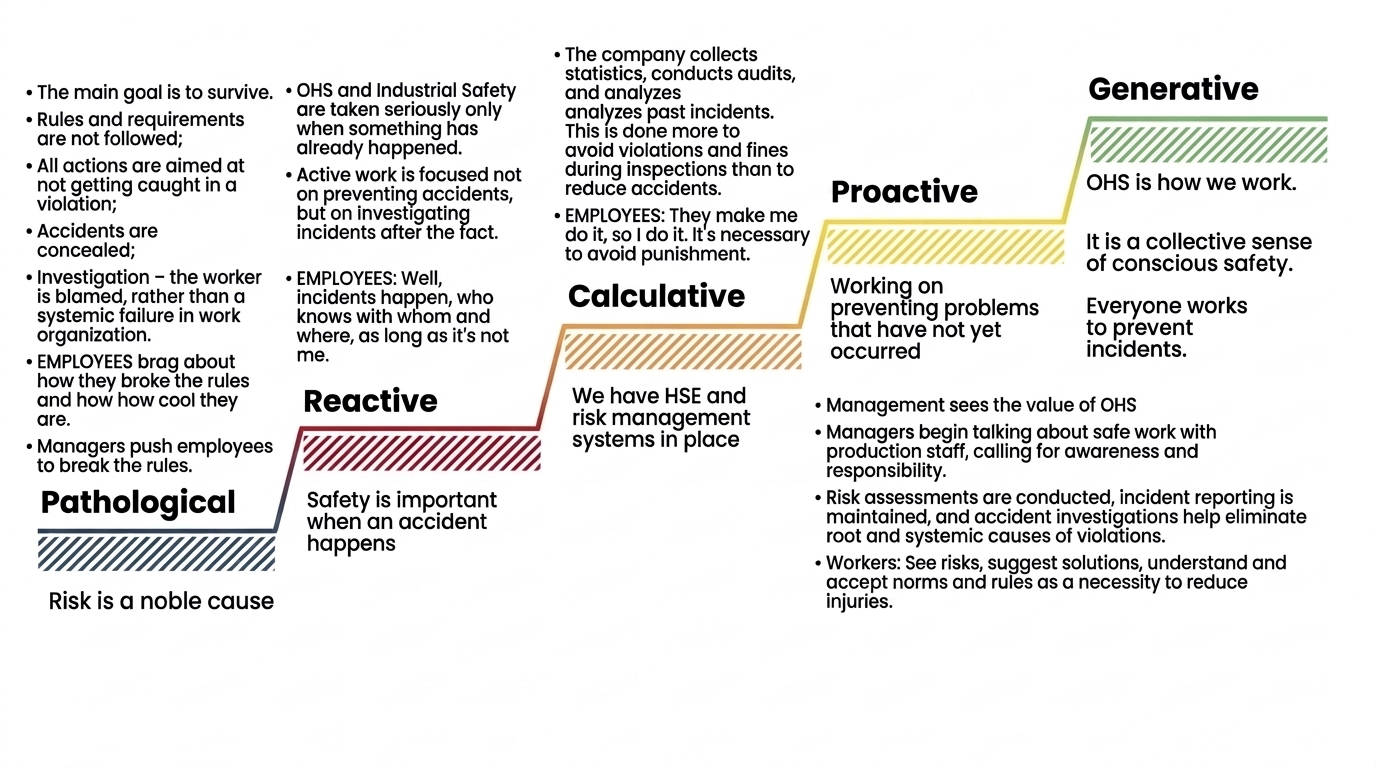
Every person is on one of the steps of the ladder. This depends on their life experience, attitude toward work, and life. At the same time, new employees adopt the established norm of behavior in the team and follow it. This rule works both ways — in both positive and negative directions. This is because an employee does not want to be the "odd one out" or detached from the collective.
Organizations often set targets like "Zero Accidents" or "Zero Industrial Safety Incidents." HSE specialists draw up plans to build a safety culture in production, but unfortunately, these targets and plans are not always met.
In this situation, it is necessary to understand which level of the safety culture ladder the organization's leaders are on. If they are at the pathological or reactive level, no real action to reduce injuries and build a safety culture can be expected.
We must understand that we — HSE specialists and managers — can only lead employees to the level of safety culture that we ourselves occupy. That is why leadership in safety matters is so important.
Let's look at several practical steps that will allow for the formation and development of a safety culture in an organization.
Personal Example
The influence of leaders is particularly noticeable when they demonstrate their commitment to safety through personal example. This can be shown through regular participation in safety training, following safety procedures on an equal footing with other employees, and proactive participation in events aimed at improving working conditions. This approach not only emphasizes the importance of safety to management but also motivates employees to follow established standards and practices.
Development and Implementation of Safety Policy
Creating clear, understandable, and accessible safety policy principles that emphasize the priority of HSE issues in the company.
I will highlight several tools that have proven themselves well in practice:
- personal safety statement – a written address from the CEO about the importance of HSE issues, indicating the main rules that managers and employees of the organization must follow;
- key (Golden) safety rules – a set of basic and relevant requirements that must be strictly observed in the organization.
Training and Development
Initiation and support by the management of the enterprise or company for continuous educational programs and safety training for employees at all levels. It is important to move from a formal attitude toward training to the actual transfer of necessary knowledge and skills for safe work performance to employees. This process requires involvement and support from immediate supervisors.
Currently, in our company, we use the following employee training tools:
- creation and use of Standard Operating Procedures (SOPs) – a document that describes the correct and safe sequence for performing technological operations;
- training portal – a resource where employees undergo mandatory and additional training according to developed programs; additionally, we develop videos for various types of work, which speeds up learning and makes information more visual and accessible;
- conducting face-to-face training and workshops. We have developed several programs for face-to-face training of company employees. The programs are divided by levels. For managers, the main focus of training is on safety leadership.
Communication and Openness
Open and honest communication between management and employees plays a vital role in shaping a safety culture. Leaders who regularly communicate with employees on safety topics, listen to their suggestions and concerns, and actually take them into account, create an atmosphere of trust. This encourages employees to be more involved in HSE processes and actively participate in incident prevention.
To implement this direction, we use several tools. First, a chatbot. Nowadays, everyone has phones and uses messengers.
Based on one of them, we created an HSE chatbot where employees can report incidents, violations, suggest improvements, and access the training portal. In addition, an employee can attach a photo to their report.
This tool allows for a prompt response to various situations in the HSE field and promotes employee involvement in safety issues.
The second tool is a direct line with the CEO: any employee can send a question to the head of the company. These questions are collected, and the leader provides answers that are published in the corporate newspaper and on the portal.
Incident Analysis
It is necessary to conduct a thorough analysis of any incidents or near-miss situations to identify root causes and develop corrective actions. When forming a safety culture, it is important to analyze past incidents and learn lessons from them. Tracking and analyzing safety incidents allows for identifying the most critical points and focusing attention on their elimination. Understanding the root causes of incidents makes it possible to develop corrective measures and prevent the recurrence of incidents for similar reasons.
It is important to inform managers and employees about the incidents that occurred and the measures developed.
Support for Innovation and Improvements
Leaders who are open to innovation and the continuous improvement of working conditions contribute significantly to the development of a safety culture. This can manifest in supporting initiatives to implement new technologies, training methods, and risk prevention, as well as a willingness to invest in improving infrastructure and equipment to increase safety levels. Encouraging an innovative approach to safety shows that management not only strives to comply with existing norms but is also constantly looking for ways to make the workplace even safer.
Responsibility and Accountability
An important aspect of HSE leadership is creating a system where responsibility and accountability for safety issues are clearly defined. Managers must be held accountable for the compliance of every employee with safety standards.
Regular analysis of safety indicators, feedback from employees, and recognition of safety achievements help maintain a high level of responsibility at all levels of the organization.
Goal Setting and Monitoring
Leaders who set clear and measurable HSE goals and regularly monitor their achievement contribute to improving the overall safety level. This includes developing plans to improve working conditions, conducting regular safety audits, and analyzing accident data to identify and eliminate potential risks. This approach allows not only for reacting to emerging problems but also for preventing their occurrence.
As an effective tool, it is worth highlighting the "Safety Committee" — periodic meetings of managers where safety performance indicators, problematic issues, and the status of projects and measures to improve working conditions are discussed.
In conclusion, I would like to note that forming a safety culture in production and developing HSE leadership is a complex journey that requires not only time but also constant development, training, and adaptation to new challenges. But it is through this that companies can build a future where the safety and health of workers are a priority and the foundation for long-term economic success.