Incident Investigation in Industrial Safety
Currently, the focus of the government and the professional community in the field of occupational health and safety is directed towards "proactive" work: identifying risks, searching for hazards, and building a culture of safe production — this is undoubtedly the right path. It is better to prevent an incident than to deal with its consequences.
The development of this approach was facilitated by the signing of a memorandum in 2017 between the Ministry of Labor and Social Protection of the Russian Federation and the International Social Security Association on mutual understanding and cooperation in promoting the "Vision Zero" Concept. The concept is based on seven "golden rules":
- Take leadership – demonstrate commitment to the principles.
- Identify hazards – control risks.
- Define targets – develop programs.
- Ensure a safe and healthy system – achieve a high level of organization.
- Ensure safety and health in workplaces, when working with machines and equipment.
- Improve qualifications – develop professional skills.
- Invest in people – motivate through participation.
Applying these rules allows for breaking the established perception of the HSE function as a secondary service engaged in paperwork to "protect against inspections" and forming a new paradigm of the function as a business partner and a bridge between the employer and employees in terms of establishing safe working conditions and developing a safety culture at the workplace.
Analyzing the statistics of industrial injury rates over the last 10 – 15 years, a clear downward trend in the number of accidents can be noted, which indicates an increase in the awareness of employers and employees regarding occupational safety and the improvement of working conditions.
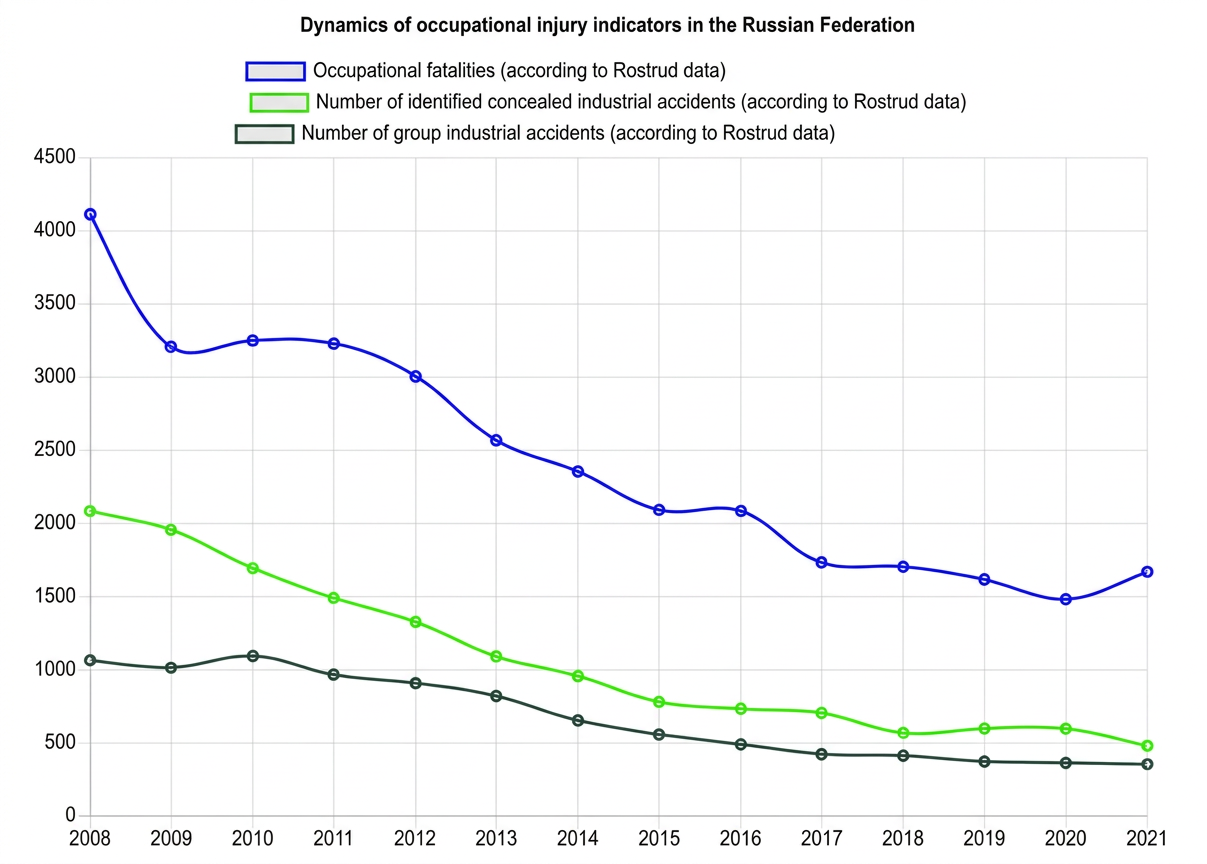
However, it is worth noting that by the end of 2021, a reversal in the trend of reducing injuries is visible. This spike may be related to the COVID-19 pandemic and new realities in the organization of business processes. I hope that during 2022 – 2023, companies and employees have learned to work under the new conditions, and the injury rate will continue to decline.
As we can see from the statistical data, despite "proactive" work on risk identification and assessment and the application of the "Vision Zero" concept, accidents, unfortunately, still occur. In absolute numbers, this is about 21,000 people, including approximately 1,200 fatal accidents (Rosstat data for 2021).
It follows from the above that the problem of workplace injuries remains relevant. And we, as HSE specialists, must make every possible effort to ensure that the number of accidents and their severity decrease.
If we consider injuries from the perspective of consequences, leaving aside regulated interactions with government agencies and legal costs for payments to the victim, the following risks for the employer should be highlighted:
- loss of working time (downtime of equipment/site/mine, etc.), i.e., lost income.
- criminal prosecution of the manager.
- loss of image / company reputation — which at first glance may seem like an insignificant risk, but in reality carries a high risk of increased costs and lost profits (for example, lack of candidates for vacancies or loss of business partners).
- loss of contracts with large companies as a result of failing audits (a common practice in large and European companies).
And risks for the employee:
- disability / loss of work capacity. It goes without saying that most infrastructure facilities are poorly adapted for people with limited mobility; most daily, routine tasks that we perform without thinking are a serious challenge for them.
- loss of job, stable income / problems finding work. It is no secret that employers are reluctant to hire people with disabilities, and an employee who has become disabled cannot always keep their previous position.
- loss of health, psychological problems.
Incidents do not happen out of nowhere; there are always prerequisites, various environmental and production factors, i.e., hazards. And if we add the human factor to these hazards, they turn into risks.
These prerequisites can be clearly demonstrated using the "Swiss Cheese" model proposed by James Reason. As seen from the model, for a risk to materialize, a series of circumstances must coincide, or it can be said that a hazard passed through a series of barriers, and only then did an incident occur.
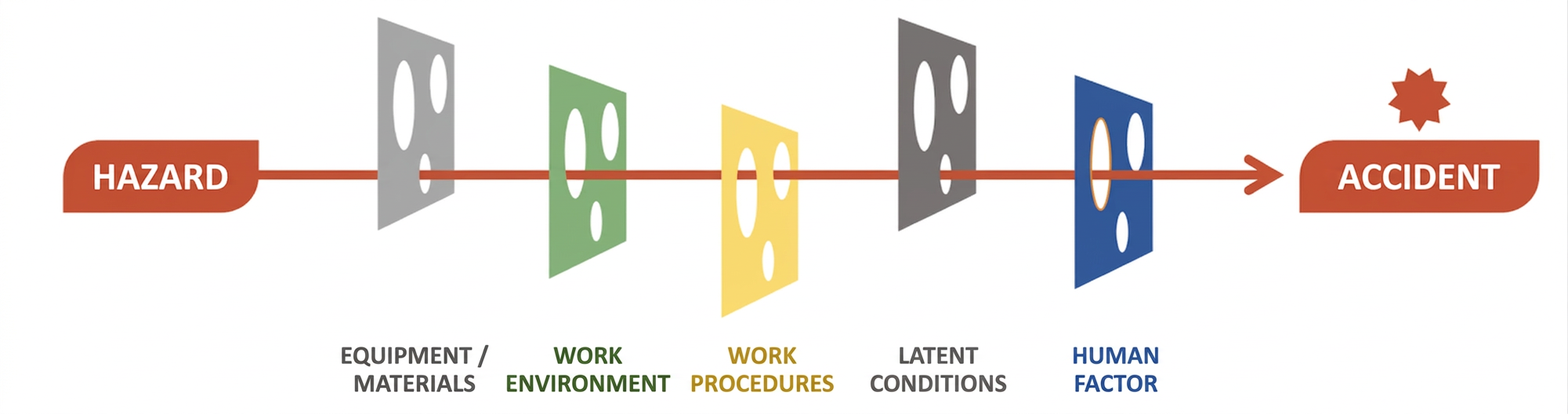
"This incident could have been prevented," "We've always done it this way," etc. — you might have heard these phrases from managers, foremen, and injured workers. Unfortunately, these people did not realize (or realized but did not give due importance) that they were dealing with some risk every day but did not react to it.
This practice is reflected in Heinrich's Pyramid, also known as the accident pyramid. It shows the dependence of severe accidents, which are at the top of the pyramid, on unsafe conditions and unsafe acts. It has been proven that 30,000 unsafe acts and conditions will inevitably lead to 3,000 near-misses, 300 recordable cases, 30 cases of lost work capacity, and one fatality.
To eliminate the top of the pyramid, it is necessary to work with its base — eliminate unsafe conditions and unsafe acts.
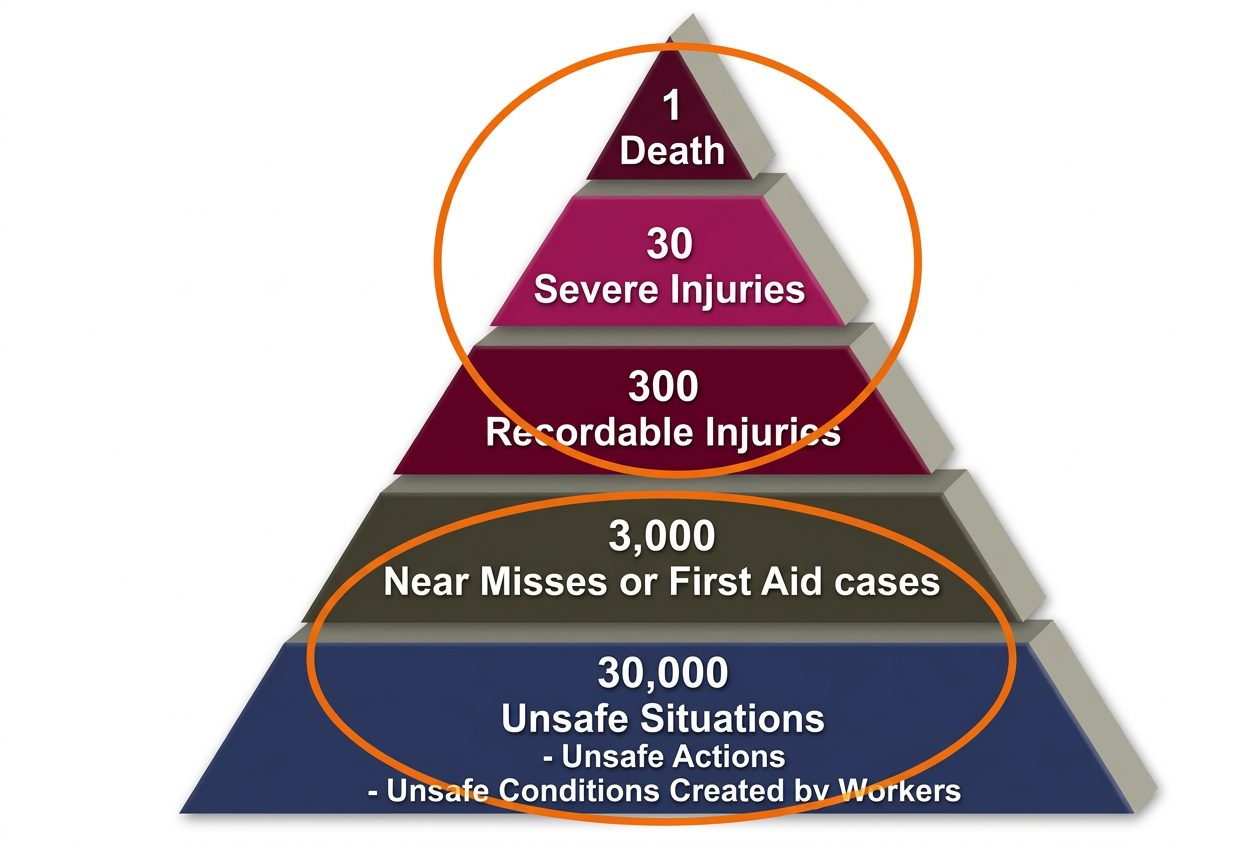
Working to eliminate unsafe conditions and acts before they lead to negative consequences is an example of "proactive" work in the field of occupational safety.
There are quite a few proactive safety practices, and you can choose those suitable for your company. However, one should not forget about "reactive" work, i.e., working with incidents.
I suggest considering the procedure for actions following an accident or other incident related to employee safety. In this work, it is important to move away from formal incident investigations that name the employee as the sole culprit and issue prescriptions in the format of "conduct unscheduled briefing, communicate information about the incident to employees."
It is important to convey to managers and employees that incident investigation is a process of searching for systemic causes and developing corrective measures aimed at their elimination, rather than searching for the guilty.
The goal of incident investigation in this approach is to eliminate the risks that led to the industrial safety incident or minimize their impact if their source cannot be eliminated, as well as to prevent the recurrence of incidents.
In the next article, we will look at which tools and methods will help identify true (root) and systemic causes.