Incident Investigation: Tools and Methods
Incident investigation is a complex process that requires a thorough approach to analysis and the correct evaluation of the data obtained. For a high-quality incident investigation, several tools and methods can be used to help identify root and systemic causes.
Applying these tools will help you systematize the investigation process, formulate the problem, and identify ways to solve it.
First tool: The 5W&1H analysis method.
This method is useful for analyzing a problem, considering it from various perspectives, and finding new, effective solutions.
The essence of the method boils down to the sequential posing of questions: What?, When?, Where?, Who?, Why?, and How?, and recording the answers to them.
Detailed, comprehensive, specific, and original answers to these questions allow for a more complete analysis of the problem, opening up additional opportunities and achieving significant progress in its resolution.
Main stages of applying the method:
- Define the problem or formulate the task.
- Sequentially ask and provide expanded answers to standard questions.
- Record all emerging ideas, summarize, and select the most successful ones.
- If necessary, ask a series of additional and expanded questions.
Below are examples of questions that can be used for a detailed description of the situation:
|
What? |
Any differences from the normal/standard state |
|
When? |
Any information regarding time/duration |
|
Where? |
Any information regarding location/site |
|
Who? |
Any information regarding employees/participants |
|
Why? |
Any information regarding conditions/parameters, possible causes |
|
How? |
Any information regarding the circumstances of the event/problem |
A more detailed list of questions:
|
What? |
When? |
Where? |
| What is it? What is happening/happened? What is interfering? What is the most important thing in this situation? What else could happen? What is the alternative? |
When does it happen? When does it not happen? When did it happen? When should or shouldn't it happen? When (under what conditions) does it happen? When is the peak/decline? |
Where did it happen? Where on the equipment, in the room, in the process? Where were the employees? Where were the signs of the problem? Where else could it have happened? Where can information be obtained? |
|
Who? |
Why? |
How? |
|
Who did it? Who participated? Who was nearby (saw, heard)? Who is interfering/helping? Who is influencing? Who can be an expert? Who is interested? |
Why is this happening? Why "What"? Why "When"? Why "Where"? Why "Who"? Why exactly like this? Why is this important? Why does it influence? |
How did it happen? How else could it have happened? How to fix/solve it? How many? How often? How to use this? |
Second tool: 4M analysis.
This method has several names: Fishbone, Ishikawa diagram, and is a graphical way to research and determine the most significant cause-and-effect relationships between factors and consequences in the situation or problem under study.
The method is used for a systematic search for all possible causes of a problem. According to this method, all possible causes of occurrence/influence on the problem are divided into 4 groups:
- 1M – Machines
- 2M – Materials
- 3M – Methods
- 4M – Men (People)
Sometimes two more Ms are added to the analysis:
- 5M – Mother Nature (Environment)
- 6M – Measurements
The graphical representation of the method looks as follows:
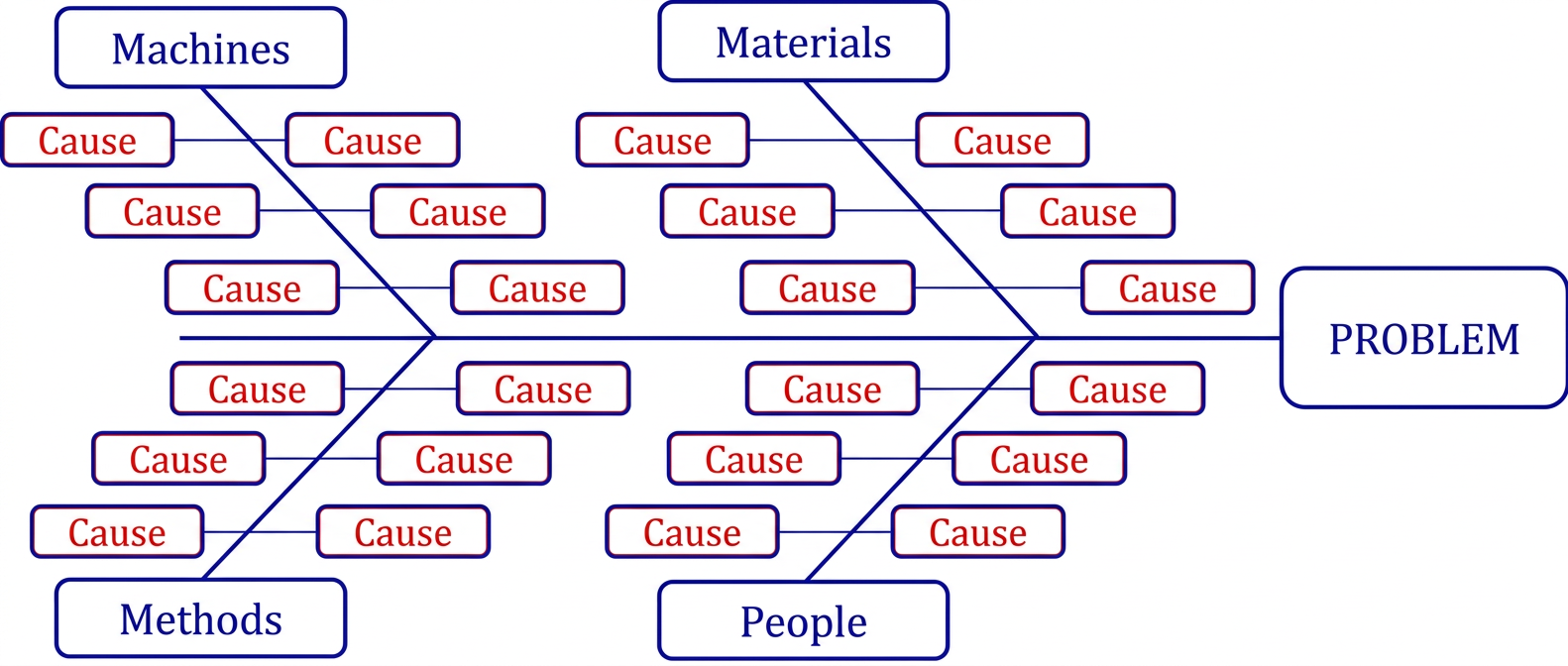
Advantages of the method:
- Helps focus on the content of the problem;
- Provides a good basis for discussion on various causes of the problem;
- Allows for grouping causes into independent categories;
- Focuses on finding causes rather than symptoms;
- Well-suited for group discussion, creating a result of collective knowledge;
- Is easy to learn and apply.
| MACHINES | MATERIALS |
|
- Does the equipment meet product/process requirements? - Does the equipment provide process and quality capabilities? - Is the equipment properly lubricated? - Is the equipment properly inspected? - Is the equipment properly maintained? - Is the equipment free of breakdowns and in good condition/without stops? - Is the equipment capable of providing the necessary accuracy? - Is the equipment without deviations and correctly set up? |
- What are the material requirements? - Is the quantity of material correct? - Is the quality (grade) of the material appropriate? - Is the brand of material appropriate? - Is the material uncontaminated? Free of impurities? - Is the material stacked in the correct quantity? - Is the material contaminated before/during use? - Is the material stored correctly before/during use? - Are materials correctly distributed at the point of use? - Is the quality of materials satisfactory? - Is their location at the point of use convenient? - Are materials protected from damage at the point of use/transportation/storage? |
|
METHODS |
MEN (PEOPLE) |
|
- Are work standards/instructions satisfactory? - Are they current/updated? - Are the work methods safe? - Are the work methods capable of ensuring appropriate quality? - Are the methods effective? - Is the sequence of work convenient/capable of ensuring quality? - Is the product transition satisfactory? - Are the temperature and humidity suitable? - Are ventilation and lighting appropriate? - Are interactions between previous and subsequent processes sufficient? |
- Who influenced/provoked the problem? - Who solved/eliminated the problem? - Do employees follow instructions? - Do employees work efficiently? - Do they care about possible problems? - Do they have a sense of responsibility? - Do they have the appropriate qualifications and skills? - Are they experienced? - Are they correctly assigned to work in these positions? - Do they want to improve the situation? - Are there good relationships within the team? - Do employees have appropriate health (physical abilities)? |
After recording all the causes, they need to be verified. After verification, some should be kept, and others excluded.
Third tool: 5 Whys analysis.
The 5 Whys analysis technique was formally invented by Sakichi Toyoda and used at Toyota during the evolution of their manufacturing methodologies. It is a core component of problem-solving training conducted as part of the Toyota Production System immersion program. The creator of the Toyota Production System, Taiichi Ohno, described the 5 Whys method as "the basis of Toyota's scientific approach... by asking why five times, the nature of the problem as well as its solution becomes clear."
The main task of the method is to find the root cause of a problem by repeating the single question "why?". Each subsequent question is asked based on the answers to the previous question.
The number "5" was chosen empirically and is considered sufficient to find solutions to typical problems. The method does not offer rigid rules or restrictions, such as what questions to ask or how long to continue asking to find additional causes.
Graphically, the analysis can be presented as follows:
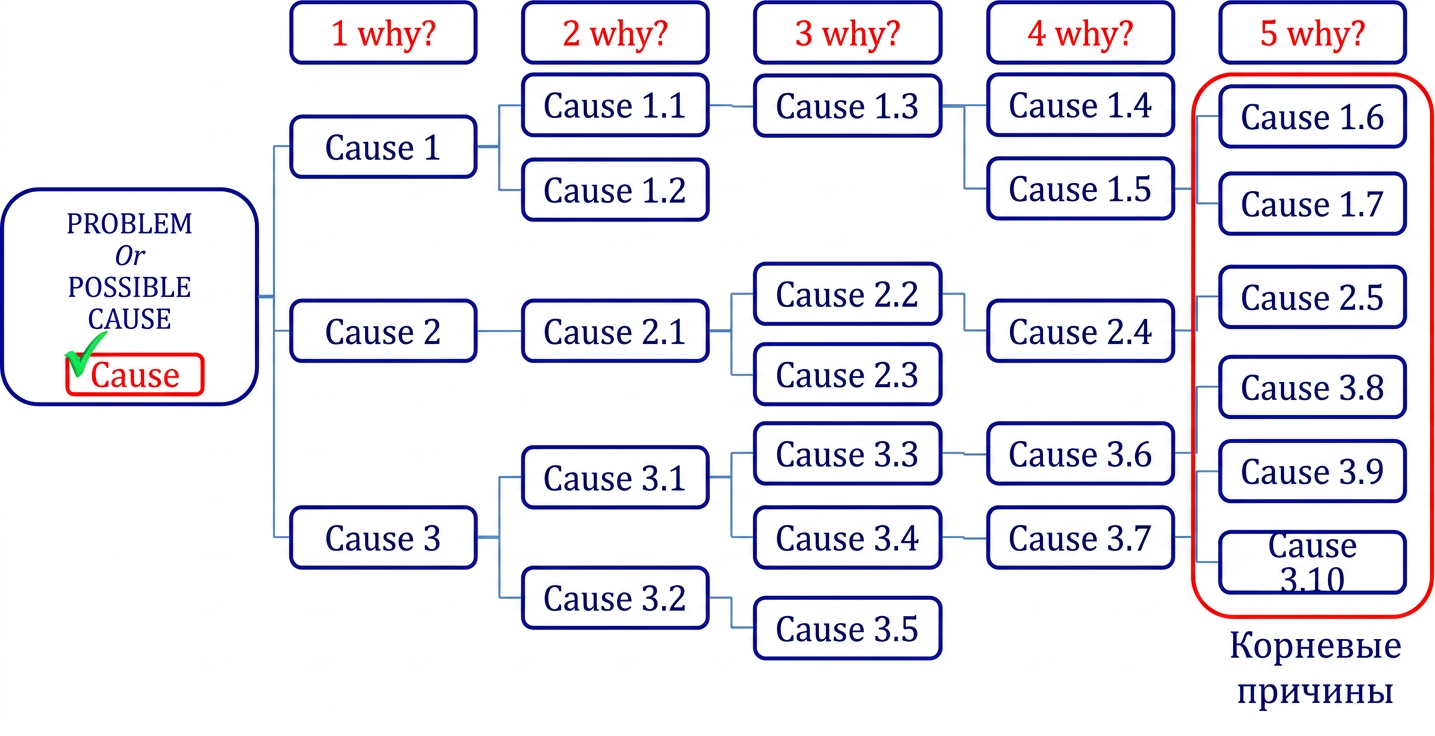
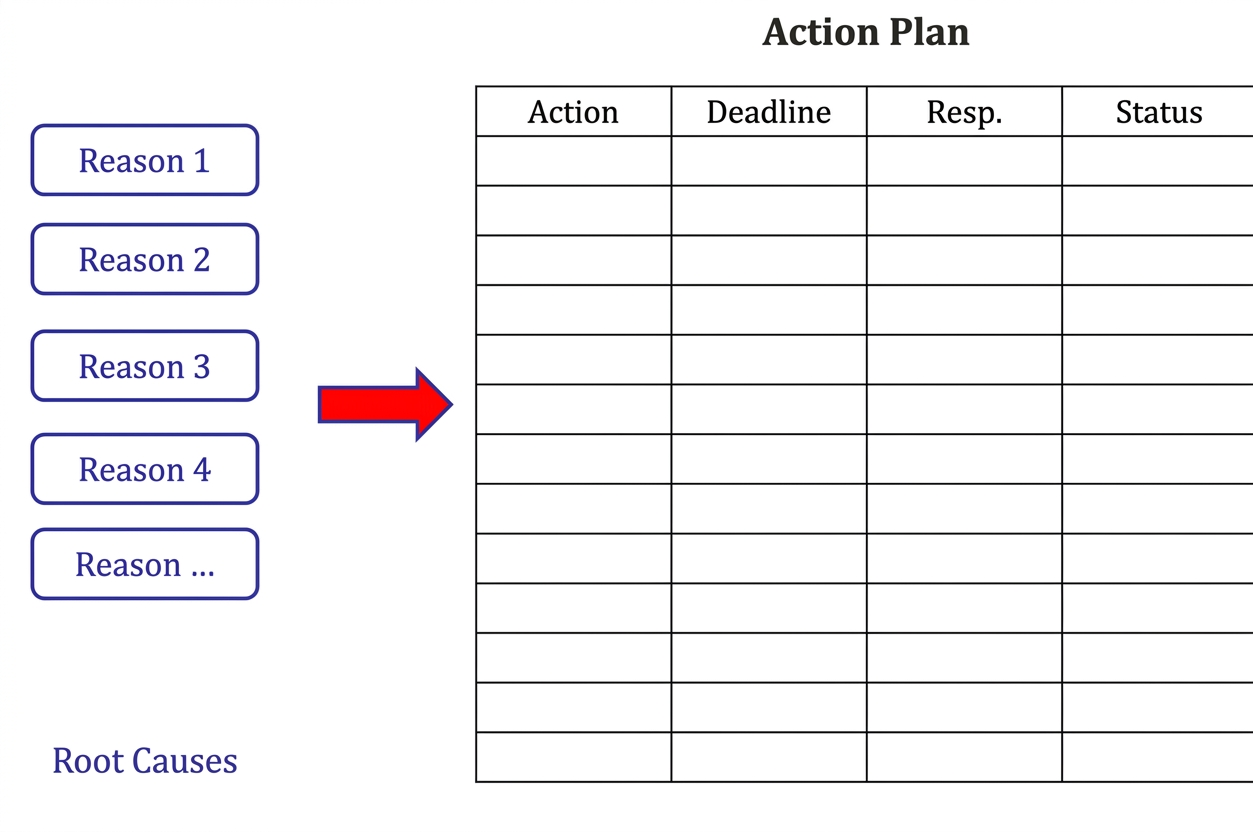
During the analysis, some causes may be excluded. After identifying the root causes of the incident, it is necessary to develop a corrective action plan specifying responsible parties and deadlines.
For a comprehensive incident investigation in the field of safety, these methods should be used sequentially: clearly formulate and describe the problem using the 5W&1H method, distribute possible causes into groups using 4M analysis, and work through the causes using the 5 Whys method.
In conclusion, it is worth adding that these methods are applicable in any situation and provide an opportunity to evaluate it from all sides. The sequential application of these methods allows for a systematic investigation and the identification of the true causes of an incident. When investigating an incident, it is necessary to work in a team, involving specialists from related departments (engineering, production, quality service, etc.). The results of the incident investigation and its circumstances must be communicated to all interested parties.