Quality and Safety – Similarities and Differences. Safety Culture
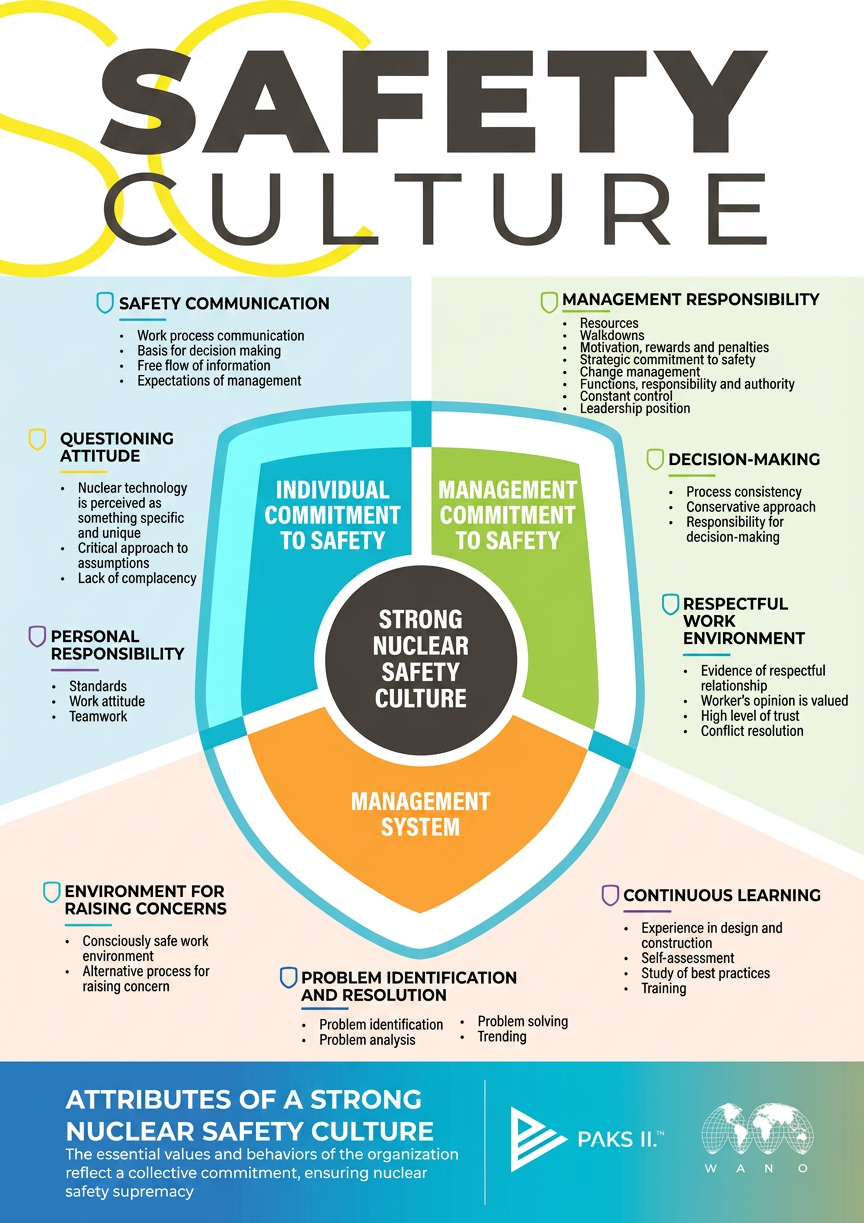
Safety in the nuclear sector is ensured by fulfilling mandatory requirements across four elements: technology; management systems; highly qualified personnel, including leadership; and the development of a safety culture, which is highlighted as a separate area.
According to the IAEA and other nuclear regulatory bodies (in Russia, this is Rostechnadzor), an organization's activities in the field of nuclear energy use must be suspended if safety culture requirements are not met... Such requirements are legally established in many countries worldwide, and the procedure for their implementation is linked to a set of characteristics and features of organizational activities and individual behavior. These establish that safety issues, as a top priority, receive the attention determined by their significance.
While suppliers previously spoke about ensuring the quality of products (services) and/or processes, now, in most countries, including the Russian Federation, customers are increasingly leaning towards prioritizing safety, including through the development of a safety culture as applied to any human (and organizational) activity.
In my opinion, quality assurance is merely a demonstration and confirmation to the consumer of the expected properties of products or services, based on evidence of monitoring the fulfillment of the customer's basic requirements. However, these are only part of the engineered safety requirements. At the same time, safety assurance processes must additionally take into account: risks; physical, environmental, and human factors; the influence of various management systems, infrastructure, technologies, and equipment; the social environment surrounding the individual, and more. By fulfilling quality requirements, we can speak of meeting, in my view, 10-20% of the requirements that relate to the entire array of design safety requirements, but this is, of course, only an approximate assessment of the role of "quality."
Unfortunately, safety culture is still insufficiently developed in most sectors of the Russian economy. Sometimes, managers treat it with disdain, unwilling to spend time and resources on forming new ("necessary") values, safe thinking skills, and behavior among their employees. Often, in some organizations, results are achieved only through the "fear of punishment" (while simultaneously lacking trust, openness, fairness, a culture of truth and non-punishment, "short power distance," etc.). As my nearly 40 years of experience in production business and project management has shown, such enterprises will not be able to maximize all their capabilities necessary to achieve the greatest success, for example, by encountering hidden or open resistance, opposition, and even sabotage by personnel on the ground.
Our experience and research have shown that the best proactive tools and methodologies of a strong safety culture allow for a significant increase in personnel engagement in ensuring safety, including the implementation of improvements — in contrast to the results obtained in companies operating in an "atmosphere of fear."
In my opinion, in the future, amidst the growing global crisis in the economy, power, and society, with limited resources, and due to the decline in human capabilities to increase productivity because of harsh exploitation — a strong (developed) safety culture will become one of the main foundations for ensuring all types of safety, commensurate with the generally accepted understanding of the need for developed management systems for success. I hope that in most companies, results will be influenced not by fear, but by the shame or conscience of a person working creatively and with pleasure, creating products or services for the end consumer in society.